






- expanding Guyana’s renewable energy capacity
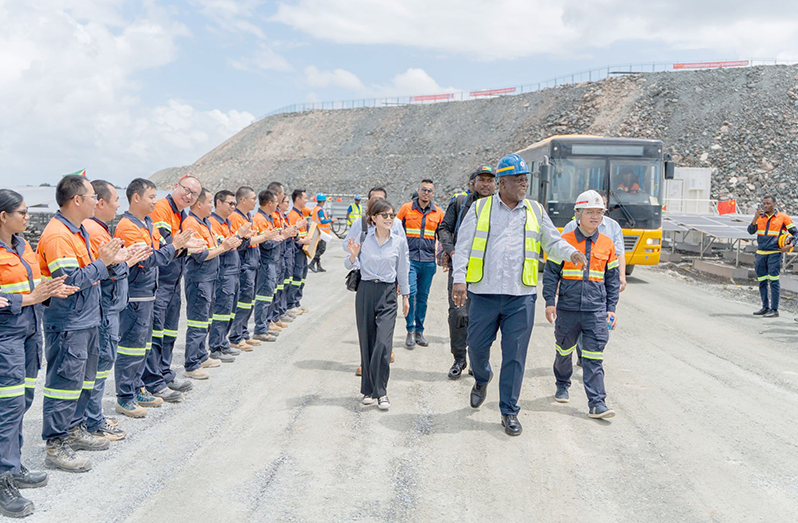
PRIME Minister Brigadier (Ret’d) Mark Phillips officially commissioned the Aurora Solar Farm at the Aurora Gold Mine (AGM) site in Region Seven on Wednesday, marking a significant milestone in Guyana’s transition to clean and sustainable energy.
The expanded facility now boasts nearly 50 megawatts of installed solar capacity, supported by approximately 82 megawatt-hours of battery storage, providing a stable and reliable power supply for one of the country’s largest interior industrial operations.
Speaking at the ceremony, Prime Minister Phillips emphasised the strategic shift from diesel-based power generation to renewable energy.
“This project represents a clear step forward in how energy is produced and managed at one of Guyana’s interior industrial sites. It reflects a shift from a model that depended entirely on diesel generation to one that integrates large-scale solar power and battery storage into a single, coordinated system,” he said.
The Aurora Gold Mine, located roughly 170 kilometres west of Georgetown and 130 kilometres northwest of Bartica, has historically relied on on-site diesel generators. This arrangement brought logistical challenges, fluctuating costs tied to global fuel prices, and environmental concerns linked to fuel storage and combustion.
The solar initiative at Aurora began in 2023 with a 3-megawatt solar system and 2-megawatt battery storage to power campsite operations. Phase I, completed in September 2024, added 15 megawatts of solar capacity with 20 megawatt-hours of storage at the Mills facility, generating over 21.5 million kilowatt-hours of electricity.
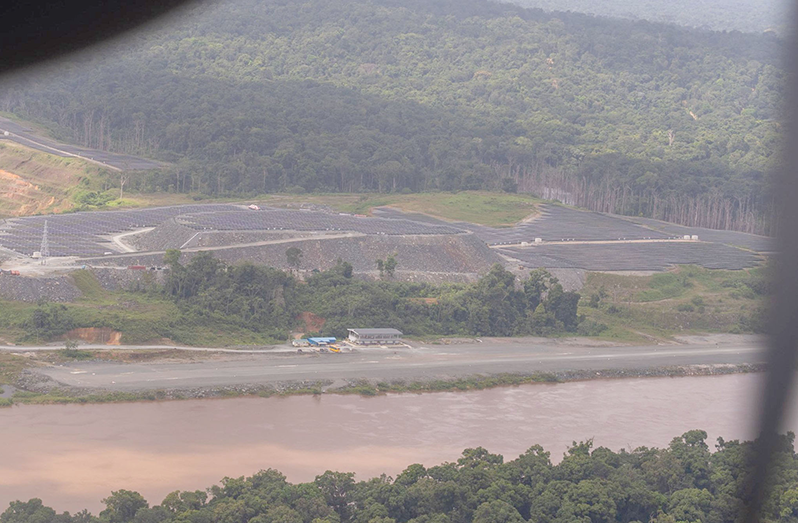
Phase II, finalised in 2025, expanded the system with an additional 30 megawatts of peak solar capacity and 60 megawatt-hours of battery storage. The integrated system now balances generation and storage in real time, supplying approximately three-quarters of the electricity required by the concentrator—the mine’s most energy-intensive operation.
The solar installation is projected to generate 60 million kilowatt-hours of clean electricity annually, reducing carbon dioxide emissions by over 46,000 tonnes per year while also lowering sulphur and nitrogen oxide emissions.
Beyond environmental benefits, the Aurora Solar Expansion Project has contributed to local employment and skills development. Approximately 100 Guyanese workers were engaged during construction, gaining experience in electrical work, equipment operation, and renewable energy system management.
“Workers received on-the-job training in battery storage technology and microgrid management, skills that will remain relevant as Guyana expands its renewable energy sector,” the Prime Minister noted.
The Aurora Solar Farm aligns with Guyana’s Low Carbon Development Strategy 2030, demonstrating how large-scale renewable energy can be deployed in remote industrial locations. It complements other government initiatives, including the Guyana Utility Scale Solar Photovoltaic Programme, aimed at diversifying the energy sector and improving system resilience.
“The development at Aurora shows how renewable energy can be integrated into existing systems, stabilising supply in remote environments while maintaining industrial productivity,” Prime Minister Phillips said.
The Prime Minister expressed gratitude to AGM Inc., Zijin Longking Clean Energy, and other stakeholders, while highlighting the enduring cooperation between Guyana and the People’s Republic of China.
“This facility is already producing tangible results—generating electricity, reducing fuel imports, improving efficiency, and supporting the transition to cleaner energy. As Guyana marks its Diamond Jubilee, investments like this reflect a country building sustainably with long-term value in mind,” he said.
The Aurora Solar Farm commissioning represents a major achievement for Guyana’s renewable energy landscape, illustrating how innovation, partnerships, and strategic investment can drive sustainable development in remote regions.



