






— ExxonMobil Guyana president says
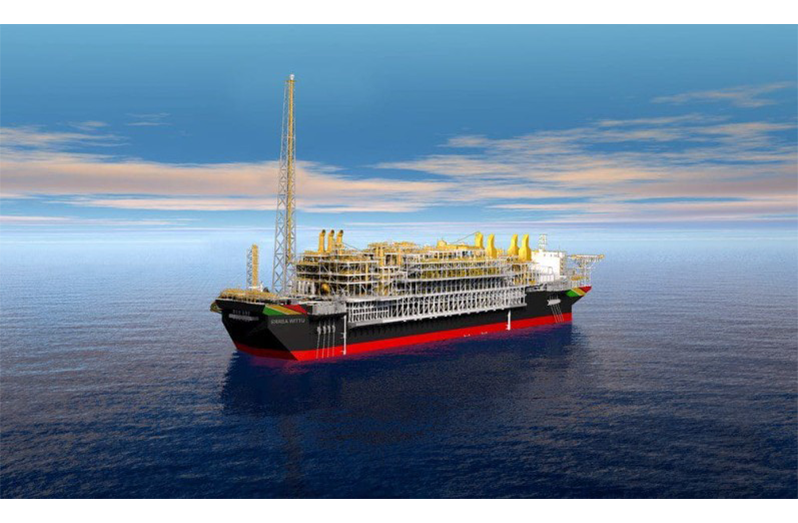
EXXONMOBIL Guyana’s Uaru development is “on track” to significantly boost the country’s oil production capacity, with the Errea Wittu Floating Production, Storage and Offloading (FPSO) vessel expected to take Guyana’s daily output beyond the one-million-barrel mark when it comes on stream.
President of ExxonMobil Guyana, Alistair Routledge, said during a press briefing on Thursday that the Uaru project is progressing “ahead of schedule” and within budget, with first oil anticipated before the end of this year.
“The Uaru project is making excellent progress,” he said, noting that the development continues the company’s trend of delivering projects efficiently in the Stabroek Block.
FPSO NEARING COMPLETION
The Errea Wittu FPSO, currently under construction in Singapore, is “almost complete”, with the majority of its modules already installed on the topsides.
Integration works are now ongoing, focusing on pipework and electrical systems to ensure seamless operation ahead of deployment.
“We anticipate later this year, the FPSO will sail to Guyana and before the end of the year, we expect Uaru to start up,” Routledge said.
Once deployed, the vessel will be anchored offshore and connected to a network of subsea wells, marking the final phase before production begins.
The Errea Wittu is designed to produce up to 250,000 barrels of oil per day, with a storage capacity of approximately two million barrels of crude. It will operate in water depths of around 1,690 metres, underscoring the technical complexity of Guyana’s offshore developments.
The vessel’s name, derived from the Warrau language, translates to “abundance,” a reflection of the scale of resources being unlocked in the Stabroek Block.
The Uaru development represents the fifth sanctioned project in the Stabroek Block and is being executed by ExxonMobil Guyana, which holds a 45 per cent stake, alongside partners Hess Guyana Exploration (30 per cent) and CNOOC Petroleum Guyana (25 per cent).
The FPSO is being constructed by Japanese firm MODEC.
Routledge also highlighted that offshore well development is advancing in parallel, with 22 development wells already completed, ensuring that sufficient capacity will be in place to support production at start-up.
The project is now entering its final installation stage, which includes the deployment of subsea umbilicals, risers and flowlines. These systems will connect the FPSO to the wells, enabling production to commence.
“We are preparing for the final season of installation… culminating in anchoring the FPSO and connecting it to the wells,” Routledge explained.
With Uaru expected to deliver up to 250,000 barrels per day at peak, its start-up will mark a major milestone in Guyana’s oil trajectory, pushing total national production beyond one million barrels per day.
The development reinforces Guyana’s position as one of the fastest-growing oil producers globally, while continuing to expand the scale and efficiency of operations in the Stabroek Block.
As Routledge noted, the project is not only progressing smoothly, but also doing so ahead of both schedule and budget, signalling sustained momentum in the country’s offshore energy sector.




