





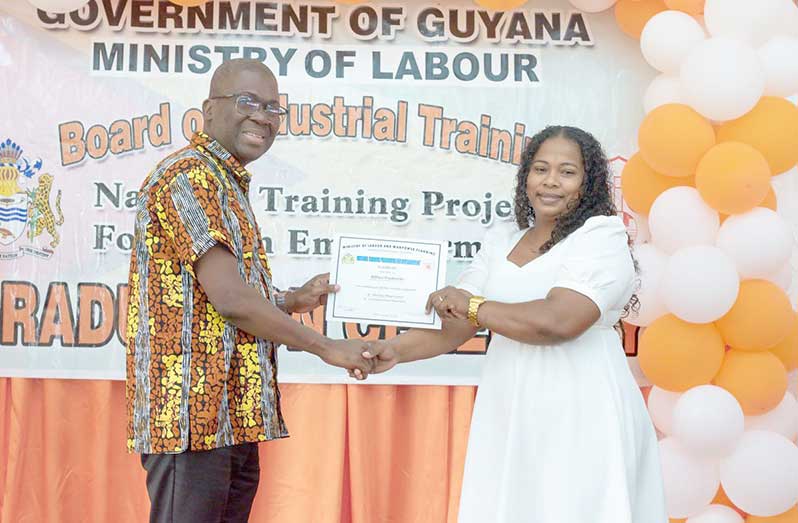
MORE than 1,700 residents of Region Two have been equipped with critical job skills over the past five years, as the Government of Guyana intensifies efforts to expand its skilled workforce and drive economic development across the Essequibo Coast.
Data from the Board of Industrial Training (BIT) shows that between 2020 and 2025, a total of 1,729 persons successfully completed training programmes in 30 occupational areas, backed by an investment of approximately $226.9 million.
The initiative, implemented through the Ministry of Labour and Manpower Planning, targeted both technical and service-oriented fields, reflecting a balanced approach to workforce development.
Of those trained, 871 were male and 858 female, highlighting near gender parity in access to skills training.
TRAINING EXPANSION PEAKED IN 2023
The programme saw its most significant expansion in 2023, when 646 individuals were trained across 51 projects at a cost exceeding $77 million. This marked a sharp increase compared to earlier years, with just 84 persons trained in 2020 at a cost of $6.8 million.
Training numbers remained strong in subsequent years, with 452 beneficiaries recorded in 2025 and 215 in 2024, indicating sustained government investment in human capital development.
Participants were trained in a diverse set of disciplines, including high-demand technical fields such as welding and fabrication, electrical installation, heavy-duty equipment operation, and motor vehicle repairs. At the same time, programmes in cosmetology, garment construction, commercial food preparation, and office administration catered to service-based and entrepreneurial opportunities.
Welding and fabrication emerged as one of the most popular areas, with 210 trainees, followed by electrical installation (187) and commercial food preparation (177). Notably, some fields displayed strong gender trends—cosmetology and garment construction were dominated by female participants, while heavy-duty and mechanical trades saw higher male participation.
At the recent graduation exercise, trainees received certification in key areas including heavy-duty equipment operation (20 graduates), tractor driving (30), commercial food preparation (55), and welding and fabrication (10).
Officials say these programmes are designed to directly align with labour market needs, ensuring that graduates can transition into employment or entrepreneurship.
A notable feature of the programme is its community-based delivery model. Training was conducted through partnerships with local democratic councils, schools, technical institutions, and private entities across villages such as Charity, Anna Regina, Wakapoa, and St. Monica.
Institutions like the Essequibo Technical Institute and several village councils played a central role in delivering courses, ensuring accessibility for residents in both coastal and riverine communities.
BUILDING A SKILLED WORKFORCE
The sustained investment underscores government’s broader strategy to build a resilient and adaptable workforce capable of supporting national development.
By combining technical training with community outreach, the initiative is not only improving employability but also fostering small business development and self-sufficiency across Region Two.
With hundreds more expected to benefit from ongoing programmes, officials anticipate that skills training will continue to play a pivotal role in transforming livelihoods and strengthening the region’s economic future.
BIT’s Chief Executive Officer, Richard Maughn, said the programme has maintained near gender balance and has contributed to tangible social and economic advancement.
“That is not just a statistic, that is impact,” he said, pointing to outcomes such as increased entrepreneurship, certified technical workers, and improved household stability.
He noted that BIT’s training programmes are aligned with national development priorities, particularly in sectors such as oil and gas, construction, agriculture and agro-processing, and emerging green industries.
“We are not just training people, we are preparing a workforce,” he said.





