







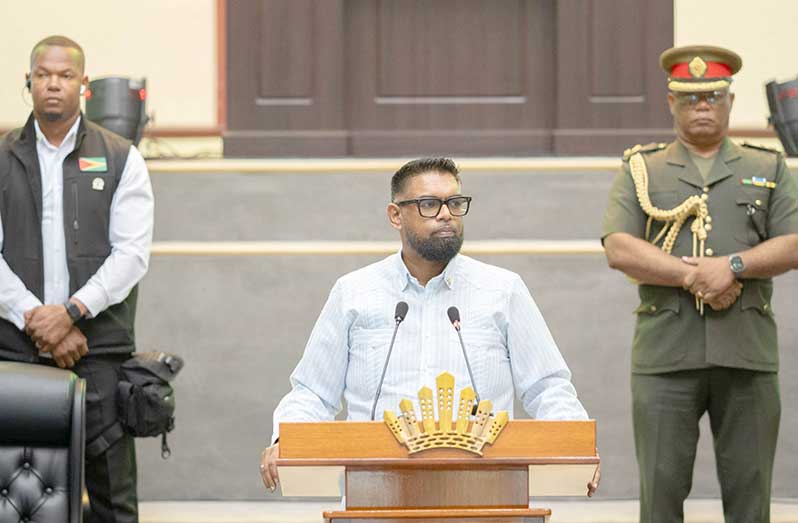
–President Ali tells senior officers conference
REDEFINING the roles of civil society, the religious community and judicial systems could drive significant changes in the Caribbean’s prison services, particularly in addressing longstanding structural fragmentation.
This was according to President, Dr Irfaan Ali during his address at the opening ceremony of the Guyana Prison Service Senior Officers Conference, on Monday,
He said that while investments to improve the infrastructure of prison services are necessary, greater integration of social and judicial organisations are needed to build an architecture that is effective and efficient.
“I believe for too long, our approach to the prison service has been fragmented and segmented,” the President said, adding: “We must start looking [to] redefine the role of civil society, the religious community, the education system, inspirational groups, development groups, influencers. We have to look at that, and we must integrate these systems and organisations into the overall architecture.”
He said that an effective prison service depends not only on internal management but also on the efficiency of prosecutors, the judiciary and law enforcement, all working together through integrated case and prison management systems.
Dr Ali related: “Why should we transport a high-profile prisoner for 15 miles in traffic and in everything else, sometimes disrupting the entire city to get to a magistrate court, when technology allows us to move the prisoner from a cell to a courtroom right in the same compound.”
He stressed that technology, infrastructure and human capital must work simultaneously to support a modern and effective prison service.
“You have to get an integrator coming up with new rules, new procedures, building out the facilities to accommodate all those who must come in, so that we can have greater efficiency in an integrated system; an integrated system where technology infrastructure and human capital collide with each other to build an efficient, reliable, safe [and] future-driven system,” Dr Ali said, adding: “We have to be able to integrate the two in developing the prison service that is modern, effective and efficient.”
Guyana has maintained the lowest recidivism rate across the Caribbean; with some 1,000 prisoners being exposed to skills training and now have access to the Guyana Digital School.
The country’s recidivism rate stands below 20 per cent. With more than $28 billion being invested into the security apparatus, the country has made significant strides to support a correctional justice system which promotes the reintegration of prisoners into society.
Here in Guyana, prisoners are provided with a toolkit on release from prison, to aid in gaining meaningful employment.
There have also been improvements in infrastructure, training, technology-driven security systems and leadership development.
Additionally, a partnership with the National Data Management Authority (NDMA) and the Guyana Prison Service has seen all personnel files being digitised, while 90 per cent of prisoner records and warrants are now in digital form, with the remaining records expected to be completed shortly.
This modernisation drive is intended to improve the efficiency, transparency, and security of information management within the prison system, creating a more responsive and data-driven corrections environment.



