–announces plans for high-level team to support greater integration of security forces
–Minister Walrond emphasises modern state cannot exist with outdated security institutions
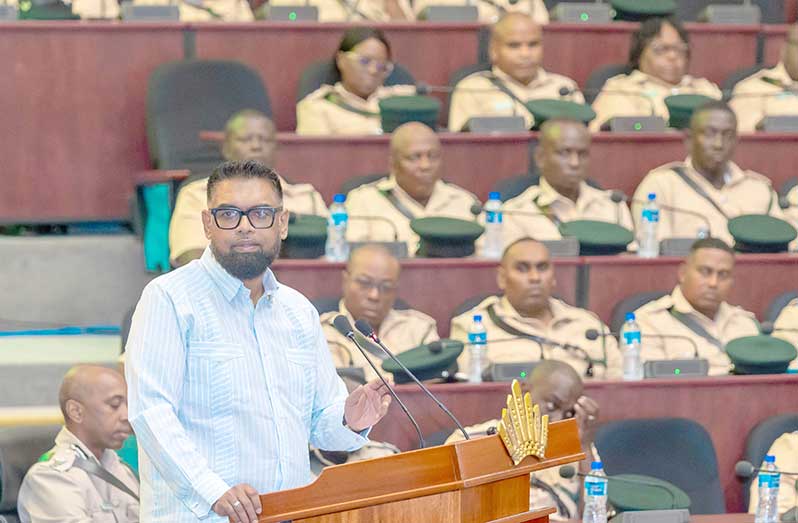
COMMANDER-IN-CHIEF of the Armed Forces, President Dr. Irfaan Ali, has called for a strategic overhaul of the Guyana Prison Service, urging the officers to move from a reactive role to a proactive pillar of national security.
Addressing the opening ceremony of the Guyana Prison Service (GPS) Annual Senior Officers Conference at the Arthur Chung Conference Centre, Liliendaal, on Monday, the President said the country’s approach to security must be unified and collaborative.
He stressed the need for the prison service to play a constructive societal role, proposing the development of a “prison avoidance” system focused on preventing people, particularly young people, from entering the criminal justice system in the first place.
“Over the past five years, we’ve been integrating our systems, integrating our leadership, and building on the success of each other, because that is the only way we can confront the multifaceted nature of the challenges of the future,” he said.
“We talk about rehabilitation, which is important, but before we get to prison, how do we avoid getting there?” he questioned.

To this end, Dr. Ali announced that in the coming weeks, he will announce a high powered group of experienced individuals to guide the integration of systems and lead the implementation of the initiatives outlined.
He emphasised that the Guyana Prison Service is an integral part of the nation’s security architecture, and must be afforded equal standing alongside the police and defence forces as it works to secure the country and reshape outcomes in communities
“Today, I want to spend some time speaking about what we want to create and how do we go about creating an institution that is not only reactive, but one that will play a proactive role,” he said, noting that the security apparatus can play a greater role in shaping more positive outcomes, especially in vulnerable communities.
CRIMINAL NETWORKS
President Ali further warned of migrating criminal networks seeking to recruit persons who are vulnerable.
He cautioned that youths, especially those who dropped out of school, suffered some form of trauma and live in stigmatised communities, often fall victim to these networks.
“In the long term, the prison service must be redefined and realigned with a heavy focus on avoiding more persons, especially youths entering the system. As pressure grows in other large economies, criminal networks are pressed. When they are pressed, they look for new grounds,” Dr. Ali said.
He noted that data and key analysis from these vulnerable groups and areas will be crucial in first adopting a system that prevents persons from entering the criminal justice system.
The President said: “We have to identify where those grounds are. And here in Guyana, we know with the growth in the economy, there is a natural attraction. How do we prepare for that? How do we analyse the data?”
He added: “I hope that at this level, we are having access to that data that allows us to do the analysis so that we can craft measures based on paper, based on reality, based on the awareness of what surrounds us.”
SECURITY AND REHABILITATION
Home Affairs Minister Oneidge Walrond highlighted the conference’s theme, “Fostering growth, driving synergy and securing the future of corrections,” as central to the country’s wider national security agenda.
She stressed that a “modern state cannot exist with outdated security institutions,” noting that for too long, corrections have been treated as the “forgotten arm” of the justice system.
The minister noted that under the leadership of President Ali’s administration, billions of dollars are being invested across the security sector in new infrastructure, training, technology-driven security systems and leadership development.
She said: “The transformation of the Guyana Prison Service is not accidental. This transformation is the result of memory policy decisions by this government to strengthen and modernise our institution.”
Strong emphasis was placed on rehabilitation as a smart security policy, with the government expanding vocational training, education, psychological and social support, and reintegration programmes for inmates. Security and rehabilitation, Minister Walrond stressed, are “two sides of the same strategy”.
“Security without rehabilitation creates a revolving door. Rehabilitation without discipline creates instability. A modern correctional service must combine both,” she added.