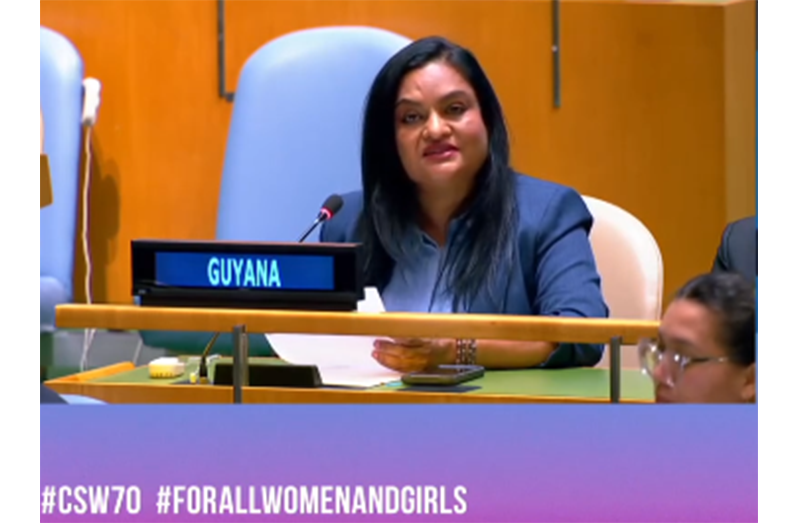
–Dr Persaud tells global stakeholders
GUYANA’S “legal architecture” continues to be modernised to enable access to justice for women and to dismantle structural barriers, according to Minister of Human Services and Social Security, Dr Vindhya Persaud.
Dr Persaud emphasised Guyana’s work during her remarks at the General Discussion Of The 70th Session on the Commission on the Status of Women, which was held under the theme: Ensuring and strengthening access to justice for all women and girls, including by promoting inclusive and equitable legal systems, eliminating discriminatory laws, policies, and practices, and addressing structural barriers.
Acknowledging that globally, women are still facing challenges when it comes to fair access to justice, the minister noted that Guyana is working extensively to break down these barriers.
“Guyana is dismantling structural barriers and closing legal gaps through the enactment of progressive legislation; education on laws and rights; provision of free and subsidised legal services for women and partnerships with civil society. Our legal architecture is being continuously modernised to improve access, including through digital transformation and the establishment of new and specialised courts,” the minister said.
The minister, in her statement, emphasised that the conversation regarding accessibility to justice for women is still pertinent.
Dr Persaud said for too many women and girls, the doors to justice remain closed and the silence of systems that were never built with them in mind is loud.
Highlighting the grave effects of increased armed conflicts around the world, the minister pointed out that more women and girls are being killed, raped, starved or treated to the worst indignities, underscoring that “impunity fuels continued violence.”
“We must hold perpetrators accountable. It is unacceptable that women remain locked out of most peace processes, relegated to the roles of victims without agency to effect change,” Minister Persaud said, while also making the call for co-operation to achieve peace, protection for all and development.
The minister made it clear that access to justice is fundamental in order to achieve gender equality, noting that legislation must be accompanied by education on rights, access to affordable legal services, effective law enforcement and timely and reasoned judicial action.
Turning her attention to the strides that Guyana has made in bridging that gap between women and access to justice, she first pointed to the amendments made to the Family Violence Act (2024), which expands definitions of violence to include economic and psychological abuse and improved protections for survivors.
“We are seeing positive results from integrated systems of support, including Hope and Justice Centres, where survivors can access medical care, psychosocial support, legal assistance and safe shelter. We recognise that to achieve inclusive and equitable legal systems, women must lead and participate in legislative and policy reforms, and Guyanese women are leading in both our legal and justice systems,” Dr Persaud went on to say.
She also highlighted that in 2024 the single largest batch of women judges was appointed in Guyana’s history.
Dr Persaud admitted, however, that combating the pervasive harassment and violence faced by women on social media remains a challenge, as despite cybercrime legislation, perpetrators are escaping accountability, hiding behind veils of anonymity and remaining out of reach in foreign jurisdictions.
“International co-operation is, therefore, critical. Tech companies must partner with governments to ensure safe spaces for users and justice for victims,” the minister reasoned.
Additionally, Dr Persaud noted that Guyana’s gender equality and empowerment seal is a “transformational tool” that holds private- and public-sector stakeholders accountable in the provision of equal opportunities for women and promote safer work spaces.
The minister also noted that access to justice and equality for women go deeper as it is also economic.
She noted that 60 per cent of government-distributed housing lands in Guyana are owned by women.
“Guyana’s intentional policy prioritises investments in women’s economic participation, education and integration into the formal economy. In closing, I emphasise that national development is inextricably linked to achievement of equality for women and girls, respect for their human rights and ensuring their access to justice,” Dr Persaud said.