





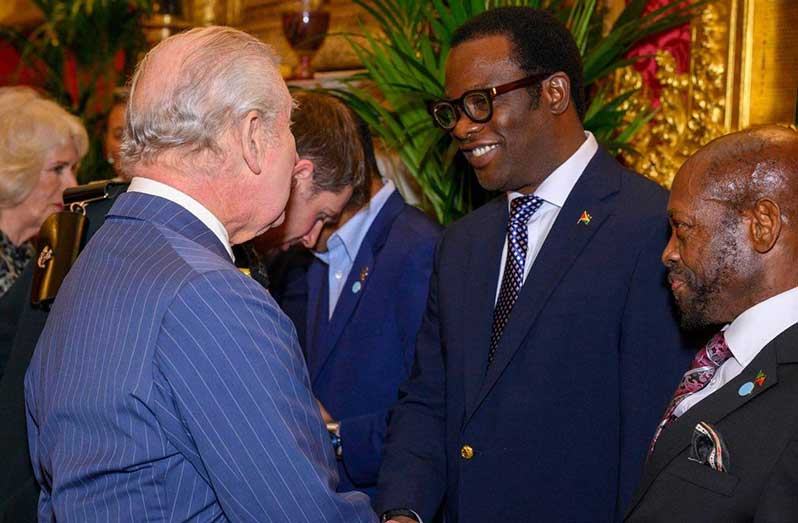
FOREIGN Affairs and International Cooperation Minister Hugh Hilton Todd represented Guyana at the 26th Commonwealth Foreign Affairs Ministers Meeting, held on March 8 at Lancaster House in London.
The meeting was convened under the theme “The Commonwealth at a Moment of Strategic Opportunity” and brought together foreign ministers from across the 56-member bloc to discuss key global and development issues affecting member states.
The engagement was held ahead of the Commonwealth Heads of Government Meeting (CHOGM), which is scheduled to take place in November 2026 in Antigua and Barbuda.
According to a statement from the Ministry of Foreign Affairs and International Cooperation, discussions during the March 8 meeting focused on a range of priority areas including the future of multilateralism, economic diplomacy, trade facilitation, and building resilience among member states.
During deliberations under the Commonwealth Ministerial Action Group, Minister Todd also updated fellow member states on the ongoing Guyana–Venezuela border controversy, providing an overview of developments relating to the territorial controversy.
The Ministry noted that the discussions formed part of broader efforts by Commonwealth nations to strengthen cooperation and position the organisation to respond effectively to emerging global challenges.
The Commonwealth is a voluntary association of 56 member states spanning Africa, Asia, the Americas, Europe and the Pacific, many of which share historical ties through the British Empire. It was formally established in 1949 through the London Declaration, which recognised the British monarch as the symbolic Head of the Commonwealth while allowing member states to remain independent republics.
The International Court of Justice (ICJ) is expected to begin hearings on the merits of the border controversy case between Guyana and Venezuela in May 2026, as parties were notified of this at the end of January last.
In August 2025, Venezuela filed its rejoinder in the ongoing case concerning the Arbitral Award of October 3, 1899.
The Government of Guyana had welcomed Venezuela’s filing, stating that it ensures the court will have “all the factual and legal arguments of both parties” before rendering its judgment.
This, the government noted, will make the ruling “fully authoritative and incontestable.”
Guyana reaffirmed its commitment to resolving the long-standing border controversy peacefully and in accordance with international law.
The case before the ICJ concerns Venezuela’s contention that the 1899 Arbitral Award, which established the boundary between the two countries, is null and void. Guyana has maintained that the award is a valid and binding legal instrument that settled the border over a century ago.
In accordance with the Geneva Agreement, Guyana and Venezuela engaged in over two decades of Good Offices efforts on the border controversy under United Nations’ (UN) Secretaries-General auspices, in an attempt to find a peaceful diplomatic resolution.
However, on January 30, 2018, after the process failed to produce meaningful progress, the UN Secretary-General concluded that the Good Offices-initiative had run its course.
In accordance with Article IV (2) of the Geneva Agreement, he exercised his authority and selected judicial settlement by the ICJ as the next method of resolution.
Guyana, in accordance with the Secretary-General’s decision, filed an application with the ICJ on March 29, 2018, seeking a ruling on the validity of the 1899 Arbitral Award and the boundary it established.
Venezuela, rather than co-operate, challenged the court’s jurisdiction, once again arguing that the Geneva Agreement did not allow for judicial proceedings.
After receiving extensive written submissions from both parties and holding oral hearings in June 2020, the court issued its judgment on jurisdiction on December 18, 2020.
The court found that: “Guyana and Venezuela mutually conferred upon the Secretary-General the authority to choose the means of settlement of the controversy, and on 30th January, 2018, the Secretary-General exercised this authority by choosing judicial settlement before the Court.”
The court affirmed its jurisdiction to hear Guyana’s application regarding the validity of the Arbitral Award and the related issue of the definitive settlement of the land boundary controversy between Guyana and Venezuela.
Guyana has gained international backing, with CARICOM, the Commonwealth, the European Union (EU), the Organisation of American States (OAS), and other global partners reaffirming support for its position.





