






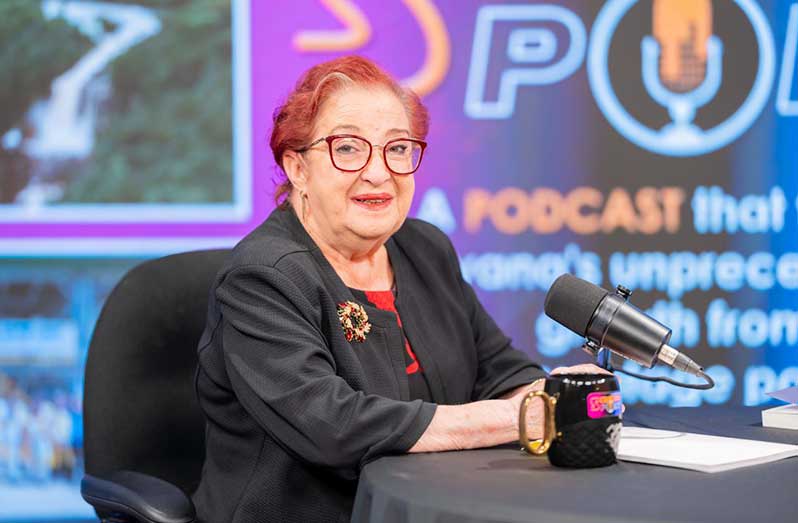
–Teixeira on the fight for Guyana’s Abortion Law
–veteran politician recounts the controversy; historic conscience vote that led to the passage of the Medical Termination of Pregnancy Act in 1995
A SURGE in maternal deaths from botched abortions pushed Guyana towards the enactment of the landmark Medical Termination of Pregnancy Act 1995, which was championed by then Minister of Health Gail Teixeira, who emphasised its impact on reproductive healthcare in Guyana.
With more than 50 years in public service, Minister Teixeira has helped shape national conversations, and stood at the centre of some of the country’s most defining moments.
The minister, during a preview of today’s episode of the ‘Starting Point’ podcast, stated that threats, protests and blood-stained symbols had marked the battle for reform of access to safe abortion care, which, today, has a real impact on people’s lives and health, from preventing unsafe abortions and complications to upholding bodily autonomy.
“I’ll say that if we hadn’t done it, then we wouldn’t be able to do it today,” Minister Teixeira said, emphasising how the Medical Termination of Pregnancy Act is still a critical component.
The World Health Organisation (WHO) defines abortion as the deliberate interruption of an ongoing pregnancy by medical or surgical means.
Reflecting on her entering into office as the Minister of Health, Teixeira disclosed that the infant mortality and maternal mortality was “extraordinarily high”, and abortion was illegal.
These alarming figures led her to set up a technical committee to source the cause of maternal deaths, to which “botched up abortions” as a leading cause was uncovered.
“So, women ended up in public hospitals, haemorrhaging, dying, and so this was the one we could change. And how could we change that?” she asked, answering: “By law. And so, I then set up another committee made up of members of the judiciary, doctors, Christians, Hindus, Muslims, etc…, and eventually they came forward and said, this was something that we should try,” the minister said.
She further noted that the previous Health Minister Dr. Noel Blackman, who served under the People’s National Congress (PNC) administration, had brought a bill for medical termination to his Cabinet. But it was rejected.
Minister Teixeira stated that she looked at the Bill and amended sections she disagreed with.
The minister credited then President Dr. Cheddi Jagan for supporting the Bill and encouraging an inclusive approach.
Teixeira stated that the effort soon expanded beyond party lines and discussions were held with opposition members of parliament including Dr. Faith Harding, who supported the initiative.
For the first time in the history of Parliament, women from different political parties met collectively to discuss reproductive health policy, she said.
“So, we reached an agreement that the next stage from my party and president was go for parliamentary select committee, which is what we did, and that’s when we had hearings with all sorts of stakeholders. And the bill was amended as a result of that. And so, it was built over stages, and of course, it was terribly controversial in certain ranks. I got things sent to me with blood on it, dolls with blood,” the minister said, recalling other intensive public controversy such as protests.
There were protests in Georgetown, and activist groups—including some from the United States—circulated graphic images while campaigning against abortion.
Yet some women confronted protesters with practical questions about childcare and economic realities.
“A number of women said ‘well, you’re going to mine my babies?” the former minister said.
She further recalled: “The day when we read it in the House and it passed, and I was terrified, because the both parties had also decided that we would agree on a vote of conscience. So, the first vote of conscience in the history of our parliament, and the only one, as far as I know, is that one.”
Abortion laws vary widely, ranging from complete prohibition to full access, with about 60 per cent of the world’s population living in places where it is legal on request or for socioeconomic reasons. As of 2026, many US states have implemented bans or severe restrictions following the 2022 overturning of Roe v. Wade.
But in Guyana, it has been legalised since 1995, and there have been numerous efforts and initiatives to further bolster reproductive health for Guyanese women.
In January, Health Minister Dr. Frank Anthony met with members of the Medical Termination Board to engage in discussions on key matters related to reproductive health services and the regulatory framework governing medical terminations.
The meeting focused on reviewing the Board’s ongoing work, strengthening oversight mechanisms, and ensuring that policies and procedures remain aligned with national health standards and best practices.
The engagement formed part of the Ministry of Health’s continued commitment to safeguarding women’s health, upholding quality care, and ensuring that reproductive health services are delivered in a safe, regulated, and responsible manner nationwide.




