





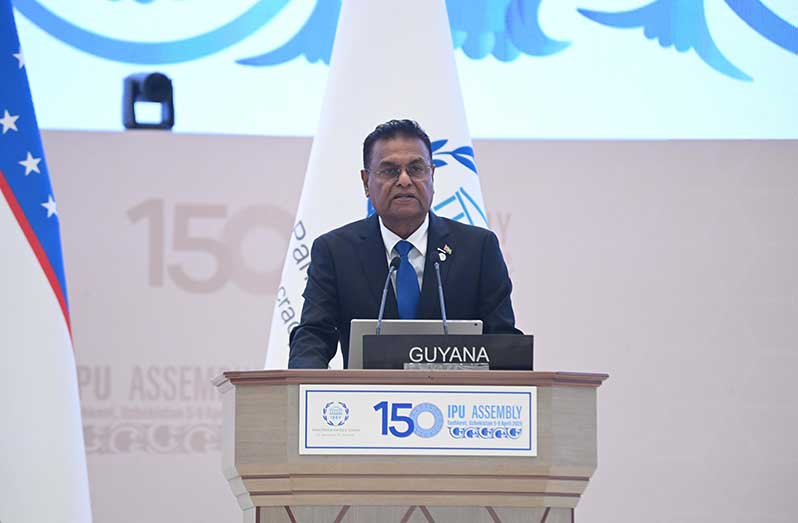
SPEAKER of the National Assembly, Manzoor Nadir, says Parliament’s rules provide several options for dealing with Members of Parliament (MPs) whose conduct disrupts the orderly functioning of the House, including referrals to the Privileges Committee and possible suspension.
During a recent appearance on The Guyana Dialogue, Nadir explained that lively exchanges are a normal feature of parliamentary debate, but the Standing Orders outline clear procedures to address behaviour that crosses the line.
“In every Parliament, this is politics. There is militancy. There is some disruption. There is heckling,” Nadir said, while noting that mechanisms exist to deal with situations where disorder escalates.
According to the Speaker, when disruptions become excessive, disciplinary action can be triggered under the rules governing the National Assembly.
“If it gets out of hand, disciplinary procedures outlined in our Standing Orders can be applied. And if it gets extremely difficult, persons can be referred to our Privileges Committee. That committee will decide on the penalty or penalties for persons disrupting the good order of the House, lying on a member in the House, and things like that,” he said.
He explained that the Privileges Committee has the authority to recommend strong penalties for breaches of parliamentary conduct, including suspension from sittings of the National Assembly.
“When you are suspended, there is no pay. You can’t do anything in the name of the National Assembly. You can’t come even within the precincts of the National Assembly until that suspension is over,” Nadir explained.
The Speaker also referred to a previous incident in which several opposition parliamentarians were sanctioned following a confrontation involving the ceremonial mace—one of the key symbols of parliamentary authority.
“Those persons, I think there were about eight of them, were taken to the Privileges Committee. Many were suspended for a number of sittings, between four and eight sittings,” he said.
In July 2022, the National Assembly approved the suspension of eight opposition A Partnership for National Unity + Alliance For Change (APNU+AFC) MPs after the Privileges Committee investigated events that had unfolded during the December 29, 2021, sitting of Parliament.
The MPs—Christopher Jones, Ganesh Mahipaul, Sherod Duncan, Natasha Singh-Lewis, Annette Ferguson, Vinceroy Jordan, Tabitha Sarabo-Halley and Maureen Philadelphia—were found to have engaged in disorderly conduct during a protest over debate on the Natural Resource Fund Bill.
During that confrontation, opposition MPs seized the parliamentary mace in an attempt to halt proceedings, leading to a physical struggle with staff and a suspension of the sitting. Following the investigation, the committee concluded that the MPs had committed acts amounting to contempt and breaches of parliamentary privilege, and recommended suspensions ranging from four to six sittings.
A legal challenge against the National Assembly’s Committee of Privileges’ decision to suspend the eight opposition Members of Parliament was dismissed on January 16, 2023, with the High Court ruling that it lacks jurisdiction to intervene in the internal affairs of the House.
Justice Damone Younge, in her ruling in the High Court in Demerara, also ordered the MPs to pay costs of $350,000 each.
Speaker Nadir explained that before such disciplinary steps are taken, the Speaker typically makes several attempts to restore order in the chamber.
“Many times, you warn, you hit the gavel, you caution, you caution, you caution. And in the end, you have to exercise a considerable amount of patience,” he said.
He also noted that the Speaker has the authority to stop an MP’s presentation if they repeatedly ignore procedural guidance.
“If I find a person reading and reading, and in spite of the cautions that they still read rather than refer to notes, I can bring the person’s presentation to an end,” he said.
Nadir stressed that these measures are not intended to punish members arbitrarily, but to safeguard the integrity and authority of the National Assembly.
“You have the rules, which you have to execute in the House. You have some sanctions at your immediate disposal, and you also have a process where a person could be heavily penalised for serious breaches of parliamentary- procedure misconduct,” he said.





