






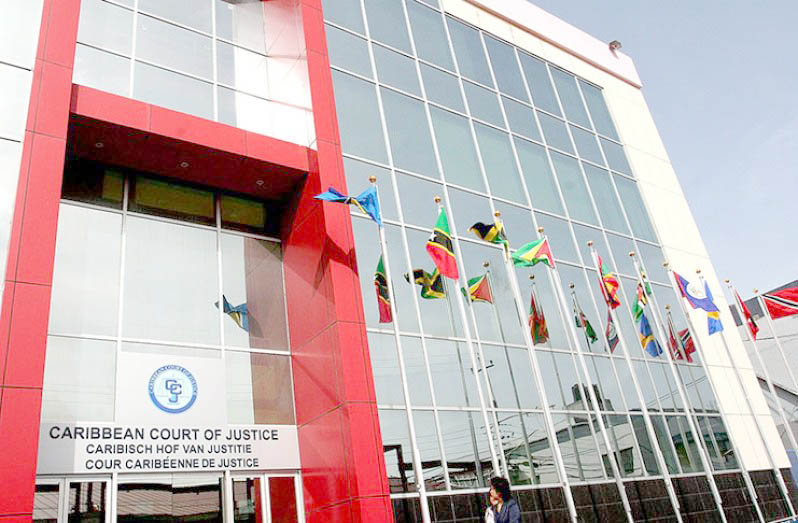
GUYANA remained one of the major contributors to cases filed before the Trinidad-based Caribbean Court of Justice (CCJ) during the 2024–2025 judicial year, according to the court’s latest Annual Report covering the period from 1 August 2024 to 31 July 2025.
The report shows that a total of 27 new matters were filed in the court’s Appellate Jurisdiction during the reporting period, representing a slight increase from the 26 matters recorded in the previous year. Of these filings, approximately 78 per cent were civil matters, while the remaining cases involved criminal appeals.
The 27 new matters filed, including 10 Applications for Special Leave and 17 Appeals, represent a modest increase compared to the 26 matters recorded in 2023–2024.
A country-by-country breakdown indicates that Belize filed the highest number of matters with nine cases, followed closely by Guyana with eight filings.
Barbados accounted for five matters, Saint Lucia for four, and Dominica for one. Guyana’s continued high level of participation places it among the court’s most active users of the appellate system for the year under review.
In terms of court operations, the CCJ held a total of 40 sittings during the reporting year. These included 10 case-management conferences, 19 hearings, and 11 judgment deliveries. The court continued to rely heavily on technology, with 92.5 per cent of its sittings conducted virtually. A smaller number of proceedings were held in person or through hybrid arrangements.
The report also highlights the court’s efficiency in disposing of matters. Case-resolution times showed that 14 per cent of matters were concluded within 90 days, while 29 per cent were resolved within 91 to 180 days. A further 43 per cent were disposed of within 181 to 270 days, and the remaining 14 per cent were completed within 271 to 360 days.
Notably, all recorded matters were concluded within one year of filing, meeting the court’s established performance benchmarks for both special-leave applications and appeals.
In its Appellate Jurisdiction, the CCJ functions as the highest court of appeal for both criminal and civil cases in Caribbean Community (CARICOM) states that have formally adopted it. At present, five countries fall under this jurisdiction: Barbados, Belize, Dominica, Guyana, and Saint Lucia.
By acceding to the agreement establishing the court, member states have affirmed their intention to replace overseas judicial bodies with a regional final court of appeal. The CCJ therefore represents not only a legal institution, but also a powerful symbol of Caribbean sovereignty, self-determination, and regional maturity.
Under its Original Jurisdiction, the CCJ operates as an international tribunal with sole authority to interpret and enforce the Revised Treaty of Chaguaramas (RTC) and to resolve disputes that arise under that treaty. The RTC created the CARICOM and the CARICOM Single Market and Economy (CSME).
Through this jurisdiction, the CCJ plays a central role in safeguarding the legal framework that governs regional economic integration. All 12 CSME member states, along with their citizens, businesses, and governments, are entitled to bring matters before the court to ensure that their treaty rights and obligations are upheld.
The CCJ’s bench is composed of a group of experienced jurists, led by its President, Justice Winston Anderson. Other members of the current bench include Justices Arif Bulkan, Maureen Rajnauth‑Lee, Denys Barrow, Peter Jamadar, Chantal Ononaiwu, and Chile Eboe‑Osuji.




