






PRESIDENT, Dr Irfaan Ali on Saturday positioned the newly established Ministry of Public Utilities and Aviation as a cornerstone of Guyana’s push to strengthen national competitiveness, accelerate infrastructural delivery and optimise the country’s energy and water assets in a rapidly expanding economy.
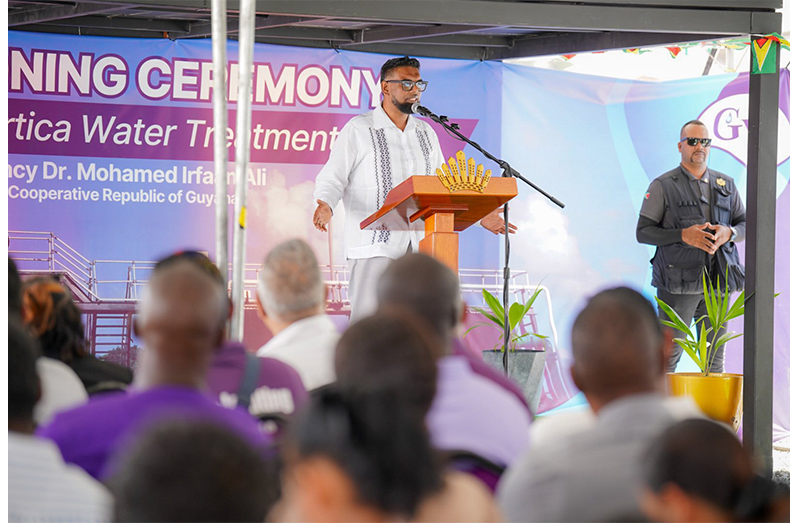
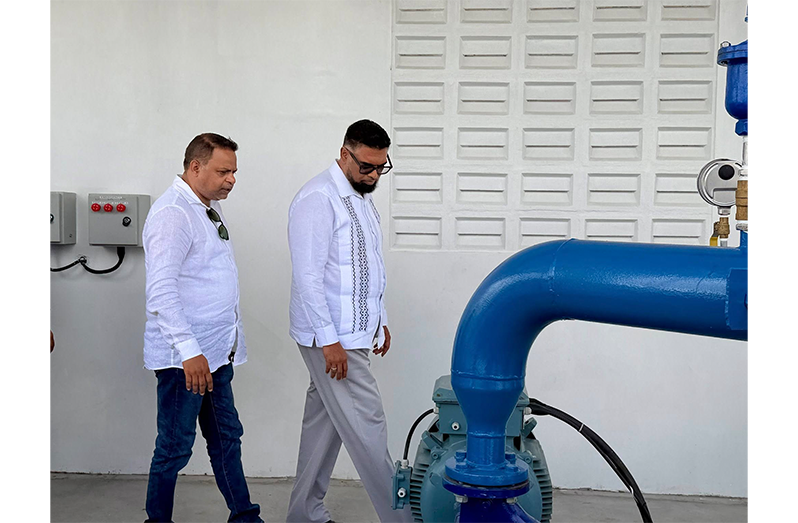
Speaking at the commissioning of the Five Miles Bartica Water Treatment Plant in Region Seven, the Head of State said the creation of the ministry reflects a deliberate shift to ensure that utility and aviation services keep pace with the country’s unprecedented development trajectory and rising global integration.
According to President Ali, the efficiency of public utilities will be one of the defining metrics of Guyana’s economic competitiveness in the coming years.
“The most important marker of national efficiency and national competitiveness is the efficiency with which our public utilities deliver service. How fast someone can get the electricity connection, how fast someone can get a water connection, how reliable is the residential supply, ” he said.
He explained that as Guyana experiences accelerated growth driven by housing expansion, new hospitals, airports, hotels and industrial development, the demand for reliable and timely utility services will intensify, requiring a coordinated institutional response.
This policy direction is reinforced by the substantial budgetary backing provided for the ministry. Approximately $140 billion has been approved by the National Assembly’s Committee of Supply for the Ministry of Public Utilities and Aviation, headed by Minister Deodat Indar.
The allocation comprises $103.6 billion for capital works and $36.4 billion for current expenditure, reflecting a heavy focus on infrastructural expansion and modernisation.
The President emphasised that the ministry’s mandate goes beyond traditional service delivery, and is intended to reposition Guyana’s utilities and aviation sectors as drivers of economic diversification and regional influence.
“And how are we building out our energy infrastructure to meet global changes and national changes that will incorporate gas, LPG [Liquefied Petroleum Gas], LNG [Liquefied Natural Gas]… and how are we positioning Guyana and our private sector to build out an ecosystem that will allow us to be a major supplier of energy across the Caribbean,” President Ali said.
He noted that the country’s emerging gas and energy resources present opportunities not only for domestic transformation, but also for regional market expansion through strategic partnerships and power-purchase agreements.
“Take, for example, one of the island states; they will use about 50 megawatts of power, 40 megawatts of power. With our LPG and LNG coming on stream, it gives us an opportunity to partner in the building out of these plants and having power-purchase agreements throughout the region. This allows us a natural market for LPG and energy,” he stated.
President Ali underscored that the ministry will play a pivotal role in mobilising public and private-sector collaboration to scale up infrastructural deployment, expand services and create new economic opportunities across the Caribbean.
“This allows us to build out our services industry, expand our private-sector reach and create opportunities. It is this ministry that must now actively look at the deployment of these resources,” he added.
The Head of State also pointed to the evolving definition of utility access, particularly in hinterland communities, noting that traditional benchmarks are no longer sufficient, as citizens demand services delivered directly to their homes rather than through communal systems.
“Yes, we’ll get to 100 per cent access to the hinterland water supply. But you know, as I know, that the hinterland communities are calling now for access to be at their doorstep. So access in the hinterland is also being redefined,” he said, while acknowledging the logistical complexities posed by dispersed settlement patterns.
This policy approach is mirrored in the government’s ongoing investments in water infrastructure through Guyana Water Incorporated (GWI), including $1.5 billion allocated for hinterland water projects and continued implementation of the Coastal Water Treatment Infrastructure Programme (CWTIP) across Regions Two to Seven.
Beyond service delivery, President Ali outlined a broader objective for the ministry to harness Guyana’s abundant freshwater resources as an economic asset, guided by integrated water-resource management principles.
“We also are aware that water is an economic commodity, and there are many studies that point to the global recession of water in decades to come. We now have to work with the integrated water-resource management system principles to develop an optimisation plan of our water asset in Guyana, our total water asset, and how that asset can be deployed to optimise value,” he said.
In this context, the President set a target for local production of bottled water, signalling a shift towards value-added utilisation of natural resources and reduced reliance on imports.
“It can’t be such a resource-rich country in fresh water and then importing bottled water. This ministry must therefore set its sight on a target of ensuring that all our water consumed locally is produced locally in the next 12 months,” President Ali declared.
He further indicated that achieving economies of scale through private-sector collaboration would be key to lowering production costs and expanding access to affordable potable water nationwide.
“So we have to look at all the verticals and to see how we can have economies of scale at every level, so that we can bring down the cost of water… so that a country that is known as the land of many waters can have the cheapest water available to its people,” he said.
The President also highlighted aviation as a transformative sector that will fall squarely within the ministry’s remit, noting that expanded airport infrastructure and improved connectivity are essential to sustaining economic growth and integrating Guyana into regional and global markets.
“This ministry is also [the one] that must deliver two international airports in five years and a second terminal… if we are to adjust our economy to regional and global competition, these are critical infrastructures that we must complete in record time, so that we can leapfrog ourselves into what the future brings for us,” he stated.
President Ali added that the government intends to develop measurable indicators to assess the contribution of aviation and utility services to the country’s Gross Domestic Product (GDP), reinforcing the ministry’s central role in shaping a diversified and modern economy.
“Aviation by itself is a massive area of transformation, and we want to see in five years, four years from now, a direct count on how much [sic] contribution [sic] aviation made to GDP, what contribution [sic] all of these sectors made to GDP, water and everything, that is what we are moving to building up the diversified economy in a measurable way,” he said.
The Head of State emphasised that the ministry has been deliberately structured with a blend of experienced professionals and emerging talent to drive innovation and sustained performance across its wide-ranging portfolio.
“This ministry was well thought out. It is beyond the norm, and that is what I’ve been pushing all of my ministers to do, go beyond the norm… we have also put a lot of talent in this ministry, a lot of young talent, and we hope that time will optimise to bring out the benefits,” President Ali remarked.
He called for the collective experience of long-serving professionals in the utilities sector to be harnessed alongside new expertise to design and position the future of the sector in line with Guyana’s long-term development vision.
Ultimately, President Ali asserted that the Ministry of Public Utilities and Aviation will serve as a key institutional mechanism to modernise service delivery, unlock economic value from natural resources and ensure that the country’s infrastructure keeps pace with its rapid transformation, thereby strengthening Guyana’s competitiveness in the regional and global economy.




