






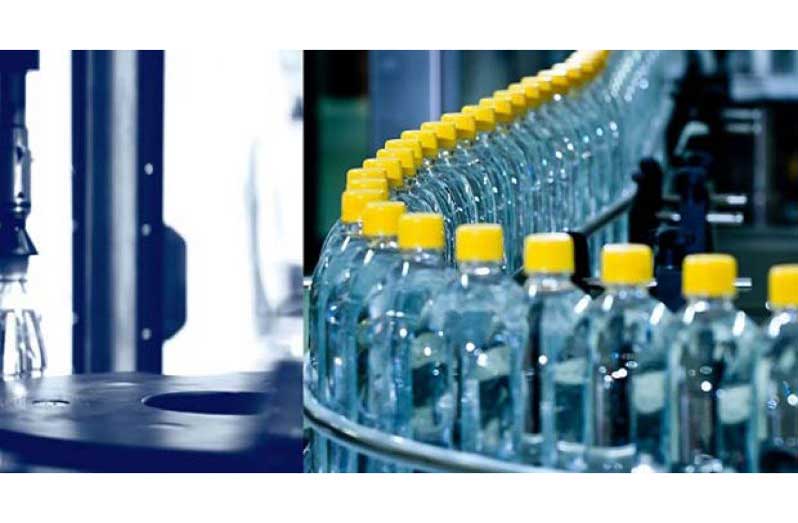
PRESIDENT, Dr Irfaan Ali has set a national target for Guyana to achieve full local production of bottled water within the next 12 months, arguing that the country’s vast freshwater wealth must be harnessed to eliminate unnecessary imports and unlock new economic opportunities.
The Head of State made the declaration on Saturday while commissioning the new Five Miles Bartica Water Treatment Plant in Region Seven (Cuyuni–Mazaruni), where he broadened the conversation on water beyond service delivery to include its strategic economic value and industrial potential.
In his assessment of Guyana’s current consumption patterns, President Ali said it was incongruous for a nation rich in freshwater resources to remain dependent on imported bottled water.
“It can’t be such a resource-rich country in fresh water and importing bottled water. This ministry must therefore set its side on a target of ensuring that all our water consumed locally is produced locally in the next 12 months,” he stated.
The pronouncement effectively places bottled-water production squarely on the policy agenda of the newly established Ministry of Public Utilities and Aviation under Minister Deodat Indar, which the President described as central to advancing national efficiency, competitiveness and economic diversification.
However, President Ali’s call reflects a broader shift in the administration’s approach to water, repositioning the resource not merely as a public good, but also as a commercial asset capable of supporting domestic manufacturing, reducing foreign exchange outflows and generating employment.
To achieve this target, the President underscored the need for structured collaboration with the private sector, cautioning against fragmented investments and instead, advocating for a coordinated, scale-driven production model that can drive down costs and ensure market competitiveness.
“Whether we have to collaborate and we must collaborate with the private sector to ensure that they build up their capacity and capability, every entity don’t need to have a water-bottling facility. We can have one entity that produces all of the plastic bottles, a standard size across the country, so that we have economies of scale,” he explained.
Such a model, he suggested, would allow Guyana to standardise inputs, streamline production and create efficiencies across the entire value chain, from bottling and packaging to distribution and retail.
The President noted that preliminary production assessments indicate that locally bottled water can be supplied to the domestic market at highly competitive prices, once economies of scale and efficient production systems are in place.
“When you look at our operational costs and the cost of production, you can have this at least at $100 on the market, or less easily. What we have to do is work with the private sector to see how we can actualise this so that a country that is known as the land of many waters can have the cheapest water available to its people,” he said.
Beyond the immediate goal of import substitution, President Ali framed the initiative as part of a larger policy effort to optimise the economic value of Guyana’s freshwater reserves through integrated planning and modern resource management systems.
“We now have to work with the integrated water resource management system principles to develop an optimisation plan of our water asset in Guyana, our total water asset and how that asset can be deployed to optimise value,” he stated.
This approach, grounded in Integrated Water Resource Management (IWRM) principles, is expected to guide how freshwater is allocated and commercialised across domestic, agricultural and industrial uses as the country’s economy continues to diversify.
The President also signalled that as new sectors expand, including agro-processing and manufacturing, the country will need to move towards a more sophisticated classification of water usage, ensuring that supplies are efficiently directed based on sectoral demand.
“We will have to move to a situation where we define water based on set use agriculture, industrial, residential. These are important concepts,” he noted.
The proposal also aligns with the government’s wider emphasis on building integrated production ecosystems that allow multiple industries to benefit from shared infrastructure and standardised inputs, a strategy increasingly being applied across energy, agriculture and manufacturing sectors.




