






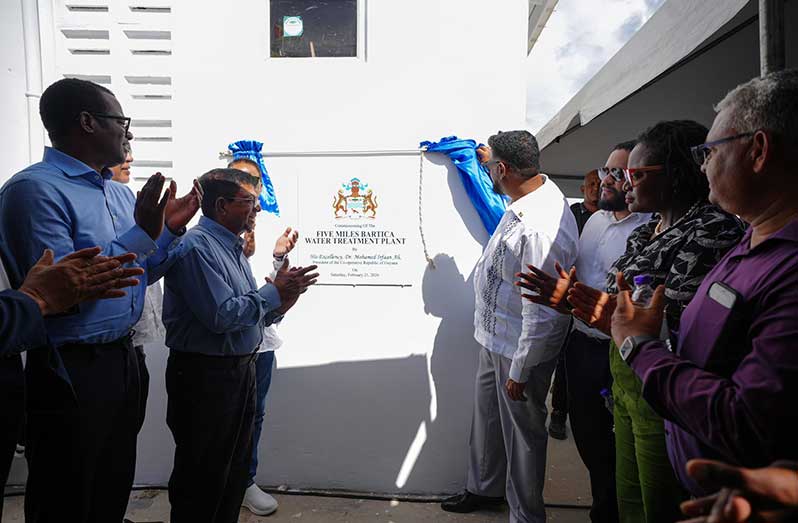
— says facility built ahead of surge in housing, hospital, airport and tourism demand in Region Seven
–first surface-water treatment plant to serve over 6,000 residents
PRESIDENT, Dr Irfaan Ali on Saturday commissioned the state-of-the-art Five Miles Bartica Water Treatment Plant in Region Seven (Cuyuni–Mazaruni), a combined investment of $607 million, signalling an “aggressive forward-planning approach” to meet the surging demand expected from rapid housing, tourism, aviation and health-sector expansion in the township and surrounding communities.
The facility, the first surface-water treatment plant of its kind in Guyana, is expected to serve more than 6,000 residents across the Four to Seven Miles area of Bartica, with a production capacity of two million litres of treated water per day.
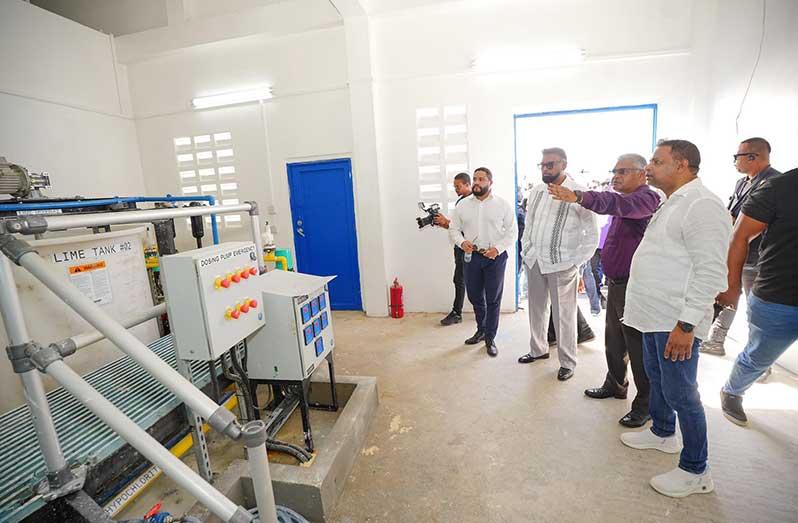
The Five Miles plant was constructed by Toshiba Water Solutions Inc at a cost of $468 million. Supporting infrastructure, including the water-catchment system, pumping station and transmission pipeline, was completed at a cost of $68 million. A reinforced concrete access road to the catchment and pumping station will also be built at a cost of $71 million to strengthen operational access.
The plant forms part of the government’s broader Coastal Water Treatment Infrastructure Programme (CWTIP), which has already transformed water-service delivery across several regions.
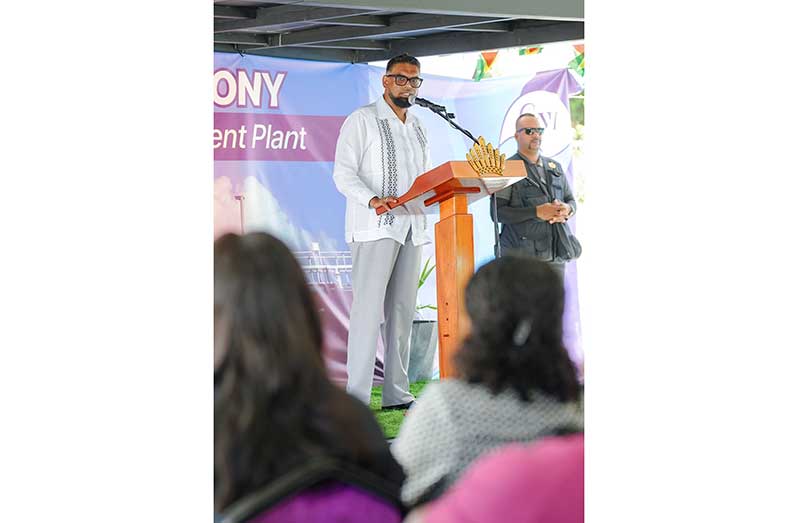
Delivering the feature address at the commissioning ceremony, President Ali explained that the investment was not merely about meeting present demand, but is also about positioning the region to absorb imminent large-scale development within a short timeframe.
“As we celebrate here, my mind is already contemplating the challenges not three years from now, but one and a half year from now, because in one and a half year from now, we’ll have thousands of new homes in a new housing scheme. We will have a new state-of-the-art hospital, we will have a municipal-type airport, we’ll have new hotels and a marina, all of which would require abundant water supply as a part of the efficiency programme,” the President stated.
He highlighted that such rapid growth requires constant forward planning and flexible infrastructure capable of quick expansion.
“That is why you cannot sit and wait. We have to plan continuously, ahead of time, and that is why, too, these plants are built in modular forms. All the new plants are built in a modular way, that is, we can add capacity very easily without dismantling the existing infrastructure,” President Ali explained.
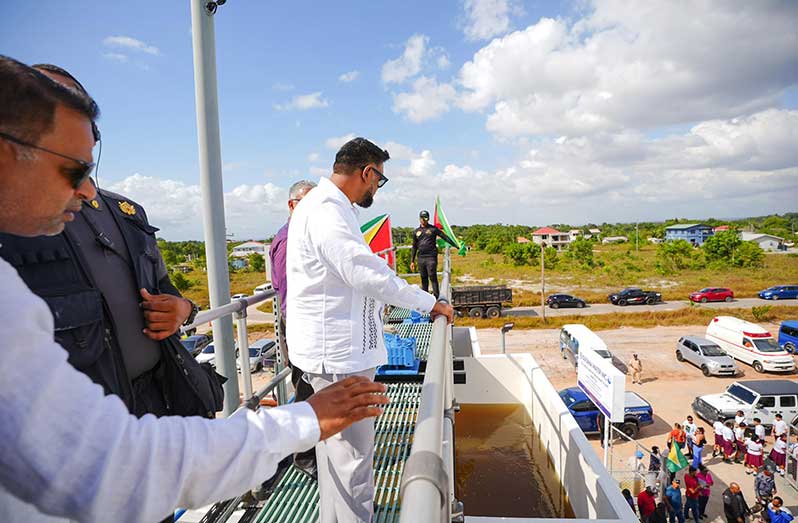
The Five Miles facility also marks a milestone for the Guyana Water Incorporated (GWI), as it introduces modern surface-water treatment technology that will enhance quality, reliability and continuity of supply for residents and businesses in the expanding Bartica township.
The investment also reflects the first-phase achievements of the Coastal Water Treatment Infrastructure Programme, under which seven large water-treatment plants and 15 smaller facilities were constructed, 12 existing plants upgraded, and approximately 200 kilometres of transmission mains installed across Regions Two, Three, Four, Five, Six and Seven.
These interventions have collectively improved water quality, service continuity and system efficiency nationwide.
Meanwhile, the second phase of the programme is already underway, with seven additional treatment plants being constructed at Maria’s Delight in Region Two, Wakenaam and Leguan in Region Three, Hope in Region Four, Bath in Region Five, Adventure in Region Six and Five Miles Bartica in Region Seven.
President Ali commended the leadership and technical teams within GWI for their decades-long commitment to expanding and modernising Guyana’s water infrastructure, noting that sustained planning has been necessary to match the country’s unprecedented development trajectory.
“Dream time planning, another joyous occasion when we commissioned this, was the treatment plan in every aspect of development. We try as far as possible to ensure at least the medium-term demand is satisfied with that investment. Unfortunately, the pace and speed at which the country is growing sometimes does not allow us, based on existing financial constraints and circumstances, to meet that rapid change,” he said.
Reflecting on past limitations, the Head of State pointed out that infrastructural constraints historically forced difficult engineering compromises, but evolving economic conditions now allow for more robust long-term solutions.
“There was a time when you had to make a difficult decision of putting the pipeline in the middle of the road to ensure that both sides of the road get water. That was not because we did not have great engineers. That was because we did not have the resources that would allow us to put the lines on both sides of the road,” he noted.
The President further stressed that the new plant forms part of a wider national strategy to modernise utility services and strengthen competitiveness as Guyana positions itself for accelerated economic diversification.
“The most important marker of national efficiency and national competitiveness is the efficiency at which our public utilities deliver service. How fast someone can get the electricity connection, how fast someone can get a water connection and how reliable is the residential supply,” he said.
President Ali pointed out that ensuring reliable and affordable water is central to unlocking broader socio-economic growth, particularly in emerging urban centres such as Bartica, which is rapidly evolving into a regional hub.
According to President Ali, Region Seven has seen billions of dollars in investments across multiple sectors, including housing, health, infrastructure and renewable energy, all of which will drive increased demand for water and other utilities.
“Clean water is not a luxury. It is life. It is health in every glass. It is dignity in every household. It is security for every child. When a community no longer worries about the safety of its supply, it will focus on growth, education, opportunity,” the President said.
He further highlighted that the government’s approach goes beyond achieving universal access, focusing instead on optimising the economic value of Guyana’s abundant freshwater resources.
“The sector is not about 100 per cent access to treated water. The sector is how do we harness the potential of our fresh water. That is a strategic objective,” President Ali explained.
The Bartica plant also complements wider infrastructural developments in the region, including the construction of a new level-five hospital, ongoing housing expansion, renewable energy installations and the extension of transport and aviation facilities that will collectively reshape the economic landscape of the township.




