





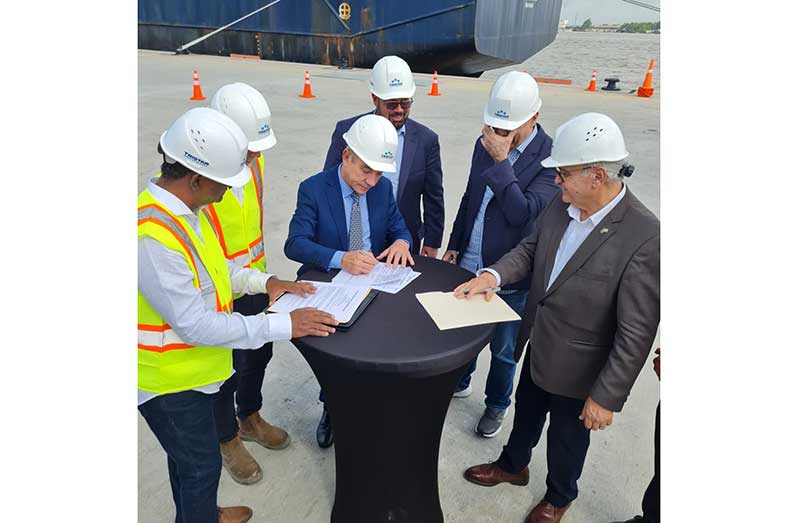
TRISTAR Incorporated, the Guyana-based developer of a major multipurpose port complex along the Demerara River, has signed a Memorandum of Understanding (MOU) with the Government of the State of Roraima, Brazil, in a move aimed at positioning Guyana as a strategic gateway for trade between northern Brazil and global markets.
The agreement was signed during a visit here by Governor Antonio Olivério Garcia de Almeida Denarium of Roraima at the invitation of President Dr. Mohamed Irfaan Ali.
The Governor is also in the country to participate in the opening of the Energy Conference, which has drawn regional and international attention to Guyana’s expanding economic role.
The agreement, signed by Governor Denarium and Mr. Cristóbal Schlaubitz, Chief Executive Officer of Tristar Incorporated, establishes a framework to evaluate Guyana’s port and logistics infrastructure as a transshipment hub for Brazilian exports and imports.
The agreement is being facilitated by two private-sector firms with strong ties to both Guyana and Brazil: Guyana-based Equaventure Solutions and North Link, one of the largest operators currently moving fertiliser, grain and liquid cargo between Roraima and Guyana.
A CORRIDOR WHOSE TIME HAS COME
For years, trade between Guyana and northern Brazil was constrained by infrastructure limitations and logistical bottlenecks. That reality is shifting.
With the Lethem–Linden road nearing full completion within the next two years, Brazil will soon have a reliable overland route connecting directly to Guyana’s Atlantic coast. For the first time, producers in Brazil’s northern states will have a practical export option that bypasses longer and costlier southern routes.
Tristar’s developing port complex along the Demerara River sits at the center of that emerging opportunity.
Tristar Port is the vision of Guyanese-born entrepreneur Kris Persaud, whose career spans real estate development and capital markets in the United States. Persaud built substantial real estate holdings by identifying and maximizing value in land and property investments and played a strategic role in guiding two companies — Homeowners Choice (HCI) on the New York Stock Exchange and Oxbridge Holdings (OXBR) on the NASDAQ — to public listings. In recent years, he returned to Guyana to invest in long-term infrastructure and real estate development, channeling family capital into projects such as Tristar Port. Those close to the project say he views the emerging Brazil–Guyana corridor as a realization of that long-term vision for regional connectivity and economic growth.
Under the MOU, the parties will assess the feasibility of utilizing Tristar’s facilities as a transshipment hub for fertilizers, grains, liquid cargo and other commodities and consumer goods from northern Brazil. The agreement also contemplates the potential use of approximately 300 acres of nearby land for warehousing, consolidation, processing, packaging, cold storage and light manufacturing.
GUYANA’S MOMENT
Governor Denarium framed the agreement as part of a broader regional realignment.
“Brazil represents a multi-trillion-dollar marketplace, and Roraima is its fastest growing state economy. Guyana is rising globally,” Denarium said. “The convergence of growth and connectivity creates opportunity at scale.”
He emphasized that the Lethem–Linden corridor changes the economic equation.
“With modern infrastructure in place, we are no longer separated by distance. We are connected by strategy. This corridor is not accidental — it is the natural evolution of a relationship that has reached maturity.”
The Governor noted that the agreement builds on strengthening diplomatic ties between the two jurisdictions, particularly following President Ali’s recent engagement with Roraima and the conferral of the Ordem do Mérito Forte São Joaquim in recognition of deepening relations.
“This reflects a partnership that is strengthening at both the political and economic levels,” Denarium added.
CONVERTING GEOGRAPHY INTO STRATEGY
Mr. Schlaubitz described the signing as the commercial framework needed to turn that political momentum into structured opportunity.
“This is about converting geography into opportunity,” Schlaubitz said. “The cargo already exists. The demand already exists. What’s changing is the infrastructure and the coordination.”
He characterized the agreement as a milestone.
“For decades, people talked about this corridor in theory. Today, we’re applying structure to it. Guyana has the opportunity to become a serious logistics platform for northern Brazil.”
Schlaubitz said producers in northern Brazil are already paying attention.
“The agricultural volumes are real. Fertilizer flows are real. The producers are looking for efficient Atlantic-facing outlets,” he said. “Our responsibility is to ensure that Guyana’s infrastructure scales in a disciplined and sustainable way to meet that demand.”
SCALE, RESILIENCE AND PRIVATE-SECTOR ALIGNMENT
American investor and international political and economic analyst Arick Wierson, a partner in Equaventure Solutions and a key facilitator in advancing Guyana–Brazil engagement, described the agreement as a structural development rather than simply a logistics initiative.
“When you connect one of the fastest-growing economies in the world with a multi-trillion-dollar economy like Brazil, you’re not just moving goods — you’re repositioning the region,” Wierson said.
He noted that Guyana’s expansion is part of a broader northern South American shift. Suriname, he added, is projected to soon rival Guyana’s pace of economic growth as major offshore energy projects come online.
“What we’re seeing is the emergence of a northern growth zone,” Wierson said. “Guyana is expanding quickly. Suriname is accelerating. Northern Brazil already has substantial productive capacity. As connectivity improves, those dynamics begin to reinforce one another.”
Wierson emphasized that global markets increasingly value diversification and supply-chain resilience.
“In today’s environment, optionality matters,” he said. “The Brazil–Guyana corridor provides producers with an additional Atlantic-facing outlet and gives Guyana the opportunity to integrate more deeply into a much larger economic ecosystem.”
Rosh Khan, Managing Partner of Equaventure Solutions, highlighted the growing alignment between Guyana and Brazil’s private sectors.
“We are seeing increasing interest from Brazilian producers and logistics operators who recognize that Guyana’s infrastructure trajectory presents real commercial opportunity,” Khan said. “Our role has been to help bridge dialogue between the public and private sectors on both sides of the border. This is about building structured commercial relationships.”
PRIVATE SECTOR ALREADY MOVING CARGO
North Link, represented by Brazilian investor Yucatan Reis, already moves significant volumes of fertilizer, grain and liquid cargo between Roraima and Guyana. Reis, who has a long history of doing business in northern Brazil and across the border region, has been directly involved in expanding commercial flows between the two jurisdictions.
“What we have been planning for over many years is finally beginning to take shape,” Reis said. “The infrastructure is improving, the relationships are strengthening, and the corridor is becoming more organized. That creates confidence for producers and traders on both sides of the border.”
North Link has expressed interest in collaborating to expand and professionalize cargo movements through structured use of Guyana’s port infrastructure as capacity increases.
The agreement signed between Roraima and Tristar provides for joint technical and commercial studies examining projected trade flows, infrastructure capacity, cost-benefit considerations, customs procedures – including CARICOM frameworks – and environmental impacts.
A STRATEGIC GATEWAY EMERGING
For Guyana, the implications are significant.
The country’s rapid economic expansion has already placed it firmly on the global map. Now, with improving road connectivity to Brazil and expanding port capacity along the Demerara River, it has the opportunity to serve not only as a producer – but as a regional logistics gateway.
If the corridor develops as envisioned, Guyana could become a preferred Atlantic outlet for northern Brazilian producers seeking access to Caribbean and global markets.
What was once considered a remote border crossing is increasingly viewed as a strategic artery linking the Guiana Shield region to the wider world – a sign that northern South America is entering a new chapter of economic integration.





