





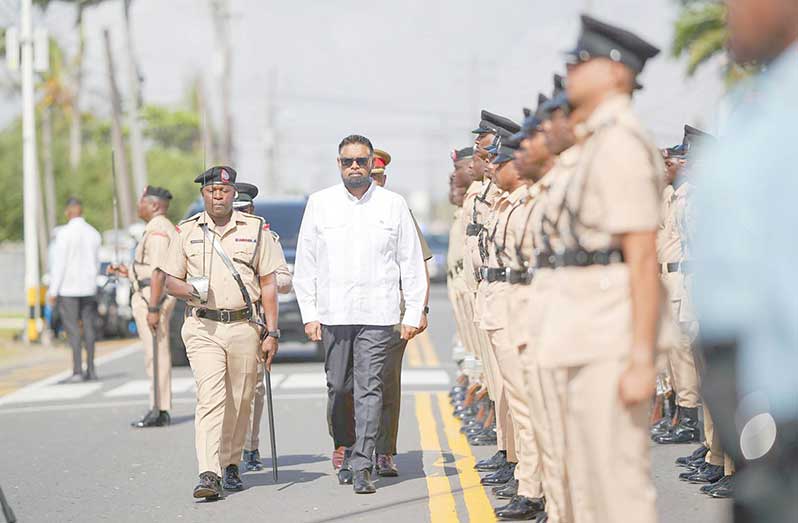
COMMANDER-IN-CHIEF of the Armed Forces, President Dr Irfaan Ali, on Wednesday, announced that Guyana and Brazil are advancing plans to establish a Joint Strike Force aimed at strengthening security and tackling criminal activities along the shared border between the two countries.
The Head of State made the disclosure while delivering remarks at the opening ceremony of the Annual Police Officers’ Conference, where he underscored the evolving nature of transnational crime and the need for a more coordinated regional response.
“I’ve mandated the Chief of Defence Staff, Commissioner of Police and the Director of NISA (National Intelligence and Security Agency), the director of CANU (Customs Anti-Narcotics Unit) …I’ve asked them and I’ve already discussed with the Governor of Roraima for us to develop an integrated joint strike force to operate along the border,” the President said.
Emphasising the importance of operational cohesion, President Ali explained that the initiative will focus on building a unified, well-trained team capable of responding effectively to emerging security threats.
Last week, President Ali warned that networks of illicit activities are growing more acute and complex, urging leaders of small states, particularly those in the Caribbean Community (CARICOM), to foster stronger collaboration to protect their societies.
“Transnational crime, including illicit trafficking of drugs, weapons and people, undermines stability and corrodes institutions. These challenges facing small states in our hemisphere are becoming more acute and more complex,” President Ali warned during an address to the Belizean National Assembly recently.
Transnational problems, he stressed, require transnational solutions, especially at a time when the international environment itself is marked by heightened uncertainty and rapid change.
“Co-operation is essential to protecting our societies and economies from transnational criminal networks engaged in the trafficking of weapons, people and illicit goods. Geography places both Belize and Guyana along routes that are exploited by such networks, creating challenges that no single state can address alone. These threats do not respect borders. They therefore require correlated responses.”
He believes that small states must look to pursue co-operation efforts both regionally and internationally with partners who share a common interest in preventing and disrupting networks that seek to threaten the sovereignty of economies.
“It is imperative that small states actively pursue co-operation with regional and international partners who share a common interest in preventing, disrupting and dismantling organised criminal activity. Such co-operation strengthens national capacity and enhances collective security,” he said.





