






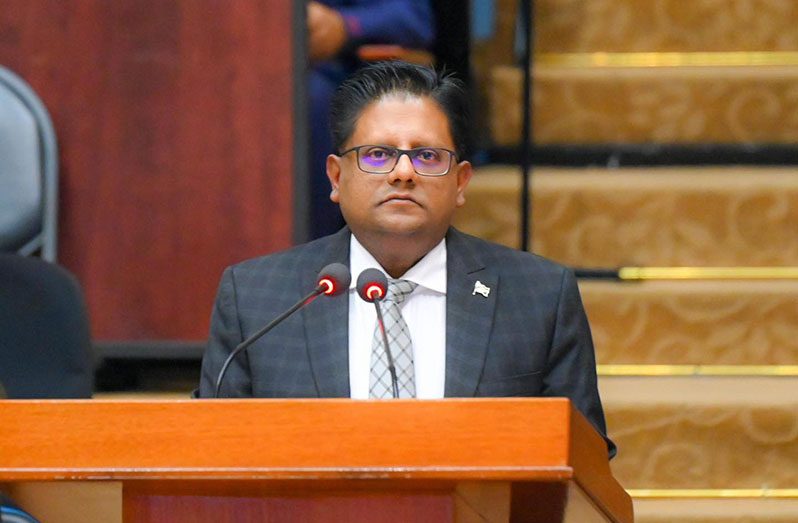
–Dr Singh tells Guyanese while drawing attention to the life of ‘Pablo’ as a measure of caution
FINANCE Minister Dr Ashni Singh used the close of the Budget 2026 debate to deliver a stark warning about the dangers of “criminalised politics,” invoking the life of Colombian drug lord‑turned‑politician Pablo Escobar to caution Guyanese against becoming shields for alleged wrongdoing.
Wrapping up more than three hours of rebuttal in the National Assembly, Dr Singh warned “against the use of politics as a shield to escape or frustrate criminal accountability,” saying such behaviour “can endanger institutions and exploit vulnerable citizens.”
He stressed that Guyana is at “an extremely important juncture” and that political platforms must never be converted into “protective cover for individuals facing serious allegations.”
The minister said he was “not making allegations,” but highlighting “the broader danger of political movements being used to cloak or defend alleged criminal conduct,” particularly when those movements deliberately target the poor and disenfranchised. He argued that true leadership requires respect for the rule of law, not attempts to mobilise supporters as a human buffer against legal consequences.
To drive home his point, Dr Singh read from the 2021 Guardian article “Killing Pablo,” which chronicles how Escobar sought elective office, cultivated an image of generosity and tried to use politics to evade justice.
Escobar, he noted, “exploited vulnerable people in pursuit of a very narrow personal effort to save himself,” using patronage and public spectacle while undermining the very institutions meant to protect citizens.
“I ask all Guyanese people, while keeping your eyes wide open, ask yourself if this story sounds familiar, if it rings a bell,” Dr Singh told MPs and viewers.
He emphasised that the Escobar reference was “purely a historical analogy and a warning about how criminal influence can corrode democratic systems if left unchecked.” He urged Guyanese to read the article and “reflect on whether the parallels reflect events unfolding in Guyana.”
Without pronouncing on guilt or innocence, Dr Singh grounded his warning in the present legal controversy surrounding Opposition Leader and WIN party head Azruddin Mohamed, who has been sanctioned by the United States and faces proceedings that are now before the courts.
He said he had “simply quoted from public documents” – including U.S. government sanctions and an unsealed indictment and he then declared, “I will not pronounce judgment. I defer to the courts.”
“If the Honourable Leader of the Opposition is innocent, then let the court process proceed and let him prove his innocence as is his right,” the minister said, adding that he has “full faith in the court system of Guyana that it will be properly considered and determined.”
But he warned that “the greater danger lies not only in alleged misconduct, but in what he described as the recruitment of ordinary citizens into political movements that may ultimately expose them to legal, financial, or reputational harm.
“Do not ensnare innocent, vulnerable Guyanese people in this effort to save yourself…If you are innocent, you will prove that innocence. But do not ensnare poor, innocent Guyanese people,” Dr Singh urged.
He described what he sees as “the exploitation of disenfranchised or vulnerable supporters under the guise of political activism,” and appealed to all political actors to act responsibly and allow the justice system to function independently.
In one of the most striking moments of the debate, Dr Singh shifted from criticism to an almost sombre reflection on the Opposition Leader himself.
“I felt as sad as I sat here and listened to the Leader of the Opposition speak or read,” he said. “Because he too is a young Guyanese person and I asked myself how he ended up here, in this situation.”
The minister said his concern extended “beyond one man” to “all of the innocent people who are being recruited and seduced into this effort with no thoughts of consequence for them.”
He accused the Opposition Leader of having “chosen to ensnare everybody, all the members of his family, innocent, poor people, vulnerable people, recruiting them by whatever means to this quote‑unquote ‘political movement,’ which one might speculate the hope that somehow this will protect him.”
For Dr Singh that pattern is precisely what the Escobar analogy is meant to expose: not a romanticised cartel narrative, but the real‑world transformation of desperate citizens into political collateral in someone else’s bid for survival.
Even as he defended the $1.558 trillion Budget 2026 as a plan to “build a modern Guyana” and “a better life for all Guyanese,” Dr Singh linked the Escobar warning to the wider struggle over trust in public institutions.
He argued that a budget built on “putting people first” cannot deliver if citizens are simultaneously being mobilised to undermine the courts, ignore evidence and treat politics as a refuge from the law.
“We are working hard, and we are building a modern Guyana,” the minister said, insisting that government is focused on solving problems and expanding opportunities in every region.
But he cautioned that “short‑term political gain should never come at the expense of national stability or public confidence,” and that Guyana’s democratic future depends on citizens keeping their “eyes very, very wide open” to any attempt to turn them into human shields in someone else’s fight with the law.




