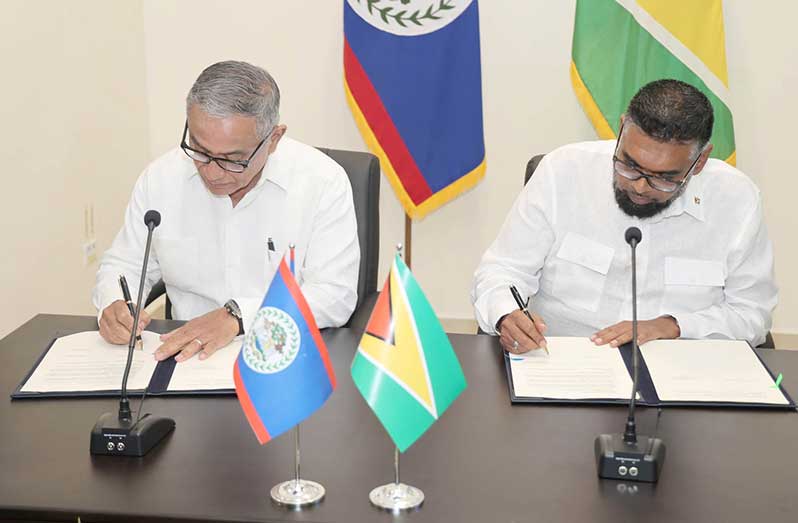
THE Governments of the Co-operative Republic of Guyana and Belize have reaffirmed their longstanding friendship and shared Caribbean values through the conclusion of a series of Memoranda of Understanding (MoUs) aimed at strengthening cooperation across key areas of mutual interest.
These agreements reflect the shared commitment of both governments to peaceful collaboration, respect for sovereignty, and practical cooperation that delivers benefits to their peoples while contributing to regional stability and development.
The MoUs establish broad frameworks for collaboration in areas including defence and security cooperation, education and skills development, tourism development, and economic engagement. They are guided by the principles of mutual respect, equality, reciprocity, and non-interference, and are consistent with both countries’ national laws and regional obligations under CARICOM.
In the area of defence and security, the governments have agreed to enhance cooperation focused on capacity-building, information exchange, training, and dialogue to address shared challenges such as transnational organised crime, drug trafficking, terrorism and other emerging security threats.
This cooperation is defensive in nature, non-binding, and aimed at strengthening institutional capabilities while supporting peace and stability in the wider Caribbean region.
In education, the governments have committed to expanding opportunities for scholarships, academic exchange, and skills development, including access to digital learning platforms. These initiatives are intended to deepen people-to-people ties and invest in human capital for future generations.
The tourism cooperation framework seeks to promote joint initiatives, knowledge-sharing, and sustainable tourism development, including opportunities for multi-destination travel, capacity-building, and diaspora engagement, with the goal of supporting economic growth and cultural exchange.
The digital transformation and artificial intelligence framework seek to improve government efficiency, effectiveness and implementation capacity.
In the area of investment, a Joint Statement of Intent to Negotiate a Bilateral Investment Treaty was issued signalling the readiness of Belize and Guyana to commence the process towards negotiation and successful conclusion of a bilateral investment treaty.
Together, these understandings form part of a broader effort by both governments to strengthen bilateral relations, encourage collaboration between institutions, and promote inclusive and sustainable development in keeping with shared Caribbean priorities.
The Governments of Guyana and Belize emphasised that these Memoranda of Understanding express mutual intentions to cooperate and do not create legally binding obligations. All cooperation will be implemented gradually, transparently, and in accordance with available resources and national priorities.
Belize has also confirmed its intention to join the Global Biodiversity Alliance which was launched by the President of Guyana in July 2025.
The Alliance is an open, non-binding platform that seeks to expand financial opportunities and cooperation by raising awareness of the biodiversity crisis and its linkages to climate change.
Both governments said they look forward to continued engagement and collaboration in the spirit of friendship, solidarity, and regional integration.
During his address to the Belizean Parliament on Monday, President Dr Irfaan Ali called for regional cooperation, diversification, and technological advancements to build resilience.
He noted that sustained investment in agriculture, modern technologies, and climate-resilient farming practices is critical to achieving food security.
“For Belize, Guyana and the wider Caribbean, food security must mean ensuring that all our peoples have reliable access to affordable, nutritious and adequate food,” Dr. Ali said, reminding of compounded pressures brought on by severe food insecurity, conflict, climate shocks, supply chain disruptions and economic volatility.
Building on CARICOM’s already established blueprint to cut food imports by 2030, Dr. Ali noted that there are enormous opportunities for greater collaboration, adopting new technologies and expand foods systems with other partners outside of the regional bloc, such as Brazil.
He stressed that small nations like Guyana and Belize should embrace such partners and new techniques to be more resilient and sustainable.
“Achieving these targets requires sustained investment in agriculture, the adaptation of modern technologies, the expansion of climate resilient farming practices, improved logistics and greater emphasis on value added agro processing, strengthening our Agri-food system is not only an economic necessity, it is a strategic imperative for resilience, public health and social stability,” President Ali said.