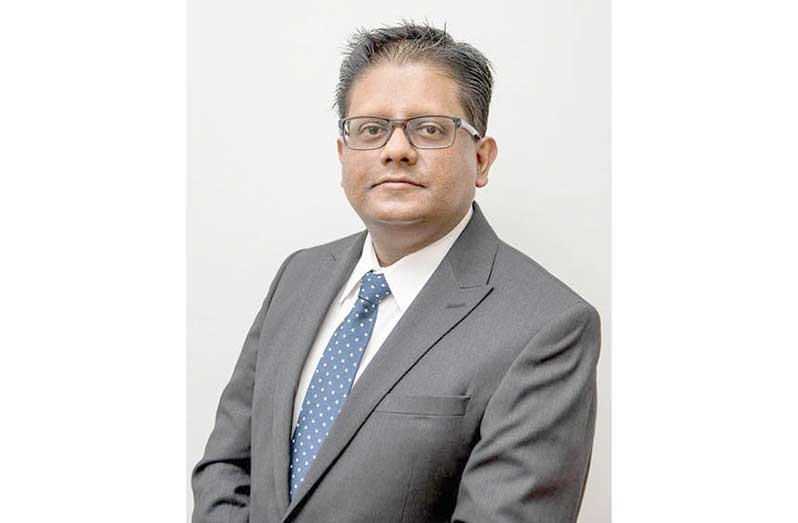
SENIOR Minister in the Office of the President with responsibility for Finance, Dr Ashni Singh, has outlined major investments in security, economic diversification and electricity infrastructure as central pillars of Guyana’s $1.558 trillion Budget 2026.
The budget was presented under the theme “Putting People First.”
Speaking during an interview on Hits and Jams 94.1 Boom FM’s programme on Thursday, Dr Singh said the government’s focus goes beyond headline figures and cash grants, and centres on creating a safe, productive and opportunity-driven society.
According to the minister, one of the most critical priorities of the 2026 budget is strengthening national security, recognising that economic progress must be matched with public safety.
“People want to be able to live in a safe society,” Dr Singh said. “When you work hard and accumulate savings, buy a home and a car, you want to know that those things are safe.”
The budget allocates significant resources to modernising the Guyana Police Force, including funding for new vehicles, training programmes, expanded bases and improved technological capacity.
Dr Singh explained that security planning now relies on a multi-layered approach, combining traditional policing with advanced technology and intelligence-led operations.
Among the initiatives highlighted is the Safe Country Initiative, which has seen the rollout of surveillance cameras across major roadways and junctions. These cameras, he said, have dramatically improved law enforcement’s ability to track and intercept suspects.
“If you have somebody fleeing in a motor car from one location to another, you’re now able to trace that with technology at a speed that was never previously possible,” he noted.
The government is also expanding forensic and data analytics capabilities, allowing investigators to use scientific and technological tools to solve crimes more efficiently.
Body cameras worn by police officers were cited as another important development, improving both accountability and citizen confidence.
“The body cam affords both the police officer and the citizen a level of protection and accountability that did not exist before,” Dr Singh said. “What we want is a citizen-friendly police force in whom citizens can have confidence.”
Beyond security, the finance minister placed heavy emphasis on strengthening the non-oil economy to ensure long-term stability. While Guyana continues to benefit from oil revenues, Dr Singh said lessons from other resource-rich countries show the danger of relying solely on one sector.
“We have become an oil and gas producer with what I call late movers’ advantage,” he explained. “We can look at what other countries did that worked and what did not work.”
He stressed that oil revenues are being used to build competitive industries outside the petroleum sector, including gold, bauxite, agriculture and tourism.
Gold production remains strong, particularly with global prices exceeding US$5,000 per ounce, while bauxite production is expected to cross four million tonnes in 2026 with new projects in Linden and the Berbice River area.
“There are more jobs being created than we are able to find people for in Linden,” Dr Singh revealed, adding that the government is prepared to fund training programmes so that residents can take advantage of employment opportunities.
Tourism has also seen unprecedented growth, with new hotels operating at near-full capacity and increasing demand for restaurants, tour operators, transportation services and community-based tourism.
“Whether it’s a hotel room or a hamburger, there is more demand than we are currently able to supply,” he said, pointing to rising disposable incomes and a growing working population.
A major infrastructure focus of Budget 2026 is electricity generation and distribution, long considered one of Guyana’s biggest obstacles to industrial growth. Dr Singh acknowledged that unreliable power supply has plagued successive governments and limited manufacturing competitiveness.
To address this, the government has already added 186 megawatts of generating capacity and is constructing a 300-megawatt Gas-to-Energy power plant at Wales. Once operational, the plant is expected to double national capacity and cut electricity costs by as much as 50 per cent.
“The cost of producing electricity will be dramatically less because we are harnessing our own gas instead of buying expensive fuel,” Dr Singh explained.
In parallel, major investments are being made to rebuild the transmission and distribution network and introduce a smart grid system to improve reliability and fault detection.
Dr Singh said these infrastructure investments will translate directly into higher disposable income for households and greater competitiveness for businesses.
From security reform to economic diversification and cheaper electricity, the finance minister maintained that Budget 2026 is designed to improve daily life while laying the foundation for sustainable development.
“What people want is opportunity,” he said. “A good job, a decent income, a safe community and the ability to live comfortably. That is what this budget is about.”