





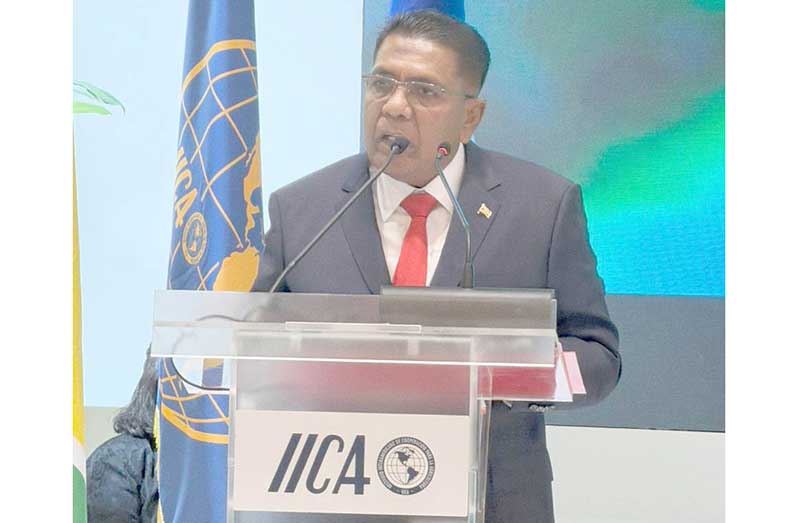
AGRICULTURE Minister Zulfikar Mustapha has warned that the most pressing challenges facing agriculture across the Caribbean and wider Americas, including climate volatility, food import dependency and the digital divide, require coordinated regional responses rather than isolated national efforts.
The minister made the remarks while attending the inauguration ceremony of Dr. Muhammad Ibrahim as Director General of the Inter-American Institute for Co-operation on Agriculture (IICA), a high-level event that brought together senior government officials and representatives from more than 30 countries across the Americas.
Addressing the gathering, Mustapha said the problems confronting the sector are regional in nature and must be addressed through collective action, with IICA playing a central role as the technical partner supporting member states.
“The challenges before us — climate volatility, food import dependency and the digital divide — are regional in nature, and so too must be our solutions,” he said, adding that IICA has a critical role in translating regional policy into practical results across its 34 member states.
The minister pointed to Guyana’s investments in digital agriculture as examples of initiatives being developed with wider regional integration in mind. He cited the planned Real-Time Agriculture Situation Room, the “Farming in the Palm” mobile application and the proposed Centre of Excellence for Agricultural Studies, noting that while these are national projects, they are intended to support a future CARICOM-wide digital ecosystem.
Mustapha also said IICA itself will need to continue evolving to remain effective in a more complex global environment. He said the institution’s internal structures must be aligned with emerging priorities such as digital agriculture, climate-smart production, investment facilitation and regional health security.
Under CARICOM’s policy direction, he noted, agriculture and food security remain key priorities, guided by decisions of the Council for Trade and Economic Development (COTED). He highlighted COTED’s decision to fully operationalise the Regional Electronic Marketing Information System, developed with IICA’s support, which is intended to improve market transparency, link buyers and sellers, and support the region’s “25 by 2025 + 5” food security target.
“This system is critical to dismantling information barriers and making regional trade a practical reality,” Mustapha said, adding that improved data-sharing and co-operation will be essential to advancing intra-regional trade and making better use of each country’s comparative advantages.
On food safety and market access, the minister said CARICOM has endorsed the Codex Alimentarius Awareness and Capacity-Building Initiative being led by IICA, stressing that stronger regional influence in international standards-setting is vital for protecting consumers and securing export markets.
He also pointed to regional health security as a growing concern, particularly the threat posed by transboundary animal diseases such as African Swine Fever. He said IICA’s work in coordinating regional preparedness, harmonising protocols and strengthening laboratory capacity reflects the “One Health” approach to protecting livelihoods, food supplies and public health.
Looking ahead, Mustapha said CARICOM expects IICA’s leadership to help guide the region through what he described as a decisive decade for agriculture. He outlined priorities including accelerated digitalisation through integrated regional systems, the expansion of climate-smart agriculture — including innovations such as Guyana’s GUYIICA-17 biofortified rice — stronger and more resilient value chains, inclusive growth that benefits small farmers, women and youth, enhanced regional health security, and a renewed focus on nutrition and human capital.
He said these measures will be critical to improving food security, strengthening regional integration and ensuring more sustainable agricultural development across the Caribbean and the wider Americas.





