






AS Amerindian Heritage month activities continue, President Donald Ramotar Saturday travelled to Karasabai , one of the largest communities in the South Pakaraimas that has been designated the 2013 Heritage village, to join in the celebrations.
 A traditional welcome awaited the President and his delegation, including First Lady Deolatchmee Ramotar; Minister of Amerindian affairs Pauline Sukhai; Toshaos and Region 9 officials.
Outriders on horseback, children adorned in traditional Amerindian head-dresses, and outfits made of plant materials, escorted the visiting delegation from the airstrip to the area prepared for the celebration. Delegates of the Miss Amerindian Heritage pageant were also introduced.
The president was given a military salute standing under the Golden Arrowhead and as the packed agenda of speeches and cultural performances started, the unique way in which it was done was noteworthy.
Karasabai is occupied by the Macushi tribe with a population of 1600, and as they reflected on the theme for this year’s heritage celebration, “Honouring our culture; advancing our future,” introductory remarks, prayers, songs and even the National Anthem were done in Macushi.
Chairman of Region 9, Wilson Lorentio, brought greetings on behalf of the regional administration, doing so fluently in Macushi.
The president conveyed his great admiration for the people’s way of life, firstly as custodians of the forests whose practices have left little or no footprint, and as preservers of a unique culture.
“Nations in the Amerindian communities have a lot to offer in promoting culture in our society. That is why our government is paying a lot of attention to preserving the various languages of the Amerindian nations,” President Ramotar said.
Language, an important component of the Amerindian culture, is the priority of a five- year strategic plan by the Ministry of Amerindian Affairs that will seek to promote the languages spoken by the nine Amerindian tribes of Guyana.
Minister Sukhai told the gathering at Karasabai that a language session for children in Lake Capoey, Region 2, will be launched on September 19, marking the beginning of a venture to revive the dying languages of a few of the tribes.
‘There is hardly any of the Arawak, Carib or Warrau population speaking their languages; and therefore, in the other regions like 7, 8 and 9, we stand tall and proud that our people continue to maintain their languages,” she said.
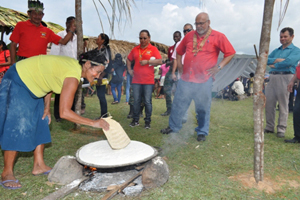
Other aspects of the Amerindian culture, such as cassava bread, were on display when President Ramotar toured the village. He sampled some of the cuisine and visited booths while the First Lady took interest in the farming aspect of which she is quite fond.
Sustained livelihood practices in Amerindian communities have been boosted since the creation of an Amerindian Development Fund (ADF) which has aided in economic viability of villages.
Karasabai has benefited from tremendous development to the extent that it is now considered one of the most developed hinterland communities. Presidential grants have funded the construction of a village shop, while capital projects saw the purchase of mobile equipment and the construction of a village market building.
The village is also equipped with a modern nursery and primary school, teachers’ quarters, health centre, two health posts, Regional Democratic Council administrative building, police station, guest house, village office, churches and an airstrip.
Taking into consideration the situation that prevailed in the past, when there were few schools, today there is success in hinterland education as investments by the PPP/C Government are bearing fruit. President Ramotar made reference to Paramakatoi and Kato, Region 8, where there are secondary schools with dormitories and commendable performances of students at the Caribbean Examinations Council (CXC) was noted.
Two years ago, the top student at President’s College was a young lady from the North West District, an Amerindian girl, and this year another Amerindian from Tapakuma in Region 2 wrote 19 subjects and she passed all of them, so we are beginning to see that investment in our people is beginning to pay off,” President Ramotar said.
It is the Head of State’s view that an educated population in the hinterland is a sure way of promoting economic development. As a child growing up in a tranquil Amerindian village along the Essequibo River, Karia Karia, President Ramotar spoke of the tyranny that the Amerindian people suffered in the era of colonialism and the window of opportunities that was provided when the People’s Progressive Party/Civic took office in 1992.
The Amazon Cooperation Treaty Organisation (ACTO) recently hailed the Guyana Government’s efforts at promoting the development of the indigenous peoples, as member countries met for the 5th meeting of high authorities on indigenous affairs.
Meanwhile other activities, including an evening of reflection on Stephen Campbell, the first Amerindian parliamentarian, sports activities and a pageant are on the agenda to be observed for Amerindian Heritage Month 2013. (GINA)




