






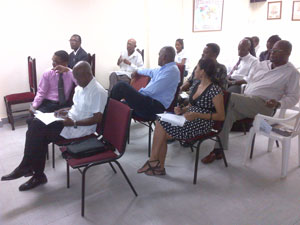
 Based at CARICOM Headquarters at Liliendaal, Greater Georgetown, the team comprising personnel from several Caribbean nations, will be conducting similar meetings in those countries. Already, Barbados has completed its rounds and Guyana is the second nation to take part in the discussion, with members of the media being the first to be engaged by the group.
President of the Guyana Press Association, Mr. Gordon Moseley, registered to a CARICOM Change Team last Monday his concern about the hassles faced by Guyanese journalists in respect of the free movement of skilled persons within the Region. Moseley pointed to instances in other Caribbean countries where qualified Guyanese journalists who have their certificates from the Caribbean Single Market and Economy are being asked to apply for the very certificates they possess when they enter those countries.
The request is being made although heads of governments of the Caribbean have years ago signed on to an agreement that only one certificate would be needed to offer skilled Caribbean nationals employment in any member state.
The Change Team was also told that some countries have taken a position that although they know that the vacancies are available, their officials would have to ensure that no one in their country is eligible to take the job before it is awarded to a Guyanese.
And despite the free movement of Caribbean nationals within the Region, there is still that bench at the Barbados Airport, the occupancy of which Guyanese are seldom spared whenever they enter or leave that country.
The hallmark of the Change Team was the presentation, to the conference of the heads in 2012, of a consultation report on the issues which need to be addressed in order for the Caribbean community to succeed.
Among the issues being focused on in the change-facilitation process are reforms of the institutions of CARICOM; roles and responsibilities within CARICOM; agricultural, economic and energy security; regional transport; climate change; economic growth and development; youth; ITC; and services.
Journalist Julia Johnson told the team that Guyanese are often placed on the bench and asked several unnecessary questions before they can enter the country. However, for members of the media, she added, there seems to be some caution adopted by the Barbados immigration officers, probably fearing the press and publicity of any adverse actions.
Ms Johnson said the restrictions to free movement of Caribbean nationals within the Caribbean Region are not just confined to Barbados. She pointed to a recent trip to St Vincent in which she was asked by immigration officers to lodge her passport before they could determine how long she would be allowed to stay on that island.
Ms. Johnson also pointed out that, while not very often publicised, Guyanese who are in-transit at the Trinidad main airport, or who are trying to enter that country, are subjected by immigration officers to the same treatment they get in Barbados.
 She produced statistics for a specific period which showed that more Guyanese have been barred from entering Trinidad than those that have been barred from entering Barbados; and said that the treatment of Guyanese and other nationals entering any Caribbean country should be addressed forthwith, since it has now reached a disgusting state.
Caribbean Airlines did not escape criticism for its position to charge Guyanese in some cases double the fares Trinidadians and other CARICOM nationals pay to fly with that airline. While admitting that the airline is owned by the Trinidadian people and it may want to ensure that its nationals receive special prices for tickets, she said it has been proven that the prices for tickets purchased in Guyana for flights on that airline are jacked up, and sometimes Guyanese purchasing tickets in Trinidad itself find the prices have been jacked up.
Guyanese journalist Enrico Woolford weighed in on the issue of management of the Region’s resources. He said the way the resources of the Caribbean Community are being utilised by its heads is a cause for concern, and should be addressed in a five-year plan being developed by the CARICOM Secretariat to ensure the integration process works, and that its successes are felt by the ordinary citizens of member states.
Woolford pointed out that heads of government of the Caribbean are themselves guilty of misusing the resources of the Region. He said one of the biggest problems of the Region is the lack of coordination.
The veteran journalist said CARICOM seems to be having much difficulty in implementing those aspects of agreements and resolutions that are implementable, or they are just downright not being implemented at all.
He said there were a few things that were tried and proven, and those things should be capitalised on and left in place. Reference was made to the successful implementation of the security arrangements which were adopted across the Caribbean when the Cricket World Cup games came to the Region in 2007.
Woolford also pointed to the need for there to be consideration of a common tax across the Region for regional transportation, especially with regard to LIAT, which at the moment is forced to pay varying taxes whenever it lands at airports in the Region, and that is putting a financial burden on the company. This is despite the very vital role the airline has been playing to ensure that the Caribbean remains linked, and the facilitation of the movement of goods and services.
The suggestion was made that coming to an agreement on a common tax will not hurt the economy of the individual member states, since that tax would be applied only to regional airlines, while those travelling into the Region from other nations can be made to pay individual taxes imposed by each member state.
The implementation of such a system, Woolford added, would see facilitation of the movement of Caribbean nationals around the Region, since such a system would bring ticket prices down, and the number of Caribbean nationals travelling around the Region would increase.
Meanwhile, former president of the Guyana Press Association and administrator of the online news site ‘Demerara Waves’, Denis Chabrol, suggested that the Region implements a regional fast-ferry service which would be able to provide a similar service to that of LIAT, but this time linking the Caribbean through the waterways. He urged CARICOM to ensure that they find the mechanisms to put such a system in place.
He also pointed out that the Caribbean Region is not adequately using technology and ICT to develop and link the Region.
There was also the issue of CARICOM officials becoming available to speak with the media on matters of concern to the Region, and which affects the well-being of those who live within. There was reference made to the soon-to-be-held CARIFESTA, which has now taken on the dimension of a business venture, but there is no one who has made himself or herself available to explain to the media the benefits to the Region that the transformation would bring.
There was also representation by the Catholic Standard in the person of Colin Smith. Smith asked the panel why the Caribbean needed to look at the United States for a report on human trafficking, gay rights, and other issues, given human resources of the Caribbean and the Caribbean people’s unique ability to gather and compile such information.
Meanwhile, acting CEO of the National Communications Network, Michael Gordon, said CARICOM needed to pay attention to its relevance and recognition, since the entire CARICOM movement seems to be reduced to a state in which there is no relevance and recognition with respect to CARICOM.
Gordon said that CARICOM needed to understand and take stock of what its resources are, and what are its liabilities. Gordon, also an executive member of the Caribbean Broadcasting Union, pointed out that one of the greatest assets of the Caribbean are the media.
According to Gordon, one of CARICOM’s greatest faults is its under-utilisation of the Caribbean Media Corporation (CMC). He said that, as it is, the Caribbean Broadcasting Union has practically given up on the heads of Caribbean governments.
It was also pointed out that there seems to be some amount of mistrust at the highest level in CARICOM, and that is responsible for some of the problems being faced, and the failed initiatives of the community.
The CARICOM Change Team was expected to meet with several other groups over a three-day period in Georgetown, including the private sector, religious organisations, Members of Parliament and other stakeholders.
*** PULL QUOTE:
Local journalists lament treatment of Guyanese by CAL, T&T and Barbados immigration




