






IN an attempt to combat organised crime, the Government of Guyana has hired four highly-qualified forensic experts for the next three years. These individuals will be assigned to the Guyana Forensic Science Laboratory (GFSL).
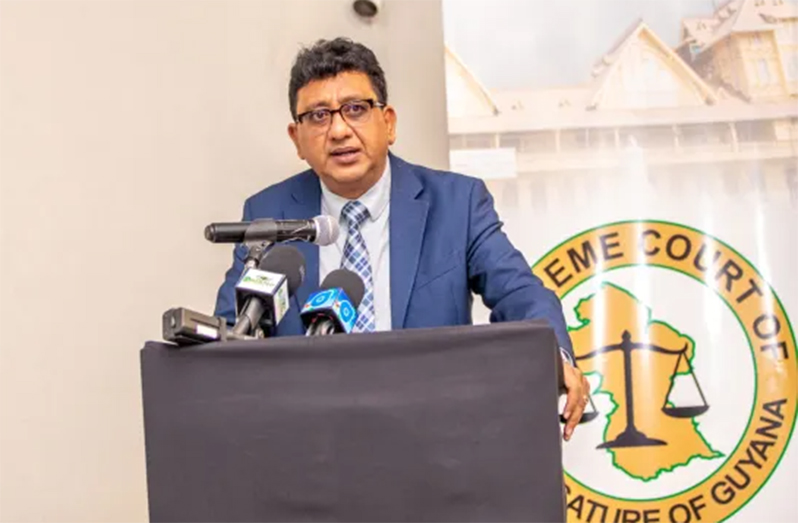
This announcement was made by the Attorney-General (AG) and Minister of Legal Affairs, Anil Nandlall, S.C, during the opening of the Regional Security System (RSS) Asset Recovery Unit’s (ARU) Financial Investigation and Asset Recovery Workshop for Judicial Officers, on Monday.
He remarked: “The government also recognises the importance of scientific type investigation. Crime and criminality is now becoming very, very sophisticated… [The] Government is committed to equipping our forensic laboratory and adding to what is there already.”
“We have [recruited] four highly qualified forensic experts who are going to be attached to [Guyana Forensic Science Laboratory] for the next three years.”
Furthermore, Nandlall said that he had discussions with the University of Guyana (UG) and asked the institution to collaborate with the recruited forensic experts in order to craft a training programme.
“I have also asked the University of Guyana to sit with those experts and work out a training programme in forensic science,” the AG said, adding: “So we [The Government] have a very comprehensive approach going forward.”
Moreover, he stated that the workshop was a clear indication of his administration’s dedication to ensuring that Guyana has a robust financial system and the capabilities to tackle new challenges that certainly will emerge from the growing and expanding economy.
“What is represented here is the state of Guyana’s commitment to battle organised crime,” the Minister of Legal Affairs said.
Also present were: Chief Justice (ag) Roxane George, SC, and Chancellor (ag) of the Judiciary, Yonette Cummings-Edward.
Acknowledging that with the growth of an economy, there is need for the enhancement of one’s knowledge and the application of the law across Guyana, the Chancellor remarked: “With our rapid economic transformation, there is increasing collaboration on regional practice to enhance our knowledge and apply the law across the length and breadth of this country. As we engage in discussion and interactive session, I encourage each of us to actively participate and share our perspectives,” adding that “this will aid and this collaborative approach will encourage productive understanding and strengthen our ability to plan.”
IMPROVEMENT
Recently, Home Affairs Minister, Robeson Benn, shared updates on Guyana’s progress in optimising its DNA-testing capabilities.
He had explained that the country had acquired new equipment, some of which is currently undergoing testing to enhance the lab’s DNA processing capacity.
Benn reported that a rapid-testing device was already operational, while another more complex yet efficient machine was in the validation, testing phase.
Minister Benn acknowledged previous setbacks with a machine procured by the previous government, and he emphasised the importance of ensuring the quality and reliability of the equipment.
To illustrate the lab’s current capabilities, Minister Benn mentioned that DNA samples from skeletal remains discovered in Guyana were being tested locally. However, to ensure smooth prosecution in court and until the equipment is certified, some samples will still be sent abroad for testing.
The Guyana Forensic Science Laboratory initiated DNA testing in June 2019 after acquiring crucial equipment with funding from the Inter-American Development Bank (IDB). That equipment included DNA testing equipment and a Gunshot Residue (GSR) testing device, collectively valued at US$465,000.
Last year, the Guyana Parliament’s Committee of Supply approved $50.5 million to further support the GFSL, specifically to acquire additional DNA equipment. The introduction of DNA testing has been instrumental in various criminal investigations, reducing the need to send samples overseas for testing, which often led to significant delays in obtaining results.
DNA testing at the GFSL involves comparisons and matching of evidence to suspects, family testing (even when the suspect’s DNA is unavailable), and paternity testing. A wide range of samples, including cheek cells, semen, vaginal secretions, hair, blood, and touch DNA, can be collected and submitted for testing.
The GFSL was established in 2014 and comprises four analytical departments (toxicology, documents, trace evidence, and Chemistry) and six non-analytical departments (security, quality system, information system, facilities operation, evidence, and administration).




