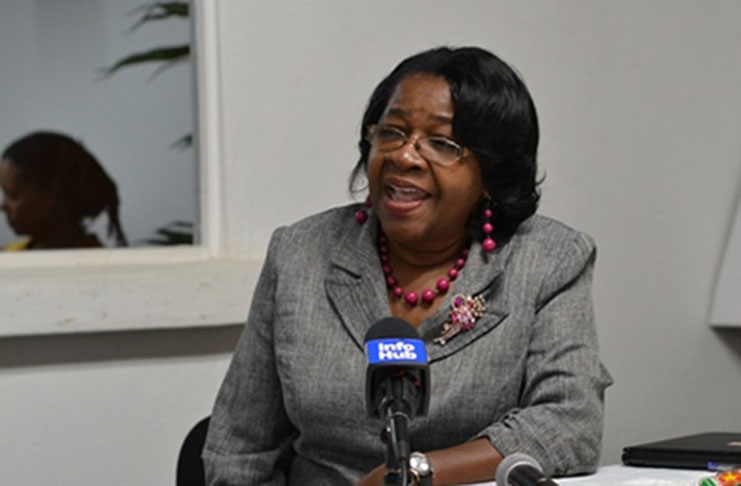
MEMBERS of the public and media engaged senior officials of the Ministry of Education (MOE) on Friday via a live webinar on a number of concerns they have in relation to the re-opening of schools and the upcoming national and regional exams.
One of the first matter addressed questioned Guyana’s conceding to the Caribbean Examination Council (CXC) dates which set the Caribbean Secondary Examination Certificate (CSEC) and the Caribbean Advanced Proficiency Examination (CAPE) for July.
The same matter also dealt with why the MOE decided on a similar July timeline for National Grade Six Assessment (NGSA) exams given that this exam date is controlled by the country and not the CXC.
WE OBJECTED
Superintendent of Examinations, Sauda Kadir, explained that, when it comes to the dates for CSEC and CAPE, there was no position that Guyana could have taken individually without the backing of a majority of the other Caribbean countries. “CSEC and CAPE are Regional examinations and even though Guyana did mention and voiced our opinions as to the various options that were presented by CXC, the vote was taken by the regional body to have the exams administered in July,” she said.
Kadir reminded that they were initially scheduled to commence on June 29, 2020 but Jamaica requested additional time due to its challenges and they were postponed to July.
Meanwhile, regarding the NGSA exams, Director of National Centre for Educational Resource Development (NCERD), Jennifer Cumberbatch, said that the Education Ministry was first examining June but this proved impossible.
They considered that the exams were only for two days and could not be held simultaneously with CSEC and CAPE. With CXC having revealed its timelines for the aforementioned exams, Cumberbatch said that the MOE decided to put the NGSA exams in the same month but just a little earlier.
“We looked at all the alternatives, we looked at if we went into August or September. You’d be shocked at the various problems that we would have. So, we thought that for the first two days we will have our children,” she said.
The NCERD Director said that the period would also ensure that the MOE capitalises on one stretch of period in which the Ministry of Public Health COVID-19 protocols could be implemented at schools.
OUT VOTED
Questions were also asked about what level of representation was made by the MOE for Guyana to the CXC regarding the moderations to CSEC and the CAPE due to setbacks arising from the pandemic.
The modified examinations strategy provides for only one common paper (Multiple Choice Assessments) along with School Based Assessments (SBAs) for public candidates and one common paper and Paper 032s (Alternative to SBA) for private candidates.
Chief Education Officer (CEO), Ingrid Trotman, said that Guyana made known its disfavour for the said decision both at local meetings and at the Council for Human and Social Development (COHSOD) – Education where Guyana was represented by Minister of Education, Dr. Nicolette Henry.
Trotman explained: “It was done on a voting basis. We objected to the structure of the CSEC examinations —- and that is the SBAs and the paper one only. The minister from Jamaica objected, the minister from Trinidad and Tobago as well as Antigua and Barbuda, but that was only four countries. All the other countries, if I’m not mistaken, about 11 other countries, they opted for the modified version of the CSEC and CAPE and so they had total majority over the four countries that objected, so that is why that plan went forward. The minister made representation fully for Guyana but, as I said previously, this was on a voting basis.”
As a result, Kadir said that the modified CSCE and CAPE exams do not cater for modern languages, Human and Social Biology (HSB) and visual arts.
Modern languages which include Spanish, French and Portuguese will have to see additional components taken for the subjects; HSB which does not have an SBA component will see candidates having to complete papers one and two; and visual arts candidates will be expected to submit only, a ‘reflective journal’ and their pieces.
HEALTH CONCERNS
Meanwhile, fielding questions about health and safety, Director of National Centre for Educational Resource Development (NCERD), Jennifer Cumberbatch, assured that teachers will be trained on COVID-19 protocols for one week from June 8, 2020 to cater for the return of students on June 15.
She said that when students arrive, they too will use the pre-examination period to learn and adhere to the necessary guidelines. Should a student or teacher show symptoms of COVID-19, she pointed to the MOE’s gazette Order which mandates that sick bays are present at each school for isolation until medical personnel arrives. Added to this, Cumberbatch said that community health centres will also be on stand-by on the exam dates.

The Superintendent of Examinations said that the Education Ministry is also working with private schools to ensure that they understand the Standard Operating Procedures (SOPs) and conduct its own visits and monitoring.
Some parents of NGSA candidates are, nonetheless, worried about the safety of their children while in schools and some are considering bypassing the exams for a placement test. Trotman informed the public there is nothing the MOE can do to force parents on either route but they should note that their children will be placed at the secondary school closest to them for one year.
“If they satisfy the criteria, they can write the placement exams in the next year of July and they have to get over 70 percent in order to be placed at a school of a higher level,” she explained.
HINTERLAND STUDENTS
Concerns have also come from the Amerindian Peoples’ Association (APA) which stated recently that children in the hinterland may be at a disadvantage for the upcoming exams because they hadn’t access to the all the necessary work books or online learning information compared to those in the hinterland.
The media posed this issue to Assistant Chief Education Officer (ACEO) – Primary, Carol Benn who said that the MOE has ensure that learners in the hinterland each received past papers for Grades Two, Four and Six assessments as far back as 2017. She said that they were also issued with work sheets which teachers distributed to individual homes and teachers are to ensure continued learning.
Meanwhile, Assistant Chief Education Officer (ACEO) – Secondary, June-Ann Gonsalves said that, catering for students who could not access the information provided by the MOE online, teachers prepared worksheets and distributed these to learners.
“We are aware that because they could not have gotten some of the stuff that was available from the zoom and our website, the teachers themselves prepared worksheets and they were sent to the different villages for those areas that we could not have gotten contact with,” she said.
Gonsalves that she feels comfortable with the level of engagement had with MOE officials, noting that there were several regional meetings held as well.
Should the national COVID-19 health situation appear to be flattening out by September 2020, the CEO said that the MOE will consider the changes needed to the academic year. Either way, she said that the first term of the new school year will first see two to three weeks of revision from where the children last left off.
She stated, “I know some children would take a longer time than others [so] what we also have in mind is a diagnostic assessment to be done in order to fill that gap.”