






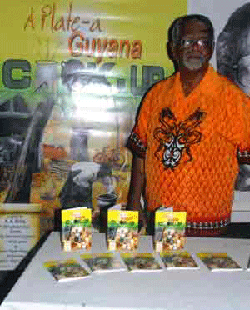
-according to Alan Fenty (Part II)
(Extract of an interview with Alan Fenty, Georgetown, Guyana, April 2011 a few months after he launched his book, ‘A Plate-a Guyana Cook-up’ in February 2011. Fenty is an educator, folklorist, editor, television producer and columnist.)  PP: This ought to be a good time to discuss what a proverb is.
AF: There are about ten definitions for a proverb, but I prefer Eusi Kwayana’s definition. He says that a proverb is ‘a simple, usually concrete saying that expresses practical wisdom.’ Some people say adage, axiom, maxim, short ‘pithy’ statement that expresses some wise thought. In short, it is words of wisdom; it is a fascinating subject.
Would you believe it? I purposely avoided reading Richard Alsopp’s big version, partly because I can’t afford it. And because I told myself not to; until I finish my portion here. This (‘A Plate-a Guyana Cook-up’) is tribute to all who have gone before me.
The advantage here, Petamber, is that my own is being done in this year, at this time, when our young people are veering away from our oral traditions, and our ring-games and our creole legacy, in terms of speech patterns, creole poems and so on. But there is a great battle going on, and your programme and some work being done by some playwrights, even on ‘Merondoi’, the current radio serial, you get beautiful language coming out of that.
PP: Margaret Lawrence made reference to your book as a source material.
AF: The battle is on, and I don’t want to be quoted as saying that we would lose because of American Soap Operas here, video games, Internet, cable… You can now get sixty-four channels. I don’t know how many backyard storytelling we have now; ole people sitting on the back step telling stories…
PP: Storytelling! Aaahh! My pet peeve!
AF: That still goes on now?? I know you try with it at Castellani House and other venues. I want to know if somewhere in Ann’s Grove or somewhere else, if people sit down now to tell stories like long ago in the moonlight, under the calabash tree. What I know [is that] the boys and girls are in the village, perhaps playing pools and video games at the same time; I don’t know how they do it…
PP: Let’s get back to my pet peeve: Lack of storytelling. I think we have lost our way; we have lost our community spirit. So many things can and ought to happen during a storytelling session. Elders can pass on values of life; how to deal with man/woman issues. Youths can be encouraged to express themselves in this friendly atmosphere, which would lead to clearer thinking and better expression in real-life situations. So, it is my contention that because we’ve lost the art of storytelling, we have lost our way; our community spirit.
AF: I would go a step further and say because parents have stopped talking to their children; not only telling them stories.
PP: Storytelling affords that opportunity to interact…
AF: Interact!!! All you hear today [is]: ‘I’m a single-parent.’ The harried mother gets home in the evening, burdened to look after three/four of them; get things ready for the next day. The father is not often there; if he comes home at all. I am a single-parent; my children are all grown; but my heart goes out to those single-parents of today. What time do they have to sit and tell stories to their children?
PP: If it is something of importance, you ought to speak to your children; and children ought to speak to their parents.
AF: Oh yes!
PP: This argument misses the point: The value and importance of our oral traditions…
AF: I’m cutting in here before I lose this thought. Let me talk about my situation: I have two girls. Growing up in Kitty (Pike and Lamaha Streets) where I had this house… My wife and I were both teachers, and I had an old bicycle. And we were poor. At that time, we had to ‘trust’ from Chan, the Chinese grocer man. Yes! We were poor, but I insisted on novels in the house; books — colouring books. And (as I was at the Curriculum Centre) I used get hold of supplementary readers — the Burnham Government wanted local literature for schools, so we started to write; Ovid Isaacs and others. And a lot of artists came out of that scheme; Harold Bascom and many others…
Books were a must in my house. And I am now proud to say: When go to my daughters in the States, a library in the home is a must! I want to appeal to Guyanese parents now: Get hold of the newspapers! Even if it is one per week, despite the fact poor people got to choose between the cost of an egg and the cost of a newspaper. Having said that: You can’t fry the newspaper! But seriously: Parents, get newspapers in the home! Colouring books… I know you have to buy the books for the Grade Six examinations and the CXC; but get hold of other books — reading books; reading for pleasure.
I know, Petamber; your home has a library…
PP: Yes; always; then and now. And my children love to read. I remember growing up in my parents’ home and visiting other homes, there was the inevitable bookshelf; that single bookshelf loaded with books staring at you in the living-room. Parents were proud to be associated with that single bookshelf; it created that climate…
AF: You don’t even have to read. Play with the books; get the feel. My granddaughter, when I visited her in the States, they say, ‘Look! She tek after you!’ And now she is doing English at a very prestigious college.
Yes, Guyanese parents, this in not only to do with ‘A Plate-a Guyana Cook-up’, but have your children read, because, even with the television, they have to read…
PP: And read faster. And with the computer and the superhighway of knowledge, the Internet, now you have to be able to read and comprehend faster.
AF: With the Indian movies and the African movies, with fast, running subtitles, you have to know to read and read faster. I trust reading is being taught, not as a harsh something to be examinable, but for people to be literate, and understand what’s happening around them.
PP: Years ago, there was a stigma attached to Creolese; it was snubbed at. I recall Vibert Cambridge referring to the efforts of Vesta Lowe and others trying to promote folk music, and they had a tough time.
What do you think about using our Creolese in the school system?
AF: An age-old debate; an age-old debate…
What’s Happening
• ‘Literature on Television’, comprising of ‘Oral Tradition’ and ‘Between the Lines’, is celebrating its 10th anniversary with the rebroadcast of some signal features including copyright, cultural industries, literary criticism, reading for pleasure, writers workshops, editing, and preparing manuscripts for publication (and literary prizes). Both programmes are aired on NCN; ‘Oral Tradition’ is on Wednesdays at 2035 hours and ‘Between the Lines’ – first Sunday each month at 2100 hours.
(To respond to this author, either call him on (592) 226-0065 or send him an email: oraltradition2002@yahoo.com)




