
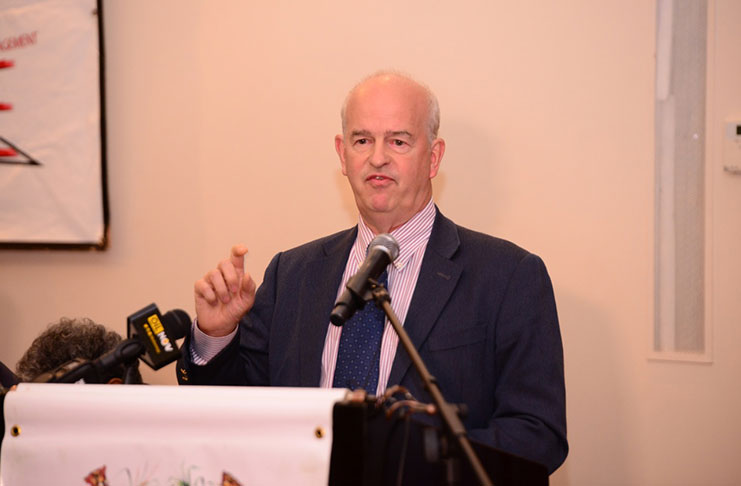
— former BP President urges Guyana
FORMER President of BP Asia-Pacific and China and Professor at the Arizona State University, Gary Dirks, has opined that Guyana should exploit its abundant natural resources to propel its Green State Development Strategy (GSDS).
According to Dirks, the energy sector globally is under tremendous pressure to evolve due to multitude of new technologies, new entrants and new expectations.
“Climate change is an extraordinary driver of change,” he said, adding that there is no doubt that climate change is a real phenomenon.
The occurrence of higher rates of climate change, particularly in warming the earth, has led to governments considering alternative and renewable pathways of energy, such as hydropower and solar energy.
Soon enough, he opined that the energy system will have to be pushed to net zero emissions, instead of the 100 per cent renewable energy.
“We will be required to take carbon dioxide out of the atmosphere, which will come with a price tag,” Dirks posited, adding: “Carbon taxes are coming and anybody that is thinking and planning for energy, needs to take that into account.”
Currently, in the Development Strategy: Vision 2040, of the GSDS, infrastructural development encompasses power generation from renewable energy sources, as a key driver of the economic transformation.
“Energy is the lifeblood of any economy, no matter how big or how small it is, but you don’t produce energy for its own sake, you produce it for what it can do,” he said, noting that the energy sector must be affordable, reliable and accessible.
According to him, because of the wealth of natural resources available, beyond oil and gas, Guyana can use these resources to push its “green development strategy”.
“There is an extraordinary opportunity for the country to use the [natural] resources that you have to stimulate a broader growth in the economy, and the economy of Guyana must grow and the economy of the world must grow,” Dirks said.
With oil revenues coming on stream, he said the country will be in a better position to propel the GSDS, which will in turn drive the economy.