






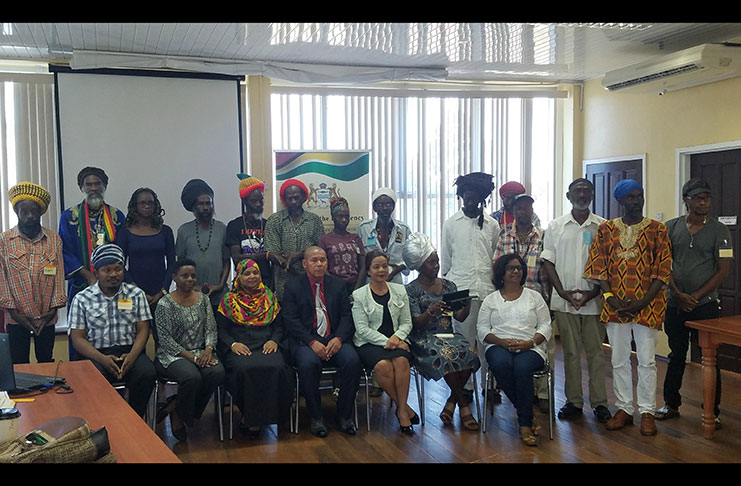
THE Department of Social Cohesion has begun training with the Rastafarian Core Group geared at promoting diversity education and inclusion in society.
The two-day training commenced at the Racquet Centre, Woolford Avenue, Georgetown on Wednesday.
Minister of Social Cohesion Dr. George Norton said the training aims to promote the notion of love, fairness and acceptance, regardless of differences.
“We hope that we will be able to have this opportunity for what is referred to as introspection. What we’re doing is looking at our own biases as individuals. This is so important because it is the only way we can be able to accept others…. We want to be able to look at others who are a little diverse from us and see beauty in this diversity in which we ourselves are a part of,” Dr Norton said.
He also noted a continuous increase in the membership of the Rastafarian Committee and deems it a movement of progress.
The minister understands that most of the Rastafari teaching comes from Marcus Garvey and it might have started with the thrust for ‘Black’ superiority.
However, he noted that the Rastafarians, when they established themselves, recognised that that might not be the best approach.
“It is much more of a message of equality rather than that of superiority that you have embarked on. And it is for this reason we are here so that we can look at the strength of equality, rather than that of superiority,” Dr Norton said.
Social Cohesion Department acting Coordinator, Natasha Singh-Lewis, said the training helps participants to learn about who they are as a person, understand biases and prejudices and diversities and how these affect national unity.
“The workshop objectives speak to participants exploring the negative internalised attitudes, beliefs and stereotypes that impact the ways in which they perceive themselves and others. It is also intended to assist participants to have a better understanding and appreciation for diversity, particularly beyond race and ethnicity,” Singh-Lewis said.
The training also sets out to help them learn about the changes and challenges that are associated with Guyana’s diverse population, and have a greater commitment to contribute towards nurturing individual, community and cross-community relations.
At the end of the workshop, it is expected that the participants would be more aware of how they can contribute to building better relations in society.




