
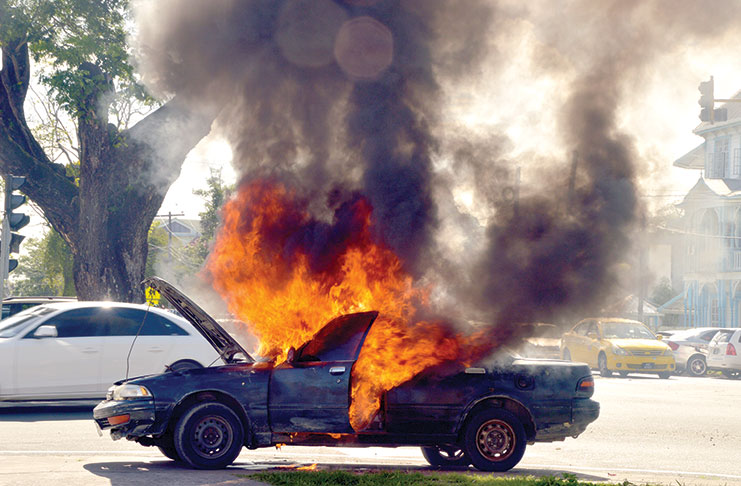
RECENTLY, a number of vehicles have caught fire and while many persons have speculated that these fires were caused by the ‘new fuel’ being imported by the government through the Guyana Oil Company (GuyOil), experts disagree.

On February 4, the Ministry of Finance and GuyOil announced a significant reduction in the cost of motor gasoline and Gasoil (LSD), owed to the lower fuel acquisition prices.
Following the closure of the Trinidadian company Petrotrin – Guyana’s main fuel supplier, the government had approached Caribbean Community (CARICOM) for the suspension of the Common External Tariff (CET). CARICOM’s approval of this allowed Guyana to acquire fuel elsewhere and at a reduced cost.
The acquired fuel, Super 95 Gasoline, was wholesaled at $208.00 per litre, while the Gasoil (LSD) was sold at $207.00 per litre. These represented a 27.44 per cent and 15.85 per cent reduction, respectively.
On the other hand, retail customers would pay $218.00 per litre of the Super 95 Gasoline – which is a $30.77 reduction from the current prices, and $217.00 per litre of Gasoil (LSD), a $19.72 reduction.
But days after the reduction was announced and drivers began filling up their tanks, two vehicles caught afire.
The first incident occurred at around 08:30hrs on February 6. A minibus contracted to work with the Guyana Power and Light (GPL) caught fire on Sheriff Street on the western carriageway. At 09:00hrs that same day, in another part of Georgetown, on the western carriageway of Avenue of the Republic, motorcar PJJ 5656 burst into flames. In both instances, it was reported that the drivers noticed the vehicles emanating smoke from the bonnet.

A third vehicle, a minibus carrying passengers, also caught fire the next day, but this vehicle had collided with a utility pole.
With these vehicular fires occurring only days after the new fuel was introduced to the local market, many speculated that it was the cause of the problem.
NOT A FUEL PROBLEM
Martin John, a mechanic at Bonedry Autoworks, Mandela Avenue, Georgetown, indicated that it is “largely unlikely” that the fires were caused by the fuel for a number of reasons.
John explained that when fuel is put into a vehicle, it goes into the gas tank, where it is stored for use. There is a fuel pump in that tank which is responsible for pushing the fuel through pipes (also called fuel lines) to the engine of the vehicle. Before it reaches the engine; however, the fuel must pass through the fuel filter, which, as its name suggests, removes any impurities from the fuel. The fuel then goes through the vehicle’s injector to the combustion chamber of the engine.
In simple terms, what the engine does is burn the liquid fuel to create a heat that works in conjunction with other parts of the vehicle to allow the vehicle to move.
What is important to note, is that fuel travels throughout the vehicle along sealed lines that are manufactured to prevent combustion.

“Some leakage has to happen; the fuel can’t catch afire just like that. A leak would happen maybe if one of the [fuel] lines are rotten or if one of them gets porous… it isn’t easy for it to get a leak just like that,” the mechanic said.
Martin, who has been a mechanic for about 22 years, had repaired one of the vehicles that caught fire and was able to provide insight into the matter.
A leakage was not found in the vehicle he was repairing and Martin shared that he has been racking his brain to find some possible cause for the fire.
What he was considering at the time of Guyana Chronicle’s visit to his repair shop on Saturday, was that there is a problem with the charcoal canister system of the vehicle.
He explained that some cars have a “return line” from the injector that takes back the excess fuel to the tank, while some do not.
“What happens is that some of the cars don’t have a return line and so they use another system that has a charcoal canister,” he said.
The charcoal contained in the canister controls the vehicle’s emissions by absorbing and trapping fuel vapour and later releasing this back into the engine, where it is then burnt.
There is an electrical switch that controls the canister and the excess vapour from the gasoline, and in his opinion, maybe a strong vapour from the gas could burn the electrical switch and cause some sort of combustion. But even so, he said that was also a far-fetched possibility.
“The only other problem I could think about is that if in some way the vapour in the gas is so strong that it burning a hole in some hose or anything but that should hardly be possible because of the materials they make these things with,” he related also.
“I don’t see any other possible way that a spark could take place and just ignite a car,” he stressed.
In an exclusive interview with the Guyana Chronicle, Fire Chief Marlon Gentle related that investigations into the first two fires proved that it was not the fuel that caused the fires.
Rather, he explained that it was found that one vehicle was modified in such a way that caused fuel to spill from the lines onto a part of the electrical circuit, causing combustion. In the other case, the vehicle was also modified after initially suffering from a fuel starvation problem, which led to fuel spilling on the hot exhaust and again, resulting in the combustion.
However, many persons believe that the new fuel was the sole cause of the fires.
One local newspaper published an article on February 9, with the headline: “Questions mount over quality of GuyOil fuel”, which fuelled the contention that the problem was with the fuel.
“GuyOil categorically rejects the reckless conjecture contained in the article, and wishes to reassure its customers and the general public that fuel sold by the company is subjected to rigorous quality control tests and is certified to have met all required specifications,” a release from the oil company said.
The release added: “Contrary to the claims made by the article, GuyOil has not received any reports from its customers or franchise holders which indicate that they have experienced any challenges in the operation of their vehicles as a result of fuel purchased from its service Stations.”
GuyOil highlighted that it would be pursuing legal action against the newspaper and the article was later removed from the newspaper’s website.
GEA APPROVES
Adding to the statement made by GuyOil was Chief Executive Officer (CEO) of the Guyana Energy Agency (GEA), Mahender Sharma.

On Friday, when contacted by this newspaper, Sharma related that the GEA has been monitoring the vehicular fires and was advised by the fire service, that these fires were “triggered by factors other than fuel quality”.
“For each shipment of fuel imported by Guyoil, a Certificate of Quality is provided,” Sharma explained, and indicated that it was no different with the ‘new’ fuel being imported.
But even so, in light of the incidents, he disclosed that the GEA reviewed the certificates of quality from two different laboratories and was satisfied that the specifications were within the national standard for gasoline.
Furthermore, Sharma indicated his confidence in the quality of the fuel and shared that he uses GuyOil fuel in his own vehicle. Asked if the GEA also uses this fuel in their vehicular fleet, he stated: “Yes and we continue to do so.”
REGULAR MAINTENANCE
More recently, a vehicle burst into flames on March 1, at Goed Fortuin, West Bank Demerara while at a mechanic shop. This vehicle was taken to the shop for overheating and suspension problems. The overheating problems were fixed but the suspension issues were not.
According to Fire Chief Gentle, the vehicular fires call for persons to exercise greater diligence with their vehicles.
Reflecting on the first two fires, he stressed that too often persons would modify their vehicles without consideration of the consequences of doing so.
As such, he called for motorists to only have their vehicles repaired according to the manufacturer’s specifications and by persons who have knowledge of auto repairs.
He also stressed that all motorists equip their vehicles with a small fire extinguisher to safeguard against emergencies.