






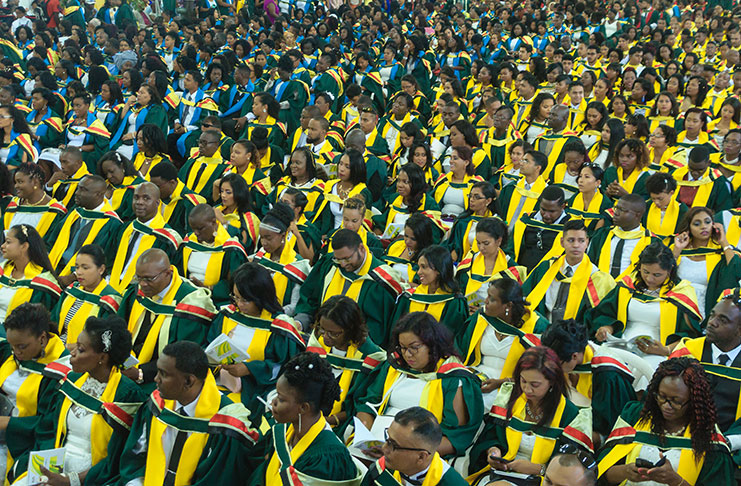
–Dr Narine tells UG graduands
GUYANA may have the best oil find in the Caribbean, but if it cannot overcome its race issues, it will continue to suffer.

This was the sentiment shared by Dr. Dhanpaul Narine while delivering the feature address during the University of Guyana(UG)’s 51st Convocation Ceremony at the National Cultural Centre (NCC) on Saturday.
“After 50 years in this country, we can’t continue with the ‘them and us’ mindset; we win, you lose. We must create a dialogue where everybody in this country is a winner,” Dr. Narine charged the graduands.
“The Mother Country is Guyana, and our allegiance is to this country,” he said. “India, Africa, China and Portugal are grandparents.”
Dr. Narine, who was born here but now lives abroad, spoke of knowing nothing but poverty while growing up in Vergenoegen on the East Bank Essequibo, but said he always believed in achieving greatness, especially in a cohesive society.
“When you want to do something, or dream big, you will have lots of opposition, but you must never give up,” he advised the some 915 students who were being honoured that morning in the first of a two-session ceremony to be held for the day.

“We should learn to treat the planet with respect, and not consume more than we need,” Dr. Narine said, adding:“If we’d respected the planet, there would be nothing like climate change; instead conservation should be the keyword in our lives.”
He recalled being encouraged while a child by his paternal grandfather, a priest, to live a life of giving to his community. Dr. Narine is the holder of a BSc (Hon.), MSc, MPhil and PhD degrees and has taught at the London School of Economics and City University, New York.
The Richmond Hill, Queens, resident has helped found Guyana Watch, a programme that every year sends medical supplies here to be distributed among the poor.
He also helped found the annual Phagwah Parade, held in New York, which attracts thousands of Guyanese living in the Diaspora.
Noting that over the years, honesty and integrity have been the watchwords by which he’s lived, Dr. Narine told the graduands before him that in much the same way those two words have aided in his development, so too can they help theirs. “Work hard, and good people will come in your life,” he urged.

As to how he perceives respect for differences, Dr. Narine said inculcating such an attitude is an important aspect of educational development. He also stressed that in order for Guyana to rise to its full potential, all women should be educated, since education is the means by which to bring about meaningful change in society.
Head of the internationally-acclaimed Iwokrama International Centre, Dr. Raquel Thomas-Caesar assured the graduands that contrary to popular belief, a degree from the University of Guyana is just as recognised internationally as one from any of the other universities the world over.
She should know, as back in 1991, she was in the very same shoes they were that morning, waiting to receive her certification to prove that she was indeed a graduate of the Faculty of Natural Sciences, in the disciplines of Biology and Chemistry.
She urged that one way of giving back to the country that afforded them this rare opportunity at a tertiary education, is to engage in voluntary community work and where possible, to further their studies overseas and travel, as this will help open their eyes on how things are done internationally.
Noting that Guyanese are in dire need of inspiration, she said that everyone who successfully graduates from the University of Guyana should aspire to become a mentor to someone.
“We have to work on inspiring our children,” Dr. Thomas-Caesar said, adding that for too long Guyanese have allowed race and politics to divide us, at the expense of the country’s development.
“Let’s not passively await for others to stand up and do something!” she challenged. “We have to actively embrace Guyana; step out and start thinking outside the box!”
UG Chancellor, Professor Nigel Harris in brief remarks reminded his charges that with the discovery of oil and potential resources linked to the find, there is a possibility of financial resources coming to Guyana.
“With imaginative, creative, honest and daring leadership,” he said, “all our people can benefit. It is important that those who lead us mobilise these new resources, if they do materialise, to address some of the adversities that plague our country.”
Among the adversities of which he spoke are the grinding poverty that affects a sizeable number of the urban and rural population; inadequate access to first-rate education for many of our young people; the growing threat of rising sea and river levels; and most of all the ever widening racial and political divide.
The valedictorian and best graduating student this year was International Relations alum, Ms Elsie Ann Harry. Aarif Baksh, who obtained a BSc in Statistics received the Chancellor’s medal.




