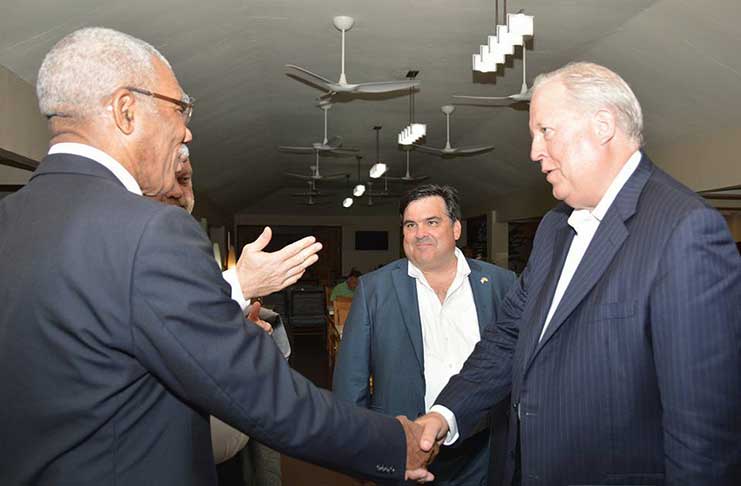
…U.S. assures Guyana that relations will not be adjusted
By Ravin Singh in Grenada
GUYANA, and the region by extension, can breathe a sigh of relief since there is no intention on the part of the United States (U.S.) to alter relations with the country or region.
This was the assurance given by US State Department Under-Secretary for Political Affairs, Thomas Shannon, during a meeting with the Guyanese Head-of-State in Grenada on Wednesday evening.
Since the election of Donald Trump to the White House late last year, fear and uncertainty had gripped the minds of many world leaders and even those in the Caribbean, since his ascension is expected to usher in a change in foreign relations. The Caribbean Community (CARICOM) has already indicated its interest in meeting with the US President to discuss pertinent issues which affect both the region and the US. However, Guyana’s Head-of-State was fortunate enough to have met Shannon who said his government remains committed to preserving its relations with Guyana and the region.

“I feel very confident after that meeting. What he [Shannon] said last evening was reassuring; that there is no intension on the part of the new US administration to alter its relations with Guyana” President Granger told reporters. He said that both the Caribbean and the US are interested in “consensual and peaceful outcomes,” and at present, he does not believe there is any threat to the stability of the Caribbean.
“I don’t think at present there is any threat to the stability of the Caribbean. I feel that anything that happens in the US will have an impact on the Caribbean and vice versa. Over the last 25 years we have had closer relations with the US and we feel that the present President, or we hope, he will have an engagement with us” the President said.
President Granger who is the immediate past Chairman of CARICOM, stated too that the regional bloc sees the US as a “trusted partner,” even at the bi-lateral level. Further, he stated that: “We want to see the Caribbean speaking with one voice when we speak to the US administration. I’m very confident that anything which could be described as uncertain will be clarified by the end of the year.”
During his speech at the opening of the summit, President Granger said that Caricom was erected purposefully on four pillars — integration, human and social development, foreign policy coordination and security. The Community could collapse if these pillars are shaken, he said noting that Caricom finds itself in an international situation today that is replete with uncertainty and complexity. He stated then that US policy, as a result of changes in its administration, is uncertain; UK policy, owing to its resolve to exit the European Union, is uncertain; EU policy, after the expiration of the Cotonou Accord, is uncertain and AU policy, within the African, Caribbean and Pacific group, will be driven by the continent’s collective interests, different from CARICOM, and is uncertain.
“The Community has vital strategic interests to protect and promote in its international relations. It is imperative that it engages foreign states to preserve its interests. The Community also must ready itself for negotiations with the UK, EU and the African Caribbean and Pacific (ACP) Group of States.
The emergence of these groups of states will play a prominent role in international relations in the twenty-first century, just as the seaborne empires dominated the nineteenth century and the rise of independent states characterised the twentieth century.
The Caribbean Community cannot cling to an obsolete model of insularity in light of these international changes. The mirage of fifteen airlines, fifteen cricket teams, defence forces and fifteen embassies in the capitals of the world might mesmerise a few sentimental romantics but could deplete the treasuries of our states.” According to the President the Community, challenged by the constantly changing international situation must redouble its efforts to ensure a more safe society for its citizens, more stable economies for its countries, deeper solidarity and a more secure hemisphere.
Guyana and the US share strong bilateral relations. Guyana has one of the highest diaspora population, per capita, in that country according to the US State Department. On the economic side, US-based oil giant ExxonMobil is among the largest companies operating in Guyana. That company is currently drilling for oil just offshore Guyana.
Only recently, the US released its strategy for engagement with the Caribbean, via a report titled: “Caribbean 2020: A Multi-Year Strategy to Increase the Security, Prosperity, and Well-Being of the People of the United States and the Caribbean”. That report outlines the US’s strategy to engage the Caribbean in the areas of security, diplomacy, business, energy, education, and health.
In addition, earlier this year, Latin American and Caribbean exports returned to a path of growth after four consecutive years of contraction. In the first quarter of 2017, the value of goods exported increased 17 percent year-on-year, having contracted 2.9 percent in 2016. The Inter-American Development Bank (IDB) in a report had said that for this incipient and unstable recovery to become sustainable, factors that have been generating uncertainty in the global economy must be reversed. Further, it pointed out that real growth in the U.S., China and the European Union (EU) could sustain the export recovery in the next trimester.
Meanwhile, CARICOM has raised concerns with the U.S. about the withdrawal of correspondent banking from the region – a move which many believes could potentially cripple regional economies. Up to earlier this year, CARICOM Secretary-General (SG) Ambassador Irwin LaRocque informed reporters that while the region has made its case internationally, it is still awaiting a response and resolution to the issue from the US and those banks involved.