…as NDIA activates plan to release water through Torani Canal
CHIEF Executive Officer of the National Drainage and Irrigation Authority (NDIA), Frederick Flatts, has said that based on the assessment from their engineers, they have put into action a plan that will see water being released out to the sea via various non-orthodox methods which should bring much-needed relief to the Cookrite Creek Savannah farmers as well as residents.
Flatts explained to this publication that the water level of the Canje Creek is the highest it has been since sometime in the 1960s that has led to the current situation. “What we are doing is essentially reversing the roles of the various canals in an effort to drain not only the lands and affected, but essentially we are draining the Canje because they are all [at] the same level right now; this is the highest it has been since 1960. Even with the regulators closed on the Torani canal the water is overtopping the doors.”
The head of the NDIA explained that he and a team of engineers were in the area all day and managed to convince the farmers to allow them to release the waters into the irrigation canals then flush them out into the drainage canals and ultimately out to the sea. “We had a hard task at convincing the farmers to allow us to let the water pass through the irrigation canals, because that could lead to flooding of not only their lands, but to the residential areas as well. However, given that this solution will also aid them, they have agreed and we have put into motion a plan which will bring relief to those affected.”
He explained that their team is working around the clock and by today they will have five pumps on the ground at five outfalls to drain water when the sluices are closed. He said there will be a pump each at Adventure, Number 46, Number 49 and two at number 52 villages. Each pump has the capacity to drain at least 120 cubic feet of water per second. Further, he has deployed three excavators to different locations to put down several 30” HDPE tubing to allow the water to transition into the irrigation and drainage canals as well as clean the Fowler Canal in Black Bush Polder. Flatts explained that works have already commenced on the HDPE tubes and by this morning at least four would be in position.
In addition, there are structures that are being rehabilitated to accommodate the excessive amount of water and allow for better control. “In addition, we are manning the various sluices and pump stations and have people on the ground to monitor the situation real time, it will take some time but the people will get relief soon.” Flatts further explained that the Torani Canal is also being used at this time to drain the Canje creek into the Berbice River. The Torani Canal was constructed to be used as an irrigation canal to top up the Canje creek during periods when the water level drops, but due to the magnitude of water in the Creek, the role of the canal has been reversed.
350 saved
Meanwhile, Seonarine Deonarine, a cattle farmer with over 700 heads of cattle in the Cookrite Creek Savannah, said he managed to bring out approximately 350 heads of cattle since the flooding and can now look to bring out more, since the prime minister has advised the stray catchers to pause their operations.
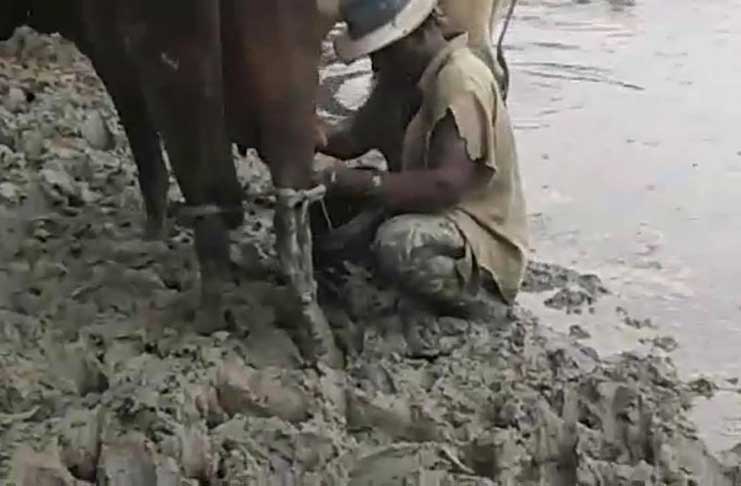
Deonarine explained that in order to bring out his cows, he has to walk them approximately six miles in the flooded conditions and place them 10 each in a boat and ferry them to the Black Bush pump where he uses a tractor and trailer to bring them to an area to load into trucks before transporting them to his home in Kilmarnock Village on the Corentyne. He told the Guyana Chronicle that he has lost at least 150 thus far and expects to lose at least 15 more by weekend, based on what he saw Thursday. “Me see it get at least eight big ones that sick that nah guh mek it and about nine more smaller ones that just waiting on time to die, I can’t do anything to help them, I just gotta try to see how best we can get the rest out before I lose more,” Deonarine related.
Deonarine said he understands that it was due to nature that they are in the current situation and is not blaming anyone, but would be thankful for whatever assistance they can receive at this time, since everything counts. “Me get about 350 heads at home and glad that stray catchers nah guh really bother me, because the space limited and some might roam, but me manage to walk a couple over six miles and get them to Black Bush and then bring them out with a trailer, but if them can open the main sluice door at Johanna me can hire a bigger boat and bring out them ones wah look weak and try fuh save them. Them other farmers can use the same boat and we can save a lot of them.”
He further suggested that a pontoon can be used to go through the Canje Creek and take the animals to New Forest or Gangaram where the creek is closer to the road to be transferred into trucks. He explained that with that method more animals can be transported in a shorter period of time. He is also calling on the authorities to see if they can further assist by making available some molasses and bran to feed their animals. Over the past few weeks, over 1200 heads of cattle have been lost due to flooding caused by the overtopping of the Canje Creek; this has taken a toll on the farmers and they met with the prime minister on Wednesday, who called for an immediate assessment and action plan to remedy the situation.
After the meeting, several technical teams were deployed in the area and the NDIA has put into place an action plan to bring relief to the farmers. Further, the REO will lead a team to Baracara,Canje Creek, which will also include medical personnel into the affected area today to take supplies and provide medical aid to residents who may be affected by the water that is littered with carcasses of the animals. This newspaper was informed that the water level remains the same and more animals are getting sick daily. The farmers have estimated their total losses to be over 100 million in the past few days and are grateful for whatever assistance can be provided for them.