






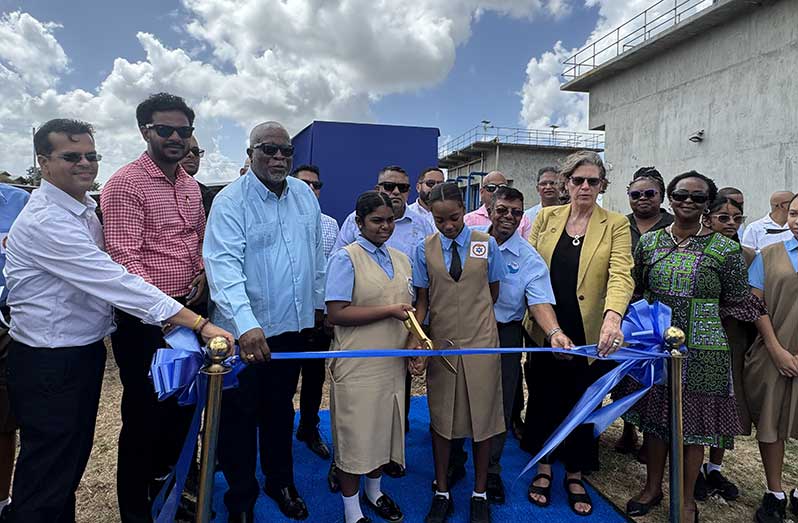
–as gov’t commissions new solar power system at Sheet Anchor water treatment plant
PRIME Minister Brigadier (Ret’d) Mark Phillips has underscored the importance of integrating renewable energy into the operations of major electricity consumers across Guyana, noting that investments in solar power can significantly reduce operating costs, ease pressure on the national electricity grid and contribute to the country’s climate commitments.
Delivering the feature address at the commissioning of solar photovoltaic (PV) systems at the Guyana Water Incorporated (GWI) Water Treatment Plant at Sheet Anchor, East Canje, Berbice, the Prime Minister described the initiative as a major step towards improving energy efficiency within one of the country’s most essential public utilities.
The Sheet Anchor Water Treatment plant caters to over 4,800 households, and Prime Minister Phillips emphasised that the commissioning was more than the installation of solar panels, but also represented a transformation in how GWI powers its operations while delivering safe and reliable water to thousands of households.
“Water is life. Every family that turns on a tap expects clean, safe water. Few of us stop to think about what it takes to get that water from the source to the home,” the Prime Minister stated.
He said that water treatment and distribution require significant amounts of electricity to operate pumps, filtration systems and other critical infrastructure.
According to Prime Minister Phillips, GWI is among the largest electricity consumers in Guyana, accounting for approximately five per cent of the country’s total electricity generation.
He disclosed that electricity represents the utility’s single largest operating expense, consuming more than 40% of its operational budget in many years.
The Prime Minister noted that reducing this expenditure would allow GWI to redirect valuable financial resources towards expanding water distribution networks, improving water quality, replacing ageing infrastructure and strengthening service delivery.
He further pointed out that approximately 52% of GWI’s service areas receive water from
treatment plants, making investments in energy-efficient technology particularly important.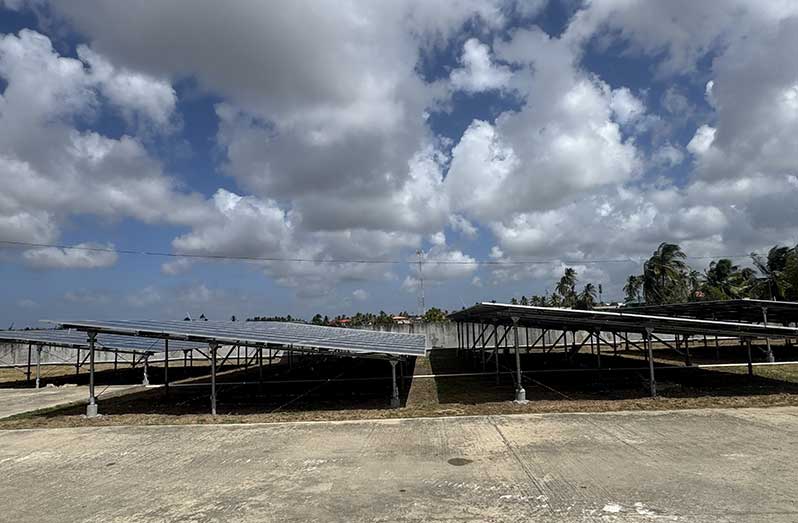
Turning his attention to the newly commissioned systems, Prime Minister Phillips explained that the initiative was implemented in two phases under the Global Environment Facility-funded Mainstreaming Low-Emissions Energy Technologies to Build Guyana’s Green Economy (MLEET) project.
The first phase, completed in February 2026, saw the installation of 15 energy-efficient submersible pumps and variable speed drives, allowing the utility to optimise electricity consumption by adjusting pumping speeds according to operational demands.
The second phase, completed in October, involved the installation of solar photovoltaic systems at eight water treatment plants across Guyana.
These include the Great Diamond and Sheet Anchor facilities, each equipped with 200-kilowatt systems; Central Ruimveldt with 150 kilowatts; and Timehri, Village 56, Uitvlugt, Pouderoyen and Queenstown, each with 100-kilowatt systems. Together, the installations provide a combined solar generation capacity of 1.05 megawatts and are expected to produce approximately 1.63 million kilowatt-hours of clean electricity annually.
The Prime Minister said that this would account for nearly one-third of the electricity consumed by the eight facilities, resulting in substantial savings for GWI.
Additionally, surplus electricity generated by the systems will be supplied to the national grid, contributing to the country’s overall electricity supply.
Over their projected 25-year lifespan, the installations are also expected to prevent approximately 25,900 tonnes of carbon dioxide emissions.
Prime Minister Phillips said the initiative demonstrates the government’s commitment to advancing the Low-Carbon Development Strategy 2030 while ensuring that economic development remains environmentally sustainable.
He also used the occasion to encourage large electricity consumers, including government ministries, hospitals, schools, manufacturing facilities, hotels and supermarkets, to explore similar investments in solar energy.
According to him, large consumers are particularly well-positioned to benefit from solar technology because much of their electricity demand occurs during daylight hours, when solar generation is at its highest.
He explained that investments in renewable energy would not only lower electricity bills but also reduce pressure on the national grid, freeing up additional capacity to support expanding residential communities and businesses.
The Prime Minister further highlighted the importance of public institutions taking the lead in renewable energy adoption, noting that successful projects such as GWI’s solar installations can build confidence in the technology while creating opportunities for local engineers, technicians and suppliers.
He outlined a practical approach for major electricity consumers, beginning with assessing energy consumption, eliminating wastage through efficient equipment and subsequently installing solar systems suited to their operational needs.
As such, he then also acknowledged the contributions of the Global Environment Facility, United Nations Development Programme, Guyana Energy Agency, GWI and other technical partners involved in implementing the project.
He reiterated that the project is to develop a diversified, reliable and affordable energy sector while simultaneously advancing sustainable development.
In closing, Prime Minister Phillips challenged public agencies and private businesses to examine their energy consumption and consider how renewable energy could improve efficiency and reduce expenditure.
He also urged GWI to carefully monitor the performance and savings generated by the eight installations and use the findings to guide future investments.
“This is what progress looks like. Practical solutions. Lower costs. Cleaner energy. Better service for our people,” the Prime Minister declared.




