






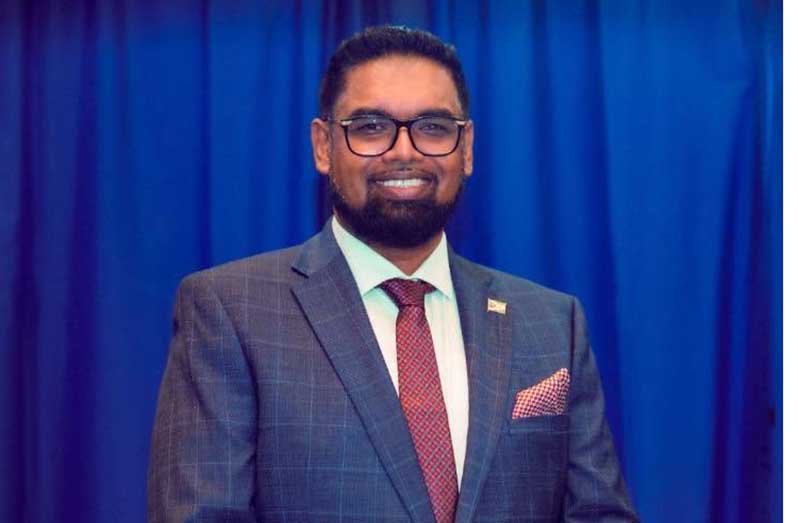
PRESIDENT Dr Irfaan Ali has called for the constitutional reform process to be accelerated, stating the commission should begin engaging communities while continuing to receive submissions from institutions and other stakeholders.
Dr Ali made the comments during a press conference on Friday, where he was asked whether he was satisfied with the progress of the Constitution Reform Commission, which was established more than two years ago.
The President said he had already called for the commission’s work to be expedited, indicating that he wanted the process to move beyond the collection of written responses and into direct public engagement.
President Ali said, “I’ve asked that the work be expedited. And I’ll tell you very clearly, I think that they need to expedite the work of the commission. I want to see the commission in the communities.”
He noted that letters had been sent to institutions and stakeholders seeking feedback, with responses expected by the end of December. However, he said public consultations could begin simultaneously rather than waiting for that exercise to be completed.
“But my position is simultaneously you can start a public consultation.”
Dr Ali said he wanted to see the commission take its work into communities, allowing members of the public to participate in discussions about the constitutional changes being considered.
During the same press conference, Dr Ali also addressed questions about possible constitutional amendments relating to the composition of the Guyana Elections Commission (GECOM), following the change in the configuration of Parliament after the September 2025 elections.
He stated, “I want the Constitution reform process to move forward very, very quickly, and for that process to take forward recommendations on every aspect of national life that requires adjustment given where we are as a country today and given where the world is. But I can’t nitpick on one issue.”
He said the opposition parties needed to resolve their own arrangements and advise the relevant authorities on their position, noting that the opposition had previously comprised multiple political parties.
His comments come as questions continue to be raised about the pace of the reform exercise and the extent of public involvement in shaping recommendations for changes to the country’s supreme law.
The President’s call for the commission to accelerate its work comes amid concerns previously raised by Attorney General and Minister of Legal Affairs, Anil Nandlall, SC, over the limited number and relevance of submissions received from members of the public.
In September, Nandlall disclosed that the commission had received only six written submissions several months after issuing an invitation for Guyanese and other stakeholders to propose constitutional changes. He said the submissions received at that stage largely did not address constitutional reform.
“It is clear that the Constitutional Reform Commission is not proceeding at the pace that we would have liked it to proceed,” Nandlall said.
The Attorney General explained that the commission had initially intended to use written submissions as part of the process, leading to wider public consultations. However, the low response prompted discussions about whether that approach should be reconsidered.
He indicated that the commission was prepared to go into communities to receive proposals directly but might have to adopt another mechanism to encourage greater public participation.
The commission’s consultation exercise covers several areas, including the protection of fundamental rights and freedoms, the rights of Indigenous peoples and children, electoral reform, the composition of the Guyana Elections Commission, judicial independence, public accountability and the functioning of local government.
The written submission period is scheduled to remain open until December 31, 2026, with the commission inviting proposals from individuals, political parties, civil society organisations and other stakeholders.
Members of the public are required to clearly label their submissions “Written Proposal on Constitutional Reform.”
Each submission must include the individual’s full name, address, email address and other contact information, along with a scanned copy of a valid photo identification. Written proposals may be hand-delivered to the Office of the Secretariat of the Constitution Reform Commission, located on the fifth floor of 211 Camp and Lamaha Streets, Georgetown, or emailed to gcycrc2024@gmail.com. The commission also indicated that individuals who have made submissions may be invited to participate in face-to-face sessions if “their submissions warrant further discussion.”
The Constitutional Reform Commission was established to review Guyana’s 1980 Constitution and make recommendations for changes aimed at strengthening democratic governance, protecting fundamental rights and improving the functioning of public institutions.
Its mandate includes examining provisions relating to the electoral system and the composition and appointment of GECOM, judicial independence, the protection of Indigenous peoples and children, minority representation, equal opportunities, public accountability and the safeguarding of public resources.
The commission is chaired by former Chancellor of the Judiciary, Justice Carl Singh, and comprises representatives of the Government, opposition parties and various stakeholder organisations, including labour, the private sector, religious bodies, women’s and youth organisations, farmers, the National Toshaos Council and the Guyana Bar Association.
The commission’s work is intended to involve public participation, with individuals, political parties, civil society organisations and other stakeholders invited to submit proposals for constitutional changes. It is expected to consider those submissions and consultations before making recommendations for consideration through the parliamentary reform process.




