






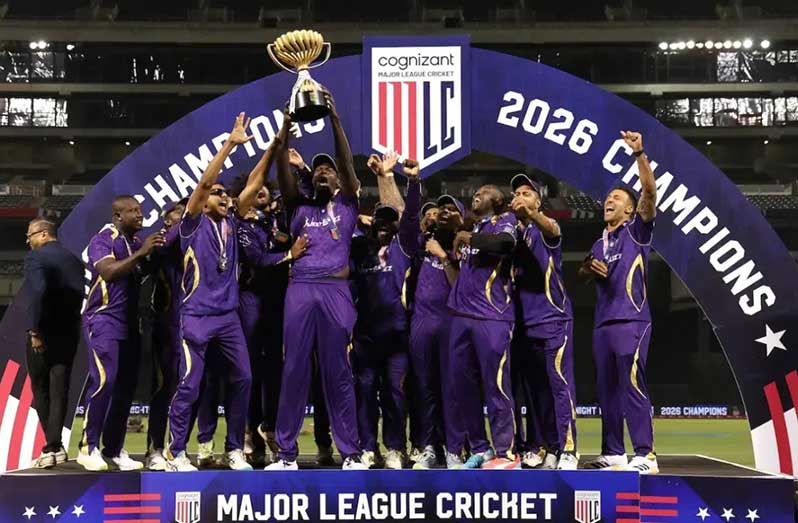
THE International Cricket Council (ICC) is set to consider a major expansion of its powers to regulate T20 franchise tournaments, a move that could threaten the viability of Major League Cricket (MLC) in the United States and the UAE’s ILT20.
Proposals from the ICC’s franchise leagues review group will be presented to chief executives and board heads at a quarterly meeting in Bali this weekend.
Formed in July to protect the global calendar and the sport’s integrity, the panel is chaired by Bangladesh Cricket Board president Tamim Iqbal and includes England and Wales Cricket Board chief executive, Richard Gould, Cricket Australia boss Todd Greenberg, and Board of Control for Cricket in India’s secretary, Devajit Saikia.
Overseas player caps threaten ILT20 and MLC
The most contentious proposal is to enforce a strict limit of four overseas players per starting XI across all existing leagues.
Both the ILT20 and MLC were granted exemptions when limits were last set in 2023. The UAE tournament currently permits up to nine overseas players per team, while the US competition allows six.
Removing those exemptions would force teams to rely heavily on local UAE and USA talent, diminishing the star power that attracts broadcasters. The move is also politically sensitive given heavy Indian investment in both leagues; five of the six ILT20 teams have ties to Indian Premier League (IPL) or Women’s Premier League (WPL) owners, while four MLC sides are linked to IPL groups.
One league official described the prospect as “very concerning” and questioned whether their tournament could function, noting they had previously been assured of protection under a grandfather clause. However, external legal advice sought by the review group concluded that member boards have no valid legal grounds to challenge the changes.
Ending Full Member autonomy and betting bans
Under existing rules, only Associate Member tournaments require direct ICC approval, while Full Members sanction leagues within their own borders.
Following a rise in poorly regulated leagues plagued by unpaid wages and corruption scares, the review group wants Full Members to conduct stricter checks on tournament funding and player payment protections.
Crucially, the proposals would allow the ICC to audit sanctions granted by Full Members. If a national board fails to meet regulatory standards, or if serious integrity concerns arise before or during an event, the ICC could step in to reject or revoke a league’s licence.
The push follows warnings from ICC head of anti-corruption, Andy Ephgrave, that his unit now receives more reports of corrupt approaches on the franchise circuit than in international cricket.
Under the new plans, leagues must pay an upfront application fee—used to fund due diligence and investigations—and employ either the ICC’s Anti-Corruption Unit (ACU) or an ICC-approved integrity body. High-risk leagues will have to cover the ACU’s costs on a not-for-profit basis, or their applications will be rejected outright if risks cannot be mitigated.
The panel also wants to ban sponsorship from betting companies and their surrogates where they facilitate gambling in countries where it is illegal—a rule that would impact South Africa’s SA20 and several smaller leagues.
Solidarity fees and ‘legends’ leagues
The review group has also asked the chief executives’ committee (CEC) to debate several broader structural issues, including standardising the “solidarity payment” paid by a host board to an overseas player’s home board.
Currently negotiated between boards—which recently sparked a standoff between the Pakistan Cricket Board and the Abu Dhabi T10—the fee could become a mandatory, fixed percentage across all tournaments.
Executives will also discuss capping the number of leagues a single country can host to protect international cricket, a measure that would primarily affect the UAE.
Finally, the CEC will examine how to regulate “legends leagues” after the panel warned that exhibition events blur the lines between active and retired players and generate significant integrity concerns. (Modified from Cricinfo)




