SIX autobiographies are indispensable to Guyanese history – those of Bharrat Jagdeo, Forbes Burnham, Eusi Kwayana, Rupert Roopnaraine, Desmond Hoyte and “Kit” Nascimento. The length of Mr. Jagdeo’s presidential tenure is only matched by that of Forbes Burnham. Mr. Jagdeo is still young and still in government, so Guyana will have to wait for his memoir.
We will never see Burnham’s memoir because he died fairly young. If he had written his life story, that text would have been read by all of the leaders of the post-colonial world. Forbes Burnham was one of politics’ most interesting and complex characters. He is dead and gone, but I think Guyana is yet to know who he really was, but sadly Guyanese history will never have that page.
Desmond Hoyte’s autobiography would have attracted attention far beyond the post-colonial world. He singlehandedly transformed a post-colonial country from near death to physiological effervescence. All Guyanese would have been fascinated to hear how he manoeuvred on that treacherous territory that he inherited from Burnham. There is a story told but never got expanded on about that treacherous terrain. It was about a plot to physically harm Hoyte as he went about de-Burnhamising Guyana.
Eusi Kwayana lived to age 101 and with those long years, one wondered why he never wrote his life story. Kwayana was one of the most inexplicable characters politics has seen. One of the irritating things about studying him is that it is almost impossible to pin him down. Who he really was will remain a mystery. I suspect there will be a biography of him, but I don’t think if 20 biographies are written about Kwayana, those 20 writers would have known who Kwayana really was.
Next is Rupert Roopnaraine. I believe and will hold that belief until I see otherwise that Roopnaraine was the most persuasive speaker that Guyanese politics gave birth to. I don’t believe anyone could have matched the vocal delivery of Roopnaraine. He was extraordinarily brilliant and used the English language to mesmerise people and he was 100 percent successful in doing so. He lived a life that was full of bohemian pleasure while traversing the revolutionary terrain of Caribbean radicalism. But his radicalism and revolutionary credentials were far from admirable so how did he accomplish that impossibility? Had he written an openly, candid autobiography, it would have been a book on philosophy.
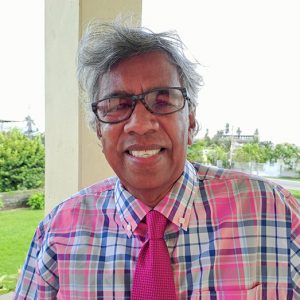
Finally, Christopher “Kit” Nascimento. At age 94, Nascimento will release his memoir at the end of this year. I was 10 when I heard and read about Nascimento. At age 94, we are looking at a man who was embedded in public life for about 75 years and still is. The periodisation of Nascimento’s life makes for fascinating reading. As soon as that book is out, I will leave everything I am doing that day and read it from page to page.
The periodisation schema takes in his young days as one of the aggressive youth leaders of the party, the United Force, headed by his uncle, Peter D’Augiar. The youth arm of the UF was Nascimento, and Nascimento was the youth arm. From 1960, Nascimento was one of the famous names in British Guiana.
His career takes in editorship of one of Guyana’s leading newspapers in the 1960s. Then an esoteric moment came for “Kit” when his uncle split with Burnham and the PNC/UF coalition in government collapsed. The United Force was seen by most Guyanese as a Portuguese party of well-to-do people. When the coalition disappeared, Nascimento stayed with Prime Minister, Burnham and became a Cabinet minister.
He told me years ago that he suffered financially because of that decision, his mother disinherited him. His time with Burnham is what is going to excite all the readers of this autobiography. The story of Burnham as told by Nascimento will be different from all other written papers on Burnham. This is because, Nascimento, I am absolutely sure is not going to be sycophantic or excessively critical.
You can expect Nascimento to objectively analyse and describe the pluses and minuses of Burnham with objectivity. I hope in the book, Nascimento takes a page or two and tell the readers why he thinks Burnham was such a positive man. One looks forward to his thoughts on Cheddi Jagan and Janet Jagan. What I am hoping to see in the book is his reflections on the Rodney assassination.
Nascimento said on the Freddie Kissoon Show that he is certain that Rodney had a bomb when it exploded on his lap outside the Georgetown prison. The evidence so far points to a transmitting device. At the time, Nascimento was close to Burnham. Did Burnham tell Kit that Rodney had a bomb and Kit believed Burnham?
DISCLAIMER: The views and opinions expressed in this column are solely those of the author and do not necessarily reflect the official policy or position of the Guyana National Newspapers Limited.