– Ambassador calls for direct flights to strengthen trade and business ties
TRADE between Guyana and Brazil reached approximately US$800 million in the first eight months of 2026, representing a 25 per cent increase compared with the same period last year, as the neighbouring country seeks to improve air and road connectivity, agricultural development and stronger trade arrangements.
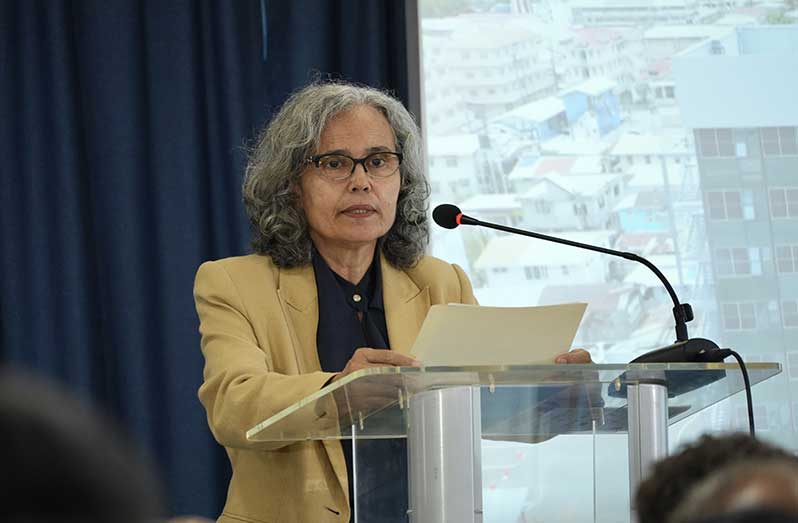
Speaking at the World Trade Centre Georgetown’s International Trade and Investment Conference on Monday, Brazilian Ambassador to Guyana, Maria Cristina de Castro Martins, said bilateral trade has exceeded US$1 billion in each of the three years from 2023 to 2025, reflecting the growing economic relationship between the two countries.
However, she noted that Guyana primarily exports crude oil to Brazil, while Brazilian exports to Guyana are spread across a wider range of goods and products. The ambassador said there is significant scope to diversify the relationship and strengthen opportunities for businesses in both countries, including through the introduction of direct flights between Georgetown and Brazil.
Martins said the absence of a direct air link creates a gap in trade and travel relations between the neighbouring countries.
Businesspeople, she noted, should not have to travel through distant hubs to meet with counterparts in neighbouring countries and called for improved air connectivity to support trade, investment and tourism.
“Two neighbouring countries should not require businesspeople to travel through distant hubs simply to meet each other,” the ambassador said. She further noted that the Brazilian Embassy has supported contact with Guyanese aviation companies interested in exploring services to Brazil, adding, “The Embassy has therefore been pleased to support contact with Guyanese aviation companies interested in exploring services to Brazil. We hope that commercial conditions will allow this and other initiatives to become viable,” she said. Direct flights, she emphasised, could make it significantly easier for businesses to establish and maintain partnerships between the two counties.
Agriculture and agro-processing were identified as key areas for expanding and diversifying trade.
Martins said Brazil had been following Guyana’s efforts to increase agricultural production, develop agro-processing and position itself as a regional food producer. She further noted that Brazil’s experience in agriculture could complement Guyana’s development plans, with opportunities for co-operation in agricultural machinery, inputs, food processing, storage, logistics, animal production, technology and technical assistance.
The ambassador noted that northern Brazil and Guyana share similar climates and faces some of the same logistical challenges, making closer co-operation possible and particularly relevant.
“Northern Brazil and Guyana share similar climatic conditions, face some similar logistical challenges and are separated by a land border that should increasingly become an economic connection rather than an obstacle,” she said.
Improved road connectivity is also an area the ambassador said is expected to play an important role in bringing the two markets closer together.
Martins welcomed the imminent completion of the Linden-Mabura Hill Road, saying that the project is a tangible example of what better connectivity can mean in people’s everyday lives.
However, she stressed that infrastructure alone would not be enough to achieve regional integration, noting that the necessary rules and arrangements must also be in place to allow businesses and travellers to use the road efficiently.
“As connectivity improves, the economic distance between Georgetown and northern Brazil becomes shorter. But a road alone does not create integration. We also need the rules that allow people, businesses and goods to use it efficiently,” Martins said.
Beyond transport, Martins said Guyana and Brazil should modernise trade arrangements governing their relationship to better tackle changing opportunities and the needs of businesses.
She noted that the existing trade agreement involving Brazil, Guyana and some Caribbean countries has been in use for more than two decades and could be updated to broaden the preferences available to businesses on both sides.
“For some time, we have been discussing ways to update and expand the legal instruments governing our economic relationship. Our trade agreement, which includes Brazil, Guyana and some Caribbean countries, has been in force for more than two decades. There is clear scope to modernise it and broaden the preferences available to businesses on both sides,” Martins noted.
The ambassador said stronger trade arrangements, combined with better physical connectivity, could help businesses make greater use of the opportunities available in both markets.
Martins said Guyana’s position as both a Caribbean and South American country gives the country a unique role in strengthening economic links between the two regions. As a member of CARICOM, Guyana maintains strong Caribbean ties, while its geographical location and improving infrastructure continues to facilitate closer engagement with South America. Reflecting on the countries’ relationship, Martins said there was scope for a deeper level of economic interaction in the years ahead. “Guyana is a Caribbean country. It is a member of CARICOM, and this is an important part of its identity and international economic relations. But Guyana is also South American. Improved infrastructure is making that geographical fact increasingly relevant economically,” she said. The ambassador emphasised that stronger roads, transport links and business relationships could help turn geographical proximity into practical economic benefits, with direct air links, diversified trade and improved regional arrangements among the areas that could better support Guyana-Brazil co-operation.