






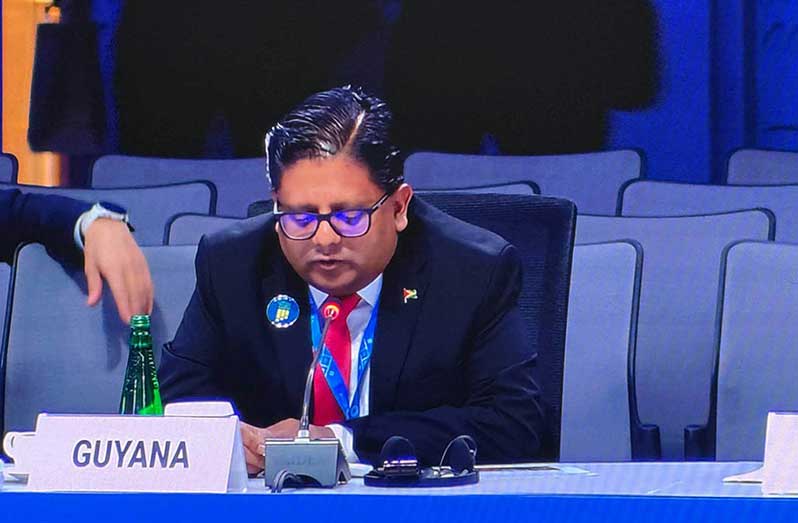
THE Government of Guyana is prioritising job creation and entrepreneurship as part of its broader commitment to ensuring that every working-age Guyanese has access to meaningful economic opportunities.
This was emphasised by the Minister within the Office of the President with responsibility for Finance Dr. Ashni Singh during the 2026 Annual Meetings of the International Monetary Fund (IMF) and World Bank Group in Bangkok, Thailand, where he participated in the Human Capital Ministerial Conclave.
The conclave was led by World Bank Vice-President for People (Human Development), Mamta Murthi, and brought together discussions on human capital development and investment in people.
During remarks, Minister Singh reaffirmed Guyana’s commitment to investing in its people, highlighting job creation as a central pillar of the Government’s development agenda.
The minister noted that over the past five years, unemployment had been reduced by half, with 156,000 new jobs created during that period.

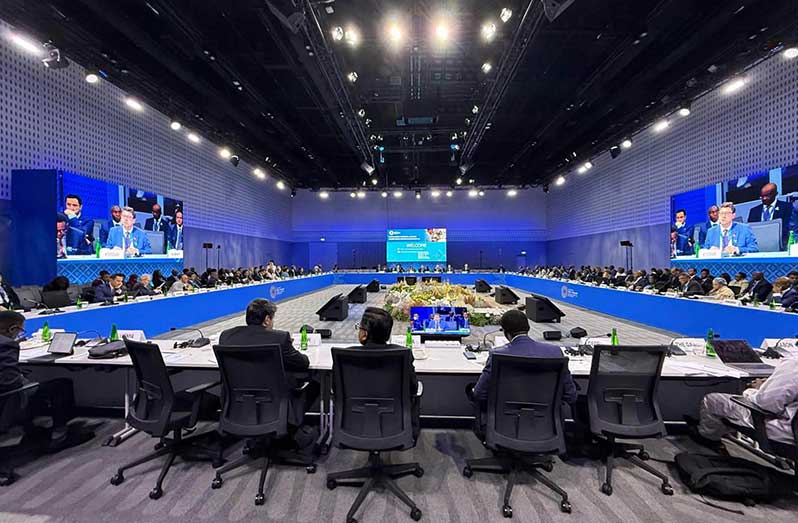
Looking ahead, the minister said the Government’s priority is to ensure that every Guyanese citizen of working age has the opportunity to participate in meaningful and fulfilling economic activity, whether through employment or entrepreneurship.
“Our Government’s priority is ensuring that every single Guyanese citizen of working age has the opportunity to engage in meaningful and fulfilling economic activity through both employment and entrepreneurship,” he was quoted in a statement as saying.
The emphasis on job creation reflects the government’s stated commitment to ensuring that economic development translates into opportunities for citizens to earn an income, build livelihoods and contribute to national growth.
Guyana’s labour force grew between 2020 and 2025, while unemployment fell sharply, as the country’s rapidly expanding economy brought more people into the workforce.
The labour force is up 47.8 per cent from the first quarter of 2020, according to figures from the Bureau of Statistics published in the government’s 2026 Mid-Year Report.
Over the same period, the unemployment rate fell to 6.2 per cent from 12.8 per cent, while the labour force participation rate increased to 59.2 per cent from 50.4 per cent.
“Guyana’s labour market strengthened between 2020 and 2025, as the labour force expanded and participation increased,” the report said, stating that, “By the fourth quarter of 2025, nine out of every 10 persons in the labour force were employed, while the unemployment rate had fallen to 6.2 per cent.”
Employment also rose substantially. The number of employed people reached 421,334 in the fourth quarter of 2025, an increase of 156,472 from 264,862 recorded in the first quarter of 2020.
The employment-to-population ratio for people aged 15 and older climbed to 55.5 per cent, from 43.9 per cent over the same period. It stood at 52.7 per cent in the fourth quarter of 2024.
The private sector remained the country’s largest source of employment. About 254,649 people, or 60.4 per cent of those employed, worked in the private sector in the fourth quarter of 2025. The public sector employed 107,266 people, or 25.5 per cent, while 59,419, or 14.1 per cent, worked in the not-for-profit sector.
Wholesale and retail trade was the largest of the five leading industries identified in the report, accounting for 14.7 per cent of employment. Construction accounted for 12.5 per cent, followed by public administration and defence at 10 per cent, agriculture, forestry and fishing at 9.8 per cent, and manufacturing at 8.7 per cent.
Construction’s share reflects the extensive infrastructure development accompanying Guyana’s economic expansion. But the figures also show employment spread across a broad range of industries, rather than concentrated in a single sector.
The latest data underscore the scale of the shift in Guyana’s labour market: more than 145,000 people joined the labour force over the five years, while more than 156,000 additional people were employed, and the unemployment rate was cut by more than half.
The government said the next Labour Force Survey was planned for the final quarter of 2026




