






A SINGLE distress signal from a vessel at sea on the night of July 18 sent search-and-rescue teams racing into action. A rapid succession of alerts meant lives were in peril.
The actions of the Coast Guard in the minutes and hours after the sinking of the MV Barima will be the material for training manuals in the years to come. And it has a name – Operation Hawkeye- and will be studied, dissected and analysed by future generations of GDF ranks.
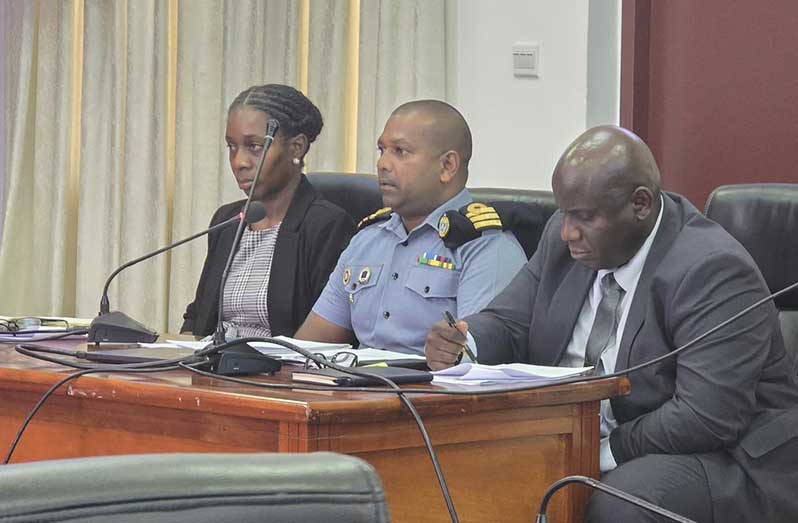
The first-hand witness account of Commander David Shamsudeen of the Guyana Coast Guard proves that while Guyana had never experienced something quite like the sinking of the Barima, the nation’s system, once activated, saved lives.
Shamsudeen explained to the Presidential Commission of Inquiry on Tuesday how the distress alert developed into a carefully coordinated emergency response, drawing in multiple Coast Guard crews, fishing vessels and a civilian interceptor-type craft in a frantic search for survivors.
Alongside his account of deployment times, chart analysis and search sectors was the human reality of the operation: a flare guiding rescuers towards survivors, reported cries for help, people recovered from the water, and a death toll that underscored the magnitude of the tragedy.
By early morning on Sunday, July 19, 69 survivors, many barely clinging to life, had been recovered and were sailing to emergency medical attention in Charity. The horrific reality of the dead was unfortunately higher: 73 bodies.
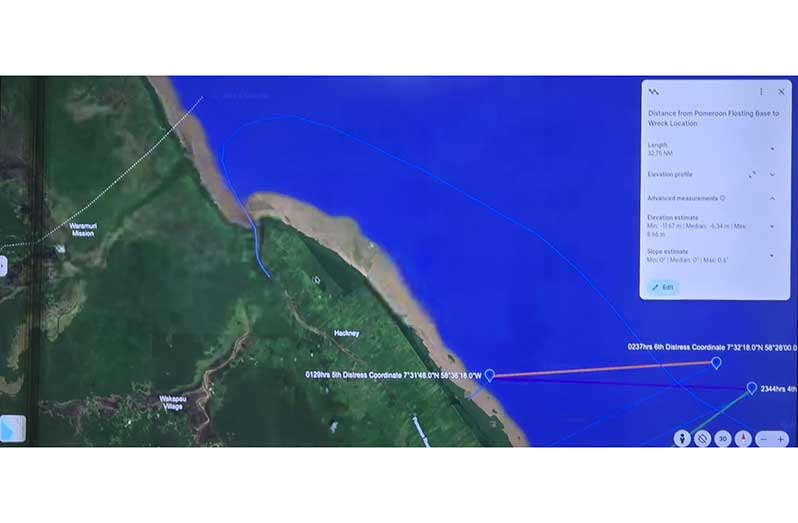
Shamsudeen described how the search and rescue mission kicked into high gear immediately after receiving the distress alert at 10:51 pm on the night of July 18 from CJIA Control Tower.
The priority was to establish which vessel was involved, or whether another vessel in the area could respond to the emergency.
The Coast Guard checked its vessel-monitoring systems for nearby traffic that could be contacted, either to establish what was happening or to provide an initial presence before its own crews arrived. No such vessel was identified through those checks, Shamsudeen said.
Soon, information emerged that the Barima might have been travelling along the route. At that point, “We started to deploy assets from every single direction so that we can have enough assets on the ground as fast as possible,” Shamsudeen told the commission.
He said the initial responding vessel was dispatched from the Pomeroon floating base because it was the closest available Coast Guard vessel to the reported distress positions. Further deployments followed from Coast Guard headquarters in Georgetown and Fort Island, with additional vessels joining as the operation developed.
According to the sequence presented during his evidence, a headquarters quick-response vessel deployed at 11:45 p.m., an additional interceptor was dispatched from Fort Island five minutes later, and a second headquarters vessel departed at 12:10 a.m.
Shamsudeen described the choice of responding craft as a matter of getting suitable vessels to the area quickly, taking account of their speed, manoeuvrability and ability to operate offshore.
The Commander said the first vessel from the Pomeroon Floating Base reached the operational area before 2 am. Its crew saw a flare coming from what he described as a liferaft, helping direct them towards survivors.
Civilian participation in the operation also produced direct results.
Asked why a particular civilian vessel had been brought into the operation, Shamsudeen said responders wanted as many suitable resources as possible, whether from the private sector, civilians or sister services. He confirmed that the vessel recovered two survivors.
Shamsudeen said recoveries took place in multiple areas, although the Coast Guard did not have coordinates for every person found. Records documenting those recovered were maintained at a forward operating base, he said.
Shamsudeen recounted how a fisherman followed oil on the sea surface and reported seeing a life jacket emerge from the water. The Commander said he reached the area about 20 minutes after being contacted and saw additional life jackets and floating containers. The location was then marked.
One commissioner made clear that scrutiny of Shamsudeen’s evidence did not mean the Coast Guard’s work was unappreciated.
“I don’t want you to misunderstand our appreciation for the work that the Coast Guard has done, whether perfectly or imperfectly,” the commissioner said.
The evidence thus placed two responsibilities before the inquiry: recognising the work that brought survivors to safety, and establishing what must change to give people caught in another maritime emergency the best possible chance of being rescued.
Commissioners repeatedly emphasised that their task extended beyond reconstructing the operation to preventing a recurrence and improving the response.




