-Minister Bharrat says, emphasises government’s intention to push both traditional productive sectors and emerging industries
GUYANA’S unique geographical location and rapidly developing economy came into focus at the World Trade Centre Georgetown’s (WTCG) International Trade and Investment Conference on Monday.
Regional leaders, diplomats, and business representatives came together to hold discussions aimed at exploring opportunities to strengthen trade, investment, and economic co-operation.
Delivering the keynote address, Minister of Natural Resources Vickram Bharrat highlighted the importance of local participation in the oil and gas sector, economic diversification and maintaining a balance between development and environmental sustainability.
Also speaking at the event was Chief Investment Officer Dr Peter Ramsaroop, who outlined opportunities in agriculture, agro-processing, energy, shipping, and tourism, urging international investors to establish meaningful partnerships with Guyanese businesses.
The conference which runs from October 19 to 23, will see discussions on Guyana’s investment opportunities, regional trade partnerships, infrastructure development, and access to global markets, with a focus on helping Guyanese enterprises compete internationally.

Addressing the gathering, Minister Bharrat highlighted Guyana’s development experience and the collaborative approach that has led to the nation’s current growth.
He noted the value of strong partnerships between government, the private sector, and international investors, adding that the country’s progress in oil and gas was not the result of the international operators alone, but rather collective and strategic collaboration.
He encouraged participants to use the four-day event to establish relationships that could translate into real, tangible business opportunities. “Today and during the next four days, partnership and networking are what we will work on in this office. Partnership and putting businesses together. Partnership with our regional counterparts, our international counterparts, as well as our colleagues in the local private sector. Without partnership, I do not believe networking will ever be successful,” Bharrat said.
Additionally, the minister urged investors entering Guyana to strongly consider working with local businesses across a variety of sectors, including mining, forestry, agriculture, construction, and manufacturing.
While acknowledging that oil and gas has acted as a catalyst for development in recent years, Minister Bharrat was keen to note that Guyana’s economy is not dependent solely on petroleum, but is backed by development across a number of traditional and new sectors.
Moreover, he stated that government will continue to support traditional productive sectors while developing emerging industries, including information and communications technology and artificial intelligence (AI).
Highlighting the new opportunities that emerging sectors can create, Minister Bharrat said AI could help small countries with limited populations and workforces overcome some of their longstanding challenges. However, he noted that discussions on AI must also address how workers could be upskilled and how people with limited formal skills could be equipped to participate in the Region’s changing economy.
He also highlighted the impact of the Local Content Act, noting that the legislation has helped create opportunities for local businesses and workers, with more than 1,200 local businesses now engaged directly or indirectly in the sector, alongside almost 7,000 Guyanese trained and employed in oil and gas.
However, Bharrat was also keen to caution that local-content legislation was not intended to shield businesses from competition or encourage poor-quality services at inflated prices. Instead, he urged Guyanese companies to improve their standards and compete regionally and internationally on both quality and price.
“The main objective of a business is to satisfy your customers’ wants and needs with quality goods and products. And when you do that, you will make a profit,” he said before seeking to encourage investors and local entrepreneurs to prioritise customer satisfaction and service. He also called for greater recognition of Caribbean products and services, arguing that regional businesses had the capacity and expertise to compete at higher levels.
Further, he said CARICOM countries should move beyond being seen primarily as service providers at the margins of major industries and instead develop the capacity to supply those industries with goods and services.
On environmental sustainability, Bharrat said Guyana is seeking to maintain economic growth through the petroleum sector while protecting its forests and biodiversity.
He pointed to the country’s Low Carbon Development Strategy and its deforestation targets, adding that development in the petroleum, mining and forestry sectors can develop alongside environmental protection.
“What we have done in Guyana over the last four to five years is strike that balance. Not many countries have achieved that. We have struck that balance between economic growth and environmental sustainability. That is something we are very proud of because, as I said, not many countries in the world can boast of having that balance that we have here today in Guyana,” he said.
The minister urged participants to ensure that the conference produced more than discussions and networking, by developing collective ideas into projects that benefits businesses as well as the wider region.
THE IDEAL ENVIRONMENT IS BEING CREATED
Dr Ramsaroop in his remarks encouraged local and international participants to approach the conference with clear objectives and highlight practical avenues for growth.
Outlining Guyana’s development priorities, he noted energy security, food security, and stronger links with regional markets as major areas of focus.
Ramsaroop said Guyana’s efforts to develop the petroleum sector, food production and regional connectivity are vital parts of a broader vision of reducing dependence on imported food. While highlighting the scale of the region’s food imports, Ramsaroop pointed out opportunities for Guyana to become a supplier for the Caribbean’s agricultural produce.
He further noted that the Government is pursuing improved air and maritime connectivity, including airport expansion, port development, and closer links with northern Brazil.
Ramsaroop said improved shipping connections could help Guyanese producers supply fresh produce to markets such as Barbados, while expanded air connectivity could create opportunities to supply cruise ships and other regional industries.
He argued that Caribbean countries need to strengthen their role in supply chains rather than remain limited to providing basic services.
Later, he encouraged investors to consider establishing headquarters in Guyana and working with local businesses, while assuring them that government’s role was to create an environment in which enterprises could operate effectively.
“Government is here to enable you to make money. Our job is to enable you, make sure the regulations are right, put efficiency in place and have laws to protect your business,” Ramsaroop said. He added that Guyana’s natural resources, including its forests and freshwater, alongside its growing economic sectors, provide opportunities for investment beyond oil and gas, pointing to prospects in sectors such as tourism
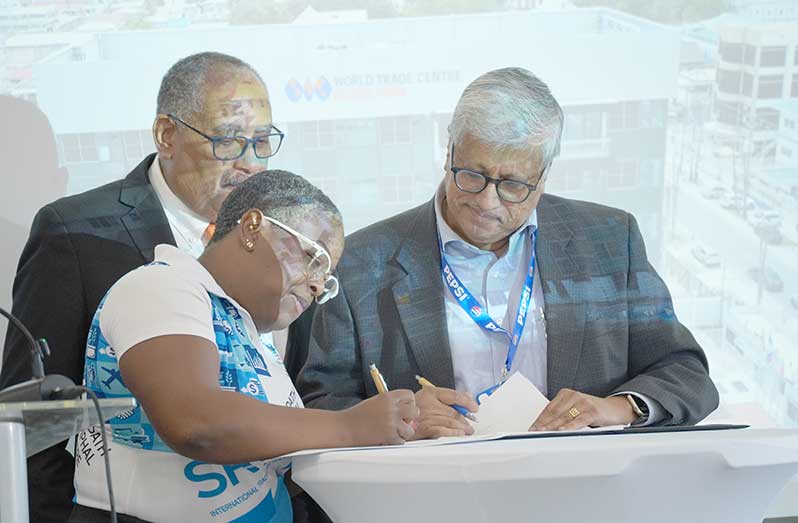
The opening of the conference also sought to cement collaboration through the signing of a Memorandum of Understanding (MoU) between the Shridath Ramphal Centre at the University of the West Indies and the World Trade Centre Georgetown.
The MoU which aims to strengthen collaboration in trade knowledge, research and development, was signed by World Trade Centre Georgetown Executive Chairman Komal Samaroo, with Dr Kai-Ann Skeete, a Trade Research Fellow at the University of the West Indies, Cave Hill, representing the Shridath Ramphal Centre. The collaboration highlights the emphasis being placed of equipping businesses with the knowledge needed to navigate international markets, trade agreements, and policy developments as they seek to expand.
As the conference continues, Guyana’s leaders and regional players are urging participants to use the discussions to establish lasting partnerships, improve the competitiveness of local businesses and develop projects capable of strengthening Guyana’s and the Region’s position in international markets.