—as 345 participants graduate from the International Human Rights Law Certificate Course
CORRUPTION does more than undermine public trust; it can deprive citizens of essential services, including education, healthcare, water and proper roads, Minister of Parliamentary Affairs and Governance Gail Teixeira has warned.
The minister stressed that as Guyana continues its rapid development, greater emphasis must be placed on human rights education, accountability and ensuring that public resources benefit the people they are intended to serve.
“If there’s corruption, it undermines human rights,” Teixeira said, explaining that when public funds are siphoned off or mismanaged, citizens can be denied access to essential services.
“These are all related to human rights,” she added, referring to investments in schools, health centres, water and roads.
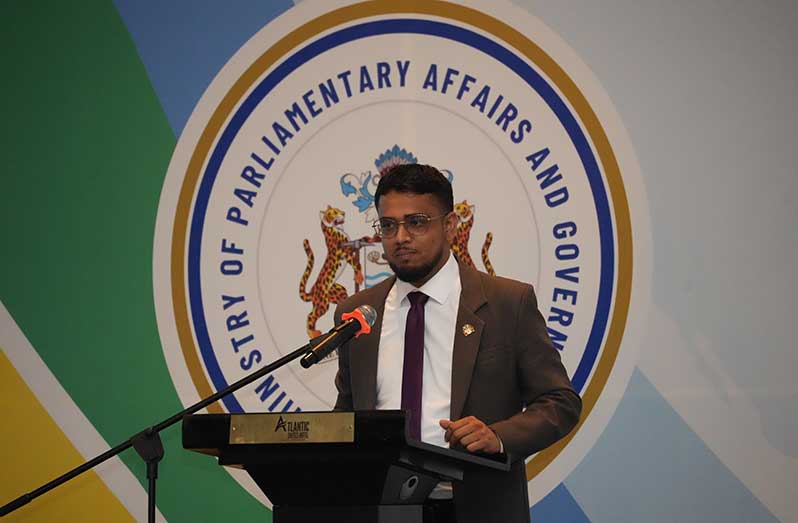
Teixeira made the remarks while delivering the feature address at the graduation ceremony for the third cohort of the International Human Rights Law Certificate Course, held at the Pegasus Hotel in Georgetown on Saturday.
The minister said the relationship between human rights and anti-corruption was one of the reasons anti-corruption had been incorporated into the programme, which seeks to equip participants with knowledge they can apply in their professional and personal lives.
The minister highlighted the importance of human rights education for law enforcement personnel, given the sensitive nature of their responsibilities and the scrutiny surrounding their interactions with members of the public.
The minister also noted that Guyana’s rapid development made it important for public awareness and behaviour to keep pace with the country’s progress.
Using road safety as an example, the minister said improvements to roads must be accompanied by greater respect among road users for one another’s rights and safety.
Minister Teixeira said the course was intended for personal development and practical application rather than competition, adding that the organisers did not publicly rank participants according to their examination results.
She stated, “As a country moving forward, it’s important that we keep training people on human rights and anti-corruption, because that is what will build our country, help us do even better and make greater progress. We have to recognise that everybody has a place in human rights, and it’s not for just certain people.”





Justice of Appeal Kim Kyte-Thomas urged the graduates to put their human rights knowledge into practice, stressing that completing the certificate course carried a responsibility to defend the dignity and rights of others.
Addressing the graduates, Justice Kyte-Thomas cited the principle that denying people their human rights challenges their humanity, urging participants to treat it as a call to action rather than simply a quotation to remember.
She said, “I urge you that this should be a call to action. It should be a reminder of the responsibility which comes with understanding, upholding, and defending human rights.”
Th judge reminded the graduates that human rights were not privileges reserved for particular groups, but the birthright of every person, regardless of age, gender, race, religion, social status or circumstances.
Justice Kyte-Thomas said the knowledge gained through the programme should influence how graduates conduct themselves in their workplaces, communities and daily lives.
“Knowledge alone is not enough. What matters is what you do with it,” she said, encouraging participants to speak out against injustice, advocate for improvements where systems fall short, and ensure that people are treated fairly.
She also stressed that human rights advocacy extended beyond courtrooms and government offices, beginning in homes, schools and workplaces.
“Development and human dignity must advance together,” Justice Kyte-Thomas said, challenging the graduates to continue learning and turn their knowledge into meaningful action.
Senior Research Officer at the Ministry of Parliamentary Affairs and Governance and course coordinator Anil Persaud said the programme had been presented earlier this year, alongside the annual Human Rights and Anti-Corruption Expo, as a national best practice at a meeting of the Organisation of American States’ Committee of Experts of the Follow-up Mechanism for the Implementation of the Inter-American Convention against Corruption (MESICIC).
He said the initiative demonstrated how public education and awareness could be integrated to strengthen institutional capacity and improve access to information.
Persaud added that feedback from participants showed how the training could influence their daily responsibilities, including police officers’ understanding of dignity and due process, nurses’ awareness of patients’ rights and teachers’ approaches to inclusion and equality.
“This cohort has demonstrated a willingness to engage with new ideas, to discuss difficult issues and to respect different perspectives. Growth is not simply about enrolling more people. It’s about maintaining a programme that is relevant, accessible, impactful, and responsive to the needs of those we seek to educate,” Persaud said.
He said the long-term objective was to ensure human rights principles became more firmly embedded in national consciousness and Guyana’s development.
The 2026 cohort was the largest since the programme began, attracting more than 2,000 applications and enrolling approximately 400 participants, of whom 345 successfully completed the course. This brings the total number of people trained through the initiative to more than 780. Applications doubled from approximately 1,000 in each of the previous two years.
The free, eight-week International Human Rights Law Certificate Course is delivered primarily online, with course materials provided at no cost and some sessions held in a hybrid format to accommodate participants outside Georgetown.
It attracts people from all 10 administrative regions, with Region Four accounting for approximately 51 per cent of applicants. Participants range in age from about 17 to 71 and represent diverse professional backgrounds. Some 83 per cent are from the public sector, 13.2 per cent from the private sector and 2.9 per cent from civil society.
The programme has also attracted participants from Jamaica, Trinidad and Tobago, Belize and Grenada. Developed by the Ministry of Parliamentary Affairs and Governance, its curriculum is regularly updated to reflect emerging issues, participant feedback and Guyana’s international commitments. It covers the development of human rights, international legal frameworks, state obligations and mechanisms for protecting rights, alongside contemporary issues such as climate change, artificial intelligence, corruption, development and food security.