






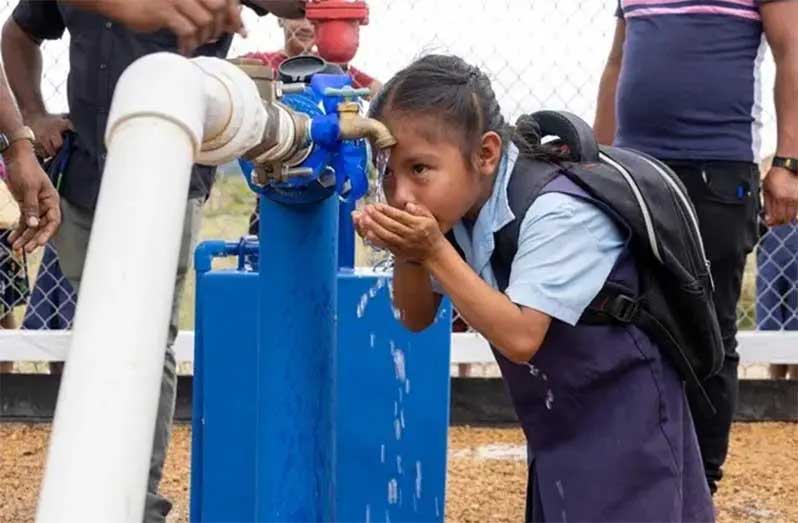
– GWI reports major gains as national coverage reaches 98.6 per cent
ACCESS to potable water in Guyana’s hinterland communities has increased from approximately 46 per cent to 95 per cent over the past five years, reflecting a significant expansion of water infrastructure in areas that have historically faced challenges accessing reliable supplies.
According to Guyana Water Incorporated (GWI), the improvement has been driven by investments in well drilling, water supply systems and distribution networks aimed at extending services to remote and underserved communities.
The figures for 2026 indicate an increase of approximately 49 percentage points in hinterland potable-water coverage, while national access has reached an estimated 98.6 per cent of the population.
The expansion forms part of a broader programme to improve access to safe and reliable water across Guyana, with particular attention to communities where difficult terrain, scattered settlements and the cost of transporting equipment have traditionally hindered infrastructural development.
GWI, which falls under the Ministry of Public Utilities and Aviation, reported that more than 200 wells have been drilled nationwide over the past five years. More than 200 kilometres of transmission and distribution pipelines have also been installed to extend networks and improve connectivity to communities.
Alongside expanding access, the agency has been working to improve the quality of water supplied to households.
Treated-water coverage has increased from approximately 52 per cent to 80 per cent during the same period, supported by the construction of eight new water treatment plants and the rehabilitation and upgrading of more than 13 existing facilities.
The improvements are intended to move the country beyond providing basic access towards ensuring that a greater proportion of households receive treated water.
GWI has also completed the installation of 16 small water treatment plants in rural communities, with another six planned. These facilities offer an alternative for areas where larger treatment plants may be difficult or impractical to establish.
The smaller plants are particularly important in rural and hinterland locations, where localised treatment systems can help address water-quality concerns while expanding access to treated supplies.
Despite the progress, challenges remain in some communities, including concerns about elevated iron levels in water obtained from groundwater wells.
GWI has indicated that these issues are being addressed through continued investment in treatment capacity and supporting infrastructure.
The expansion of water services is part of wider efforts to improve living conditions and extend essential public services to communities that have historically experienced infrastructural gaps.
Reliable access to potable water is important for household health, sanitation, education and economic activity, particularly in remote communities where alternative sources of safe water may be limited.
While the reported increase in hinterland coverage represents substantial progress, the remaining five per cent without access underscores the need for continued investment to achieve universal coverage.
GWI has reaffirmed its commitment to working with the government and communities to strengthen infrastructure, improve service reliability and extend potable-water access to underserved areas.
The agency’s latest figures point to significant gains in the reach of water services, while highlighting the importance of sustaining infrastructural development and improving treatment capacity to ensure that access translates into a reliable supply of safe water.




