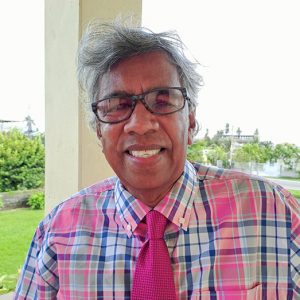
THIS is the second part of the analysis of class struggle in the AFC which began last Saturday. I have studied Guyanese history all my life but I find the tale of the PNC and the AFC in power between 2015 and 2020 a very complicated, complex and maybe incomprehensible story in modern Guyanese history.
That relationship between the PNC and AFC has been shrouded in esoteric metaphysics that has no parallel in Guyana’s history. As the analysis flows, there are times when things make no sense.
If you offer an intellectual analysis of how the PNC and AFC related to each other, you run the risk of your work being deemed mumbo jumbo and indeed things were so incomprehensible in that period of government that they come close to being mumbo jumbo.
I honestly do not think some of the key players in the PNC and AFC understood the dynamics of what they were involved in as they ruled Guyana.
What follows is an attempt to make sense of the relationship between the PNC and AFC in government. Part three will have to follow. Please note these are very truncated notes.
The journey of APNU+AFC in power begins with the unique relationship between David Granger and Raphael Trotman. Both men accepted the urgency for there to be an influential middle-class third party.
They thought out the broad outline of this formation when they were at the airport in The Bahamas. What happened in 2011 was that two Berbice Indians began reshaping the AFC.
Part one stopped at the insistence of Granger that Trotman be the House Speaker after the 2011 general elections. Granger rejected Nagamootoo’s nomination.
In so doing, he went on to argue that it was misplaced to think that Nagamootoo brought in the Berbice vote. Granger named Charrandass Persaud as playing a major role in securing votes from Berbice
Granger and Trotman frowned on the new shape the AFC had taken on after 2011. Interestingly, Raphael Trotman did not visit the AFC office during the 2015 election campaign or attend the AFC’s management committee meeting during that period. He was based at the PNC campaign office at Albert and Forshaw Streets.
What was Granger and Trotman vexed about? The AFC had become more like a mass-based party with a deluge of Indian constituencies.
Trotman was mentally uncomfortable working out from the AFC office. The real story of the fight between the PNC and AFC began after power was achieved. Here is where the story becomes complicated.
There were two compartments within the PNC after 2015 that had their own reasons for disliking the AFC. Granger’s resentment of the AFC was based on the diminution of the power of the Mulatto Creole class in the AFC. It must be remembered that Granger’s son-in-law, Dominic Gaskin, was also a founder of the AFC.
Other PNC leaders, particularly Volda Lawrence and Basil Williams, saw the AFC as a challenge to the PNC and felt that it should not have a huge chunk of power. Here is where a power struggle developed in the PNC between Granger and the more down-to-earth PNC leaders.
Two facts are important in attempting to remove the confusion that comes with trying to understand who in the PNC was anti-AFC and who was pro-AFC. Fact one – in his book, “From Destiny to Prosperity” on page two, Trotman revealed that after APNU+AFC won power, the AFC overlooked him for a Cabinet position.
This is a disgusting, repugnant fiction. When the APNU+ AFC won power, the AFC’s leader was Khemraj Ramjattan but from 2005 when the AFC was founded to the time it acquired power, three names had equal decision-making clout in the AFC – Ramjattan, Trotman and Nigel Hughes.
There was no one in the AFC that had the power or right or privilege to deny Trotman a Cabinet post. Both Gaskin and David Patterson on the Freddie Kissoon Show contradicted that revelation by Trotman.
Here is the reason why Trotman was not named a minister in May 2015. He indicated in the AFC’s boardroom when ministers were being selected that he was not interested in a Cabinet position.
The reason being was that Trotman and Granger had discussed Trotman’s suggestion of being the Roger Luncheon in the APNU+AFC Government.
In the Cheddi Jagan government and subsequent PPP governments, Luncheon’s role was akin to the Chief of Staff. This was a position of real power.
Trotman was in discussion with Granger on being the Cabinet Tsar. This explains why he was not named an AFC minister. But he didn’t get the Cabinet Tsar position because of an intense power struggle in the PNC. Part three will begin with that explanation.
DISCLAIMER: The views and opinions expressed in this column are solely those of the author and do not necessarily reflect the official policy or position of the Guyana National Newspapers Limited.