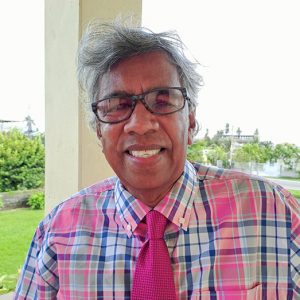
I MET Mr. Corbin at the Bourda Green Street market five years ago. He told me he was working on his autobiography. I did not see him since. I met Volda Lawrence in the bank about a month ago and I asked her about the autobiography, and she said she knows he is doing it.
When it comes out, it will be one of the most absorbing memoirs of a Guyanese, not just a Guyanese politician. Mr Corbin and I are contemporaries. Though we were political actors around the same time, I never met him, never spoke with him in my entire life except in the middle 1990s when he did the philosophy course with me at UG.
After he left UG, I must have spoken with him maybe two or three times. I cannot write a biographical note on him from interactions because there have been none. These notes here come from my experience observing and analysing politics in Guyana over several decades.
Mr. Corbin started out his career as one of the executives in the PNC’s youth arm, YSM. He was generally seen outside of political circles as a street politician. He easily earned the description as a street fighter. I remember for decades that was how he was portrayed in society. It was generally perceived that Hamilton Green was his mentor.
His elevation in politics came under the presidency of Desmond Hoyte where he was promoted to the Cabinet. The headaches and the pains of politics visited Corbin long after the PNC lost power in 1992. His trials and tribulations began when he became head of the PNC.
Corbin was defined as a Hamilton Green type of politician and thus he started out with a disadvantage. The Mulatto/Creole class (MCC) did not accept him as PNC leader. Unfortunately, an incident at his ministry in which an allegation of harassment was made against him dogged him. The MCC was cruel to Corbin. It stayed away from the PNC and withdrew any form of resources to the PNC.
Internally, Corbin had to endure guerrilla warfare led by Vincent Alexander, James Mc Allister and Aubrey Norton. He removed McAllister from Parliament. He recalled Alexander from GECOM. Alexander refused to comply.
Alexander challenged him for the leader position, rejected the wholesomeness of the congress, and resigned his membership of the PNC, never to renew it. The Corbin/Norton confrontation became nasty and reached the High Court.
From 2003 to the general election of 2006, the PNC under Corbin’s leadership stood at its weakest since its formation in 1957. This weakness has only been surpassed by the present rut inside the PNC. Mr. Corbin began to feel the pangs of class discrimination. The MCC starved him of funds. They wanted nothing to do with Corbin.
In 2006, the MCC formed its own party, the Alliance For Change (AFC) with an MCC personality at the helm- Raphael Trotman. The AFC took five seats from the PNC in the 2006 election. Corbin knew that his time had come and he was endangering the anatomy and physiology of the PNC.
Then the moment came when he decided that he will ensure the PNC does not die. He accepted the cajoling influence of Dr. Rupert Roopnaraine that it was time for him to step aside and reform the PNC.
The PNC then subsumed itself under the umbrella of APNU under a quintessential MCC personality – David Granger. Corbin withstood enormous pressure from the PNC diehards in its leadership to eschew an APNU direction. But he knew it was the only way to save the PNC.
Strangely, after the PNC secured power in 2015, Corbin faded away from politics. We do not know and will only know when his memoir is out if that was a conscious decision of his or that the APNU in government did not reach out to him. The long journey of Robert Corbin has four characteristics that hold immense lessons for understanding West Indian politics.
The first one is that people do not want street fighters to lead their governments. The street politician was the choice Mr. Corbin made. But that image took up permanent residence in the eyes of the nation. Mr. Corbin did seek to dissolve that stain by becoming a lawyer but I don’t think that changed the nation’s perception. Secondly, Mr. Corbin’s career was marred by the harassment incident.
Thirdly, the class structure of Guyana contains the powerful impulses of the MCC. Mr. Corbin learnt bitterly that the MCC did not want him to lead the PNC.
He was not seen as leadership material by that class and thus they alienated him. His autobiography will be a valuable addition to Guyanese history. Fourthly, and importantly, in his later years, he became a politician with an open, pleasing mind.
DISCLAIMER: The views and opinions expressed in this column are solely those of the author and do not necessarily reflect the official policy or position of the Guyana National Newspapers Limited.