-information sharing, joint investigations, asset recovery keys to tackling increasingly sophisticated crime
CRIME is increasingly crossing borders and law enforcement agencies must be prepared to cross those same borders with information, intelligence and coordinated action.
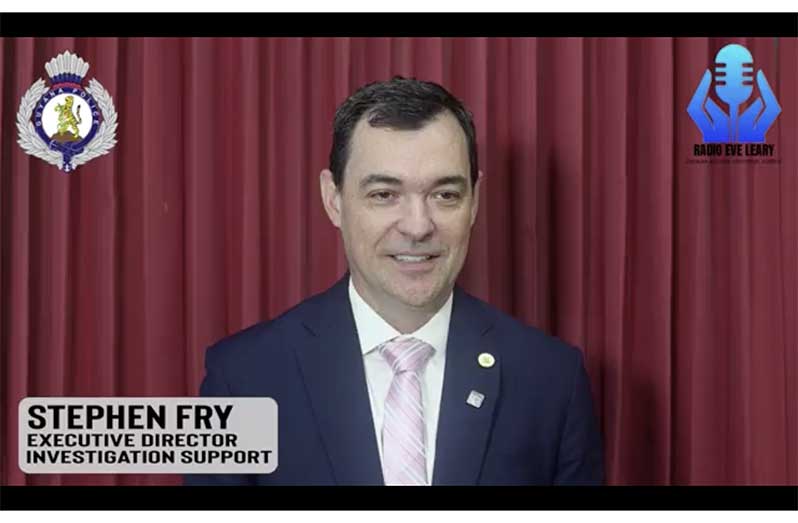
This was the message reinforced by Executive Director of Investigation Support at INTERPOL Stephen Fry, who stressed the organisation’s commitment to supporting Guyana and other countries in the Americas in tackling increasingly complex criminal threats.
Speaking with the Guyana Police Force’s Public Relations Officer on the sidelines of the recently concluded 27th Americas Regional Conference in Georgetown, Fry said INTERPOL’s 196-member network provides countries such as Guyana with practical mechanisms to exchange information, access databases and intelligence, support victims and pursue offenders whose activities extend beyond a single jurisdiction.
While INTERPOL continues to strengthen joint investigations and efforts to trace and recover criminal assets, Fry emphasised closer operational co-operation as a vital tool against fraud, as this and other crimes become increasingly industrialised through technology and artificial intelligence.
The use of technology and artificial intelligence is changing the scale and speed at which fraud can be committed. This challenge, Fry noted, is why public awareness and stronger law enforcement co-operation is increasingly important across Guyana and the wider region. “The industrialisation of fraud is occurring due to advances in technology, artificial intelligence, and those tools are increasing the speed and the scale at which frauds can occur,” he said.
He identified investment fraud, particularly schemes involving cryptocurrencies and virtual assets, as a significant concern, noting that victims are losing significant sums of money. Fry urged members of the public to remain cautious of offers that appear too good to be true and to verify that they are dealing with reputable people and organisations before providing personal information.
“We really encourage members of the public to be very careful and be aware of these types of frauds that occur,” he said.
Speaking on the potential for collaboration between Guyana and INTERPOL, Fry noted that the agency works to provide access to a global law enforcement network. This network allows countries like Guyana to be better equipped with information in investigations that extends beyond one jurisdiction.
With 196 member countries, the organisation can facilitate the exchange of information, database checks, and intelligence between investigators to tackle criminal activity moving across borders.
“When investigations are complex, investigations in the crimes that we are seeing occur, rarely do crimes in one jurisdiction exceed, so we see them going across borders,” Fry said.
He explained that INTERPOL provides a mechanism through which Guyana and other member countries can work with counterparts overseas while pursuing cases and supporting victims.
“INTERPOL provides a fighting mechanism and a vital tool to support new member countries in combating these types of crimes,” he said. That support, he added, is increasingly important as organised criminal networks continue to use international connections to commit offences, move illicit funds and evade detection.
This collaborative approach is also being strengthened through INTERPOL’s new Operation Task Force model, which Fry said is designed to enable investigators from different member countries work alongside one another on dedicated operations and investigations. Rather than co-operation being limited to information exchanges after a crime has occurred, the model is intended to bring investigators together to plan operations, share intelligence and identify targets.
“Essentially what we are trying to do is bring still investigators together from different member countries to work on dedicated operations, dedicated investigations,” Fry said.
He said investigators will work alongside one another, exchanging information and planning targets as they respond to serious crimes affecting communities across the region. The model, he explained, is intended to make greater use of INTERPOL’s databases and the resources of its member countries, allowing investigators to combine their capabilities when confronting criminal networks that operate across multiple jurisdictions. For frontline investigators and law enforcement, this approach emphasizes on practical cooperation rather than simply exchanging information.
Beyond identifying offenders, Fry said law enforcement agencies must also focus on the money and assets generated through crime, describing asset recovery as an important part of the fight against organised criminal activity.
He said the global recovery rate for criminal proceeds remains extremely low and pointed to INTERPOL’s Silver Notices as one measure being introduced to help countries trace illicit assets through information from other jurisdictions. “Going after and striking organised crime at the heart of their motivation is a really key priority,” Fry said. The wider objective, he explained, is to trace where criminal assets are held, support countries in obtaining information about those assets and ultimately remove illicit profits from criminals.
Fry said the Georgetown conference sought to produce more than declarations, with cooperation, information-sharing and operational coordination as the main pillars of the event. “The real value can be just putting resources together, cooperating with one another, exchanging information, combating crimes that are affecting communities across the region to make communities safer, to save victims, to solve crimes,” he said.