






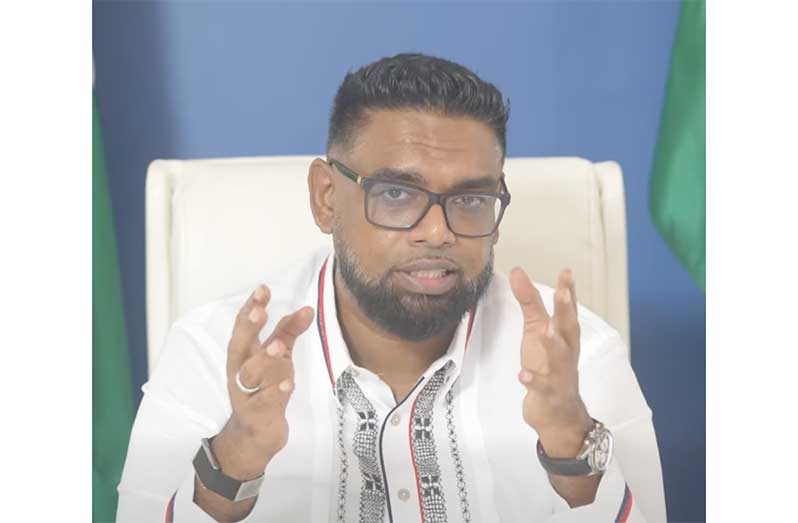
–President Ali says in reflection on nation’s journey from period of crisis between 1970s-1980s to continuous progress after 1992
REFLECTING on Guyana’s journey from severe debt distress to a stronger economic position, President Dr. Irfaan Ali, on Monday, credited successive People’s Progressive Party/Civic’s (PPP/C) governments in building reforms, debt relief and enhancing economic growth.
He stressed that fiscal management and economic discipline helped the country rebuild its international creditworthiness.
President Ali traced the country’s challenges to the decades after independence. Guyana, he said, did not enter independence in 1966 with the extreme debt burden it faced later.
He pointed instead to the economic policies adopted in the 1970s, when nationalisation and the expansion of state-owned enterprises significantly increased the public sector’s role in the economy.
“Guyana’s development was tiny because of this excessive debt burden, weak institutional framework, and productivity deficit that allowed our debt to balloon in all of these categories, and our that led to our inability to invest in education, health, housing, social services, pensioners, community infrastructure, water, and that led to more or less the decay of our society,” he said.
This, he noted, led to mass migration, destruction of the social fabric within societies and extreme vulnerabilities, including massive squatting.
Dr Ali said weak productivity, loss-making public enterprises, persistent government and external deficits, and reliance on a narrow range of commodity exports contributed to falling production and a foreign-exchange crisis.
Between 1976 and 1988, real GDP per person fell by a cumulative 31 per cent, while international reserves declined to less than a week’s worth of imports. By 1989, he said, external debt was approximately 276 per cent of GDP, and Guyana had defaulted on its obligations.
“Over the years, from 1992 to now, the People’s Progressive Party Civic Government made enormous strides towards reducing our debt and putting us in the strong position we are in today,” he added.
President Ali described the resulting crisis as more than a problem of accumulated loans: the country lacked the revenue, export earnings and foreign currency needed to service its debt and finance essential imports. Guyana’s creditworthiness was severely weakened, making new commercial borrowing difficult.
HOYTE ADMINISTRATION
The Hoyte administration launched an Economic Recovery Programme in 1989, involving currency devaluation, tighter fiscal and monetary policies, trade liberalisation, privatisation and public-enterprise reform.
Guyana also renewed relations with the IMF, the World Bank and bilateral creditors. When the PPP/C took office in 1992, President Ali said debt levels remained exceptionally high.
He cited an IMF historical series that placed total public debt at 623 per cent of GDP in 1992, while noting that this measure covered a different period and definition from the 1989 external-debt figure. A major part of the recovery, he said, came through debt rescheduling and international relief.
In 1999, it reached the original HIPC completion point, qualifying for debt-service relief. President Ali said the resources freed up helped create fiscal space for poverty-reduction programmes and investment in health and education.
Guyana completed the enhanced HIPC process in 2003, receiving further relief. In 2006 and 2007, the IMF, World Bank and Inter-American Development Bank cancelled a further US$611 million under the Multilateral Debt Relief Initiative, according to the figures cited in the address.
President Ali described the period from 1999 to 2011 as particularly important for stabilisation, debt management and public investment.
He pointed to stronger relationships with international financial institutions and bilateral creditors, and to investment in housing, roads, schools, health facilities, water services and telecommunications.
He also cited expansion in traditional sectors including gold and rice as well as construction, services and remittances.
“Political stability weighed heavily on economic development, and we saw how political stability inspired confidence also in the economy during the period cumulative real expansion over the period 1999 to 2011,” President Ali sai



