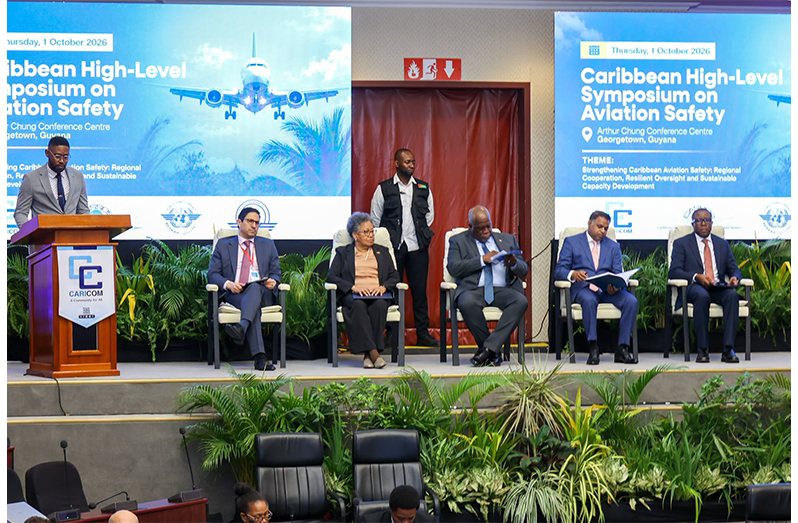
-regional leaders call for stronger institutions, shared expertise and oversight
CARIBBEAN aviation leaders are calling for stronger regional co-operation, resilient safety oversight and greater investment in technical capacity as air connectivity expands across the region.
Speaking at the Caribbean High-Level Symposium on Aviation Safety, hosted by the CARICOM Secretariat in partnership with ICAO, CARICOM Secretary General Dr Carla Barnett stressed that aviation is essential to tourism, trade, investment, emergency response and social connections, particularly for small and developing states.
She called the symposium on aviation safety a timely gathering. Extending appreciation to Guyana for hosting the event, Barnett noted that the forum aims to ensure the safety of the connections on which people depend on for travel through the region.
Barnett noted that the importance of this sector is underpinned by its impact on more than travel. As she noted, aviation for the Caribbean region is an economic and social tool.
“Air transport sustains tourism, trade, investment, emergency response, family connections, and the wider economic and social integration of our community. Safe transportation is essential for economic activity, it is essential also for social and cultural connections and community building within our countries, especially the coastal countries with much larger land areas, and among our countries,” she said.
This is why the need remains for stronger safety systems and regional co-operation. Barnett noted that the Caribbean region must do more than simply exchange perspectives, but ensure that Caribbean aviation remains safe, resilient, and efficient, through systems that meet all international standards.
The Secretary General made the call for Caribbean neighbours to ensure that regional mechanisms are sustainable, adequately resourced, and equipped to respond to emerging aviation safety demands.
“Safety, regulatory confidence, and operational reliability are indispensable foundations of an integrated regional air transport market, because a more connected Caribbean must also be a safer Caribbean,” she said.
Barnett further cited the Declaration of Aviation Safety, which she anticipates will come from the symposium, as an important platform for translating shared purpose into collective commitment and practical action. “With a clear roadmap for implementation, defined priorities, strengthened co-operation among our aviation authorities, sustainable arrangements for regional safety oversight, greater investment in our technical workforce, and a shared commitment to deliver measurable progress, there can be strengthened aviation safety and a more connected, resilient, and prosperous Caribbean community,” she added.
Meanwhile, Caribbean Development Bank official, William Ashby, highlighted the need for stronger institutions and coordinated regional approaches.
Ashby, Division Chief, Economic Infrastructure Division at the bank also used the forum to highlight the importance of regional aviation, noting that the Caribbean Development Bank recognises that aviation is not merely a transport sector in the Caribbean, but rather a vital enabler of regional integration.
Ashby also highlighted the shared challenges facing the industry, noting, “Many of the challenges confronting Caribbean aviation are shared. Our states operate in relatively small markets. We face constraints in specialised technical capacity and must meet the same international obligations and standards as countries with significantly larger populations and resources.”
These realities, Ashby said, underscore the importance of co-operation, coordination and institution building at the regional level. He pointed to the CDB’s work supporting regional air transport studies, airport modernisation initiatives and collaboration with the Eastern Caribbean Civil Aviation Authority to strengthen airport security systems, emergency preparedness, regulatory capacity and aviation security training across the OECS.
According to Ashby, these experiences have demonstrated the value of regional approaches to complex aviation challenges, while highlighting that infrastructure alone is not enough to sustain a safe aviation system.
“Physical infrastructure matters but institutions matter just as much. Sustainable aviation systems depend on strong regulatory frameworks, effective oversight arrangements, skilled technical personnel and organisations capable of coordinating expertise and resources across borders,” he said.
He highlighted regional institutions, like CASSOS, can help member states achieve outcomes collectively that would be more difficult and costly to achieve individually. Ashby said this principle is reflected in CDB’s new 10-year strategy, which recognises that the Caribbean’s future resilience will depend on stronger institutions, deeper regional co-operation and sustained partnerships.
He added that the discussions on the Caribbean Aviation Corporation roadmap, strengthening of CASSOS, harmonisation of regulations and procedures and sustainable institutional arrangements for aviation oversight are not simply technical matters, but investments in the long-term resilience, connectivity and competitiveness of the region.
‘INDISPENSABLE ECONOMIC AND SOCIETAL BRIDGE’
Further, ICAO Regional Director, Luis Fernando Fiallos, stated that shared expertise and common technical protocols are critical to maintaining safety as traffic grows and administrations face resource constraints.
Fiallos, in his remarks, focused on the importance of the systems behind every safe flight, noting that passengers do not think about technical audits, airworthiness certificates or safety inspections when they board an aircraft.
“They place their trust in a quiet, invisible architecture built by dedicated professionals who work to ensure that every departure is safe and every landing routine. That quiet assurance is not accidental,” Fiallos said.
He described aviation as an “indispensable economic and societal bridge”, noting its role in transporting patients to critical care, connecting communities, bringing local goods to international markets and sustaining livelihoods rooted in trade and tourism.
Fiallos said the symposium brings together three closely connected priorities: regional co-operation, resilient oversight and sustainable development.
He noted that every civil aviation authority requires specialised technical expertise to certify operators, inspect aircraft and aerodromes and assess operational risks, but maintaining that capacity remains a challenge for administrations with limited resources.
Fiallos also warned that resilient oversight requires continuous engagement, particularly as experienced personnel leave, air traffic grows and severe weather creates disruptions.
“When experienced personnel transition out, when traffic grows rapidly, or when severe weather forces an airport to close and safely resume operations, on those days, shared expertise and common technical protocols make the difference between disruption and continuity,” he said.
He further linked safety oversight to the Caribbean’s plans for greater air connectivity, noting that the CARICOM Multilateral Air Services Agreement aims to establish a single market for air transport services.
“A single market relies fundamentally on institutional trust,” Fiallos said. “Each state must trust that a licence or certificate issued by another administration meets ICAO standards. Safety earns that trust day after day. It is the foundation of connectivity, and connectivity is the engine of sustainable economic integration.”
He said these priorities are central to ICAO’s strategic plan for 2026-2050, guided by its aspiration of zero fatalities and its commitment to no country being left behind.
“The size of a state’s administration must never determine the safety of its skies,” Fiallos emphasised.