






A NEW assessment of the Rupununi’s honey industry is expected to help beekeepers and other stakeholders strengthen production, improve profitability and develop stronger market opportunities across seven communities.
The first major honey production assessment report was officially released and handed over to communities and key stakeholders in the Rupununi on September 16, providing an assessment of the region’s honey value chain and outlining potential models for greater co-operation and commercial development.
The report is the result of collaboration between WWF-Guianas and the Rupununi Livestock Producers Association (RLPA) under the European Union-funded Sustainable Forest Livelihoods (SFL) Programme.
WWF-Guianas, which implements the SFL Programme, presented copies of the report to Region Nine Regional Chairwoman, Vania Albert, the Regional Agriculture Department and representatives of the Guyana Livestock Development Authority, Guyana School of Agriculture and Guyana Marketing Corporation.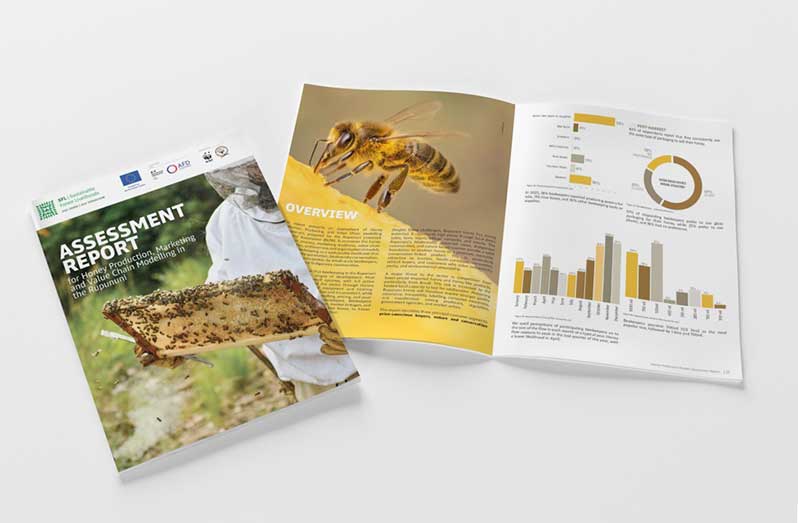
The assessment maps the existing honey value chain, establishes current production levels and identifies opportunities to improve the profitability and coordination of the sector.
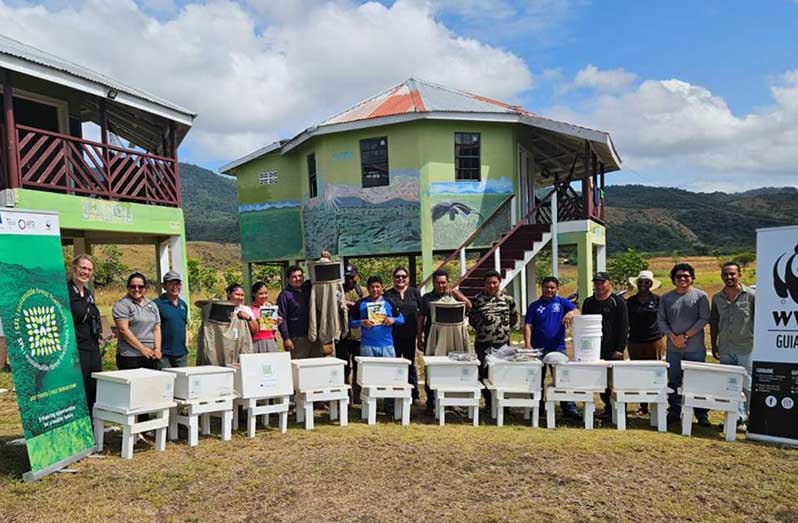
Alongside the report’s release, WWF-Guianas and the RLPA began distributing beekeeping equipment to communities supported by the SFL Programme.
The first tranche of equipment, distributed under a sub-grant to the RLPA, included 40 beekeeping boxes, 20 bee colonies, 16 locally sewn bee suits and other honey-processing equipment.
The supplies were shared among eight beekeepers in Crashwater, Toka and Masara, three of the seven Rupununi communities participating in the programme.
The remaining four communities are expected to receive support in the coming months as the RLPA expands training in apiary management and other beekeeping practices.
The partners will also work with local stakeholders to strengthen safety measures, quality control, product branding and market linkages, areas considered important to building a more effective honey value chain.
The SFL team also conducted monitoring sessions with the RLPA, Kanuku Mountains Community Representative Group (KMCRG) and Bina Hill Institute (BHI) as work continued on other components of the honey production initiative.
One of the areas being advanced is the development of a beekeeping course for possible integration into the BHI curriculum, alongside the distribution of training materials to participating communities.
The SFL Programme promotes forest-friendly livelihoods, with honey production identified as an area with potential for sustainable income generation in the Rupununi.
The programme noted that established interest among local beekeepers, coupled with the region’s healthy surrounding ecosystem, provides a foundation for expanding the activity while maintaining environmentally responsible production practices.
Further support is planned for the four remaining communities, including the distribution of equipment, additional training in apiary management and honey processing, and continued work on quality standards, branding and market access.
The initiative is expected to give all seven participating communities greater capacity to produce and market honey while strengthening the role of beekeeping as a forest-friendly livelihood in the Rupununi.




