BUSINESS leaders, contractors, decision-makers and key industry stakeholders on Thursday gathered to discuss what Guyanese businesses must do to compete, scale and win in Guyana’s rapidly evolving oil and gas sector.
The occasion was the Georgetown Chamber of Commerce and Industry’s (GCCI) Energy Luncheon 2026, held at the Guyana Marriott Hotel under the theme, “Beyond the Barrel – Oil, Gas, Growth and the Guyanese Contractor.”
Minister of Public Utilities and Aviation, Deodat Indar, highlighted the expansion of Guyana’s economy and the growing number of opportunities available within the sector.

President of the Georgetown Chamber of Commerce and Industry Kathy Smith made the call for the involvement of more Guyanese within the industry, while President of ExxonMobil Guyana Alistair Routledge spoke about the growth and impact of the sector, highlighting the role of oil and gas in developing the human resources of Guyana. While each made different calls for greater involvement, increased safeguards and new conversations, they all reinforced the growth of Guyana’s oil and gas sector and the vital role that Guyanese play in it.
Giving the feature address, Minister Indar emphasised the rapid and unprecedented development of Guyana’s economy. With the sector seeing increased investment from both local and foreign businesses, he was keen to highlight the steps the government has taken, particularly in relation to the development of the Local Content Act, which has played a significant role in ensuring Guyanese businesses are a part of the industry. Moreover, he noted that the sector has created far-reaching effects, creating new investment opportunities beyond oil and gas.
However, while these opportunities are available, the minister was keen to note that Guyanese contractors and businesses should “look beyond the barrel” at new avenues, rising sectors and up-and-coming areas for investment.
Pointing to opportunities across logistics, transportation, warehousing, construction, certification, specialised technical services, training, waste management and the developing gas industry, Minister Indar shared, “Oil and gas is the catalyst that is creating opportunities throughout the wider economy. The opportunities are not only offshore. They are in logistics, transportation, warehousing, certification, construction, training, maintenance and professional services.”
He encouraged businesses to study where Guyana’s economy is heading, identifying areas in which they can build expertise and invest in the people, systems and partnerships needed to compete. “If you do not know about gas, you have to learn. You have to bring somebody who knows, or find a partner who understands the business,” he said.
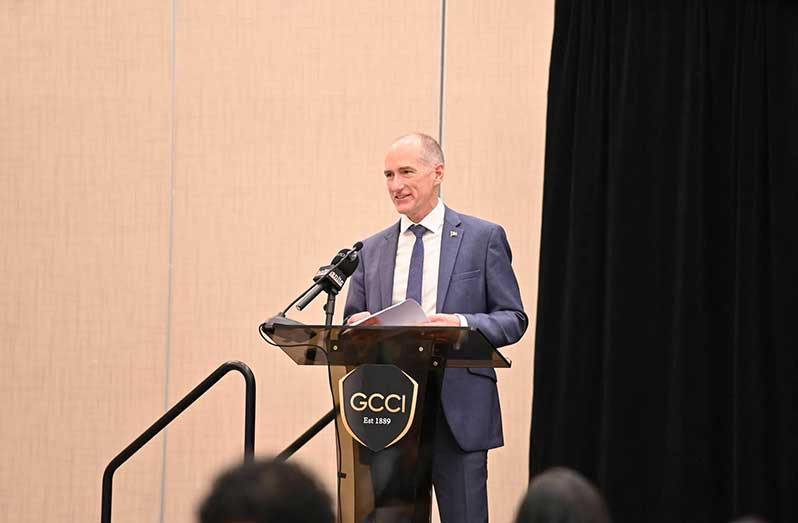
Meanwhile, Smith shared similar sentiments. Offering remarks, Smith noted that the growth of the oil and gas industry has created space for new business. This, she said, is backed by pathways for guiding Guyanese businesses to participate in the petroleum sector, particularly the local content framework. However, while pathways have been created, Smith noted that the next step must be about building capacity.
“The next stage must be about capability. It must be about guiding these companies, becoming stronger, more technically competent, better capitalised, and increasingly capable of competing for higher-value contracts,” she said.
Oil and gas is not an endpoint, but rather a platform, Smith said, urging Guyanese contractors to partner and innovate to grow. “It is an opportunity for you to build a business that outlast the commodity. A contracting firm with the technical expertise, the safety culture, the financial discipline, and the market relationship to compete, not just in Guyana, but across the Caribbean and across the world,” she said adding, “It requires commitment. Not just from you as an individual contractor, but from this chamber. From operators, from government, from the financial institutions that are willing to take calculated risk on proven teams with strategic vision.”
The Exxon President emphasised the increasing number of Guyanese who are a part of the sector, noting that the development of the oil and gas sector should aim to benefit the people of Guyana. He said that with the resources of oil and gas being finite, steps must continue to ensure that the growth of the sector is maximised and leveraged for the Guyanese people.
“Developing the resources of the country needs to be for the benefit of the people of the country. It needs to be maximised, because they are finite resources. We have said this before. The resources the country has been blessed with are finite,” he said adding “The people are the most valuable resource for the long term. And so, we need to make sure we maximise the value of that resource, in the development of the country, and the furtherment of the opportunities for the Guyanese people.”