






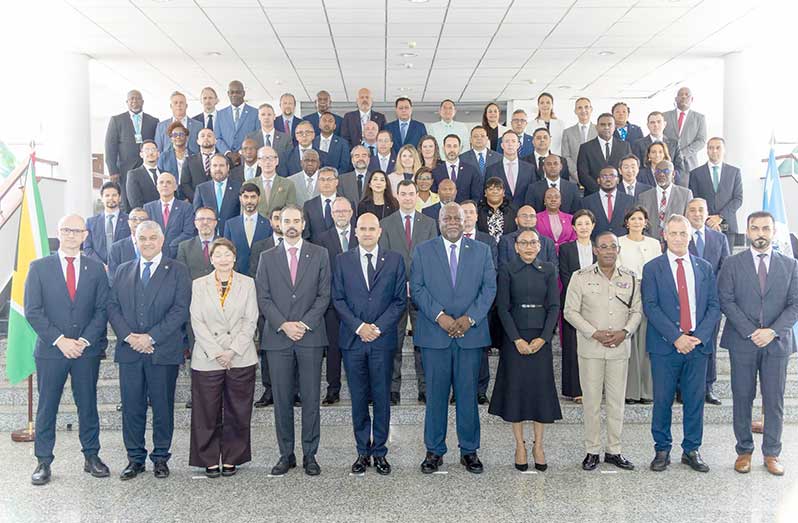
– PM Phillips urges timely intelligence-sharing in fight against organised crime
GUYANA is hosting the 27th INTERPOL Americas Regional Conference as law-enforcement leaders from across the region examine ways to strengthen co-operation against transnational organised crime, including drug trafficking, cybercrime, money laundering, illegal firearms and the illicit trade in natural resources.
Prime Minister, Brigadier (Ret’d) Mark Phillips, delivering remarks at the opening of the two-day conference at the Arthur Chung Conference Centre on Wednesday, said approximately 50 officials from 37 countries have gathered in Georgetown to discuss threats that increasingly cross national borders.
It is the first time Guyana is hosting the INTERPOL Americas Regional Conference, marking a significant point in the country’s longstanding relationship with the international police organisation.
Guyana joined INTERPOL on October 1, 1968, and its National Central Bureau in Georgetown operates within the Guyana Police Force as a permanent link to the wider INTERPOL network.
Phillips said Guyana’s geographical position between South America and the Caribbean makes the conference particularly relevant, given the country’s land borders, Atlantic waters and connections with neighbouring states and the wider region.
He noted that the same routes and systems that facilitate legitimate commerce, travel and financial activity can also be exploited by criminal organisations operating across jurisdictions.
Criminal networks, he said, increasingly take advantage of differences between national laws and weaknesses at borders, with operations sometimes planned in one country and financed in another before moving through several jurisdictions.
The Prime Minister identified narcotics and illegal firearms trafficking, human trafficking and smuggling, cybercrime, money laundering and illegal mining as among the activities posing challenges to countries across the Americas.
He said the interconnected nature of these crimes requires a coordinated response, particularly because delays in cross-border investigations can give offenders an advantage.
“Once an investigation crosses a national boundary, any delay can shift the advantage to the offender and place justice further out of reach,” Phillips said.
INTERPOL’s systems are intended to help address that challenge by enabling authorised law-enforcement officers to securely exchange information and access international police records.
Phillips pointed to the I-24/7 communications network, as well as INTERPOL Notices and Diffusions, as mechanisms that can help investigators identify connections between cases and persons across jurisdictions.
He stressed, however, that the effectiveness of those systems depends on the accuracy and timely availability of information, as well as its lawful use.
Guyana has already participated in international operations targeting cross-border criminal activity.
The Prime Minister cited Operation Guyana Shield in December 2025, which brought together authorities from Brazil, French Guiana, Guyana and Suriname in an operation targeting illegal gold mining and its links to organised crime.
More than 24,500 checks were conducted during the operation, resulting in 198 arrests and the seizure of criminal assets and materials associated with illegal activities.
He also referenced the February 2025 extradition of Harry Narine Rajkumar to Canada following an INTERPOL Red Notice. The extradition was the first successfully completed between Guyana and Canada.
According to Phillips, the cases demonstrate the practical value of international law-enforcement cooperation while also highlighting the need to ensure that intelligence reaches the officers and agencies responsible for acting on it.
He said Guyana is strengthening its national capacity through investments in intelligence-led policing and modern investigative systems.
The Prime Minister said the Guyana Police Force, Immigration Department, Customs Anti-Narcotic Unit and other competent agencies must be able to exchange information securely, understand their respective responsibilities and coordinate operations that extend beyond Guyana’s borders.
He said the conference also provides an opportunity for Guyana to build professional relationships and gain access to expertise and technology needed to respond to rapidly changing forms of criminal activity.
Phillips noted that closer co-operation is particularly important for Caribbean states, which often have comparatively small jurisdictions while confronting criminal networks that are well financed and capable of operating quickly across borders.
He said stronger coordination could provide border officials with earlier warnings about persons or activities of concern and allow investigators to identify connections that may not be apparent within a single jurisdiction.
The Prime Minister said the success of the conference would ultimately depend on whether decisions taken in Georgetown result in practical improvements in the work of law-enforcement officers.
He pointed to the Americas Biennial Implementation Plan for 2026 to 2028 as a mechanism for assigning responsibilities and measuring progress.
Trust among participating countries, he added, would also be critical, particularly in ensuring that sensitive information is protected, lawfully used and handled responsibly.
The conference is taking place as INTERPOL advances its Strategic Framework for 2026 to 2030, which includes strengthening the organisation’s role as a trusted global information hub and improving access to critical information for investigators, border-security officials and judicial authorities.
Commissioner of Police, Clifton Hicken, attended the conference along with Phillips, Minister of Home Affairs, Oneidge Walrond, members of the Guyana Police Force’s Executive Leadership Team, and regional and branch commanders.
For Guyana, the conference represents an opportunity to strengthen relationships with law-enforcement agencies throughout the Americas while improving the mechanisms available to address crimes that affect communities regardless of national boundaries.
Phillips said the real measure of the conference would come after delegates leave Guyana, when agreements and relationships established during the meetings are tested through actual investigations and operations.
He said Guyana is prepared to work with INTERPOL and participating countries to ensure that offenders cannot exploit international borders to evade justice.
The Prime Minister subsequently declared the 27th INTERPOL Americas Regional Conference officially open.




