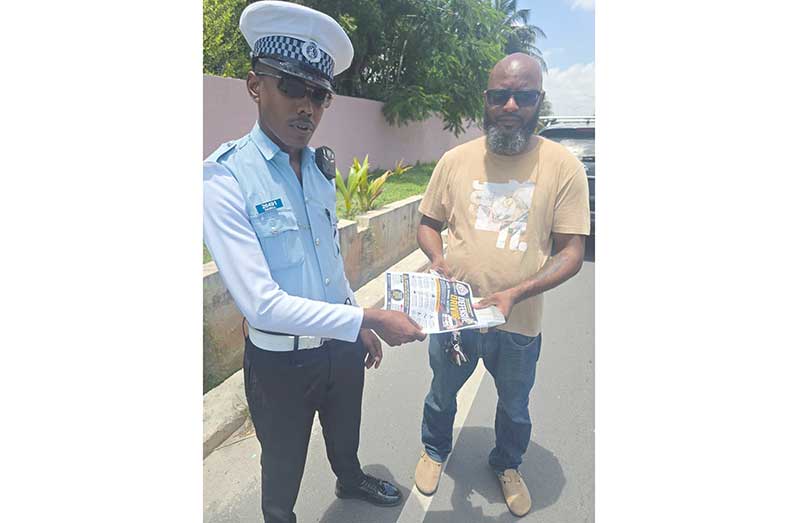
– GPF records 3,011 traffic offences last week as enforcement continues
THE Guyana Police Force (GPF) recorded 3,011 traffic offences between September 13 and 19, with failures to wear safety helmets, dangerous parking, tinted windscreens and speeding among the violations detected during the week.
When contacted for a comment, Traffic Chief Assistant Commissioner Mahendra Singh said the enforcement figures were being supported by continued public education aimed at changing road-user behaviour and improving safety on Guyana’s roads.

Singh stressed that traffic education exercises conducted by police ranks are not intended merely for publicity or photo opportunities, but are designed to increase knowledge among motorists and other road users and reinforce responsible road-use practices.
“Traffic Education exercises conducted by traffic ranks are not done for photo opportunities,” Singh said, explaining that the initiatives are intended to raise awareness, reinforce values among motorists and encourage the use of safety equipment.
He said the ultimate objective is to achieve safer practices and improve the overall quality of road safety.

HELMET VIOLATIONS REMAIN PROMINENT
During the reporting period, police recorded 244 cases of persons failing to wear safety helmets, while 63 cases involved motorists carrying pillion riders who were not wearing helmets.
Driving under the influence (DUI) accounted for 54 cases, while 369 motorists were cited for speeding.
Police also recorded 102 seatbelt violations and 123 cases involving motorists leaving vehicles in dangerous positions.
Other offences included 114 cases involving tinted motor vehicles, 102 unlicensed drivers, 114 breaches of prescribed fitness conditions, 72 cases involving unlighted vehicles, 47 at the front and 25 at the rear, and 15 breaches of traffic-light signals.
According to the Traffic Department, all 114 tint-related cases concerned the front glass of motor vehicles.
The department also reported an increase in the detection of unlicensed drivers, with an equal number of breaches relating to insurance.
The enforcement figures highlight several areas of road-user behaviour that continue to require attention, particularly the use of protective equipment by motorcyclists, impaired driving, speeding and the safe positioning of vehicles on public roads.
EDUCATION ACROSS REGIONS
Alongside enforcement, Traffic Department ranks conducted lectures and outreach activities at communities, workplaces, transport facilities, bars, police stations and other public locations across the country.
During the week, education sessions were held at locations including Section D Field, Sophia; Public Road #65; Brickdam and Turkeyen police stations; De Kinderen; Blairmont; Farm Housing Scheme; Parika; Anna Regina; Ruimveldt; Sheriff Street; Tuschen; La Grange; Rose Hall Town; Soesdyke Junction; Independence Boulevard; Lethem; Arawanza; the University of Guyana access road; Maruranau; Moblissa; Carifesta Avenue; Camp Street and Regent Street.
The programme also included engagements with Guyana Water Incorporated and a radio programme on NCN 102.5 FM.
The geographic spread of the initiatives covered communities from Georgetown and the East Coast and East Bank of Demerara to West Coast Demerara, Berbice, Essequibo, Region Nine and the North West District.
Traffic ranks also conducted education activities at taxi services, minibuses and hire-car facilities, reflecting the department’s focus on reaching both private motorists and operators involved in public transportation.
LINKING ENFORCEMENT TO SAFER ROADS
The Traffic Department’s approach combines enforcement with education, with police seeking to ensure that road users understand the risks associated with violations and the importance of complying with traffic regulations.
The emphasis on helmets and seatbelts is particularly significant because these measures are intended to reduce the severity of injuries when crashes occur. Similarly, enforcement against DUI and speeding targets behaviours that can increase the likelihood and seriousness of road collisions.
Singh said the desired outcome of the education exercises is not simply an increase in motorists’ knowledge, but a change in behaviour that translates into safer practices on the country’s roadways.
The Traffic Department’s weekly figures, the Traffic Chief noted provide both an enforcement snapshot and an indication of the areas in which continued public education is being directed as the GPF seeks to improve road-user compliance and reduce the human cost of traffic crashes.