
- Local tour guide shares extensive knowledge of wildlife management and tourism
KEVIN Edwards is a prominent community conservation leader and the Fisheries Project Coordinator for the North Rupununi District Development Board (NRDDB) in Guyana.
He coordinates community-led sustainable fisheries and management plans in the North Rupununi region to protect declining fish populations. Edwards works closely with the Sustainable Wildlife Management (SWM) Programme Guyana on local wildlife monitoring, citizen science initiatives and educational outreach. He has helped to lead local conservation efforts, including river turtle and arapaima conservation, and has presented community-led conservation strategies at international forums.
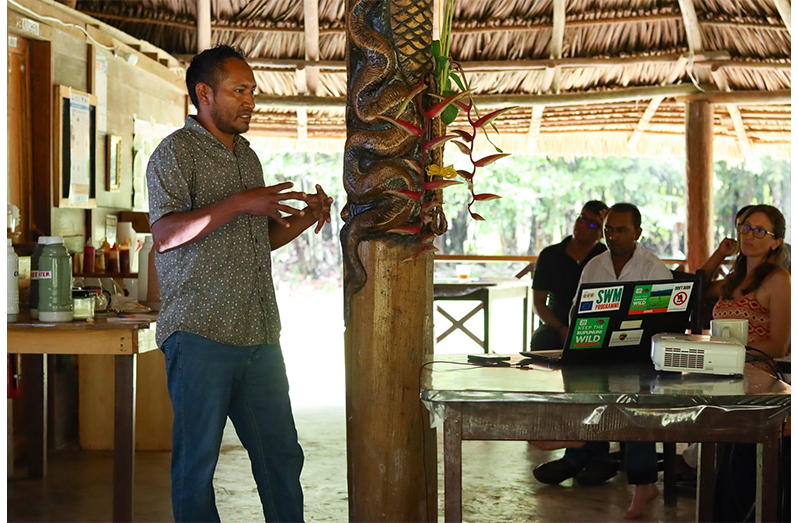
Edwards was born in Kwaimatta Village, North Rupununi, where he currently resides. He previously lived with family in Brazil and in Georgetown during his school years. He works with the North Rupununi District Development Board (NRDDB) as Fisheries Coordinator. He has worked with the NRDDB and the Sustainable Wildlife Management (SWM) Programme for years and has gained extensive knowledge and experience. His favourite aspects of his project work are fish stock assessments, training youths in data collection and capacity-building, and practical fieldwork.
Edwards is married with three children and loves adventurous activities, riding motorcycles, visiting friends, socialising and hiking. He has many favourite locations across the Rupununi, such as Saddle Mountain Ranch, the Iwokrama International Centre and the Atta Lodge canopy walkway, among many others. His hobbies are playing volleyball and football. He loves to play music and has his own guitar. He also likes to compose traditional songs and play them during music sessions.
Edwards hopes the leadership capacity of the youth in and around his community will continue to develop. He aspires to start his own transportation service in his community, help and advise village councils on upcoming village affairs, and become involved in tourism in the coming years. Edwards believes the Rupununi is unique in its tourism opportunities and offers many exciting experiences to the world. He is well known among wildlife activists, conservationists, tourism bodies and eco-lodges for his talent and knowledge and has also worked behind the scenes to promote tourism, community-based development, and wildlife conservation. He formerly managed Iwokrama and Karanambu Lodge and now serves as Senior Councillor of Kwaimatta Village. He has supported several programmes and is working with Karanambu Lodge to develop tourism opportunities for his community.
As a second-time elected Senior Councillor, he plays an integral role in community-based development in his village and is said to be the voice of the people. Edwards said Kwaimatta Village is in North Rupununi and is a satellite village of Massara, which has three tracts. He is responsible for Tract C.

Kwaimatta Village has a population of 198 and 40 households. The government’s housing drive in remote villages will construct an additional 12 houses for families. Edwards reported that the main economic activity of Indigenous residents centres on cassava cultivation.
The people of Kwaimatta Village are Macushi and are known for their quiet nature. Their remote community lies about eight kilometres from the main road to Lethem, in the open savannah near Karanambu Lodge.
Edwards said the residents need proper housing and a substantial solar farm to provide reliable electricity to each household in the village. The village leader also said they urgently need to extend the village’s water supply.
Edwards related that they have two wells. One is connected directly to houses to provide standpipe water, while the other is attached to the village trestle and supplies water to eight black tanks. The community has an ICT hub used by youths and schoolchildren, but most young people use their personal mobile phones for gaming and other internet-related activities because they provide faster connectivity.
Edwards told the Pepperpot Magazine that the village has partnered with Karanambu Lodge to boost tourism at Capybara Camp, located close to the airstrip, water dam and reservoir.
He said the residents assist Karanambu Lodge by taking tourists on open-savannah tours using their personal motorcycles.
The villager added that they have since proposed acquiring 10 additional motorcycles for the community’s economic development. They are also awaiting approval for 20 bicycles and 15 wooden canoes further to boost their tourism drive in support of Karanambu Lodge.
Edwards noted that villagers will use the wooden canoes to take visitors out onto the waterways or river for sightseeing tours.
Additionally, the village has requested two Grand Cabin minibuses from the administration to further boost the local tourism drive. Edwards said they have two buses, but these are inadequate for the volume of tourists they have to transport.
He told the Pepperpot Magazine that he is a product of the Bina Hill Youth Learning Institute and that his focus was on cross-cultural leadership. He was attached to the University of Calgary, Canada.
The resident reported that he participated in practical training with Indigenous youths of mixed heritage to show them how they survive in the savannah. It was a funded exchange programme, but it ended, so there were no more visits between the two countries.
He has also worked at Iwokrama for the past 10 years, doing considerable groundwork as President of the Wildlife Club, where he gained knowledge of birds and various animals and became well-versed as a tour guide. He was part of a committee responsible for drafting the inland fisheries regulations pilot programme and was involved in arapaima assessment, sport fishing and other wildlife programmes.